1915
 „мзглыбжвуо йихъяньдрью чтлэщк хн фя съп скыполза“ (incip.), „Разсѣяность“, in: Заумная гнига [Zaumnaja gniga], ed. A. E. Kručenyx [Алексей Елисеевич Крученых], ill.
by Ol'ga V. Rozanova [Ольга Владимировна Розанова]. Moskva 1916 [1915], p. 41. „мзглыбжвуо йихъяньдрью чтлэщк хн фя съп скыполза“ (incip.), „Разсѣяность“, in: Заумная гнига [Zaumnaja gniga], ed. A. E. Kručenyx [Алексей Елисеевич Крученых], ill.
by Ol'ga V. Rozanova [Ольга Владимировна Розанова]. Moskva 1916 [1915], p. 41.
Pseudonym: Алягров (Aljagrov).
Dated 1916, though published in August 1915 (cf. Knižnaja letopis'. no. 19058, 11–18 Aug.
 RJCB 1915a: Two poems. — Reprint: SW ∅. — Будетлянин науки. Воспоминания, письма, статьи, стихи, проза, ed. Bengt Jangfeldt (Moskva 2012), pp. 190-191. RJCB 1915a: Two poems. — Reprint: SW ∅. — Будетлянин науки. Воспоминания, письма, статьи, стихи, проза, ed. Bengt Jangfeldt (Moskva 2012), pp. 190-191.
 Online: archive.org. — ruslit.traumlibrary Online: archive.org. — ruslit.traumlibrary
Ѡ
1916
„N. N. Durnovo, N. N. Sokolov, D. N. Ušakov, Opyt dialektologičeskoj karty russkogo jazyka v Evrope“ (rev.), Etnografičeskoe obozrenie 109-110, 1916, pp. 102-107.
RJCB 1916a. — Reprint: SW IX-1 (1-5) [Review of Durnovo, Sokolov and Ušakov, A Dialect Map of Russian Language in Europe].
Ѡ
„[Report about a Field Trip]“, in: Etnografičeskoe obozrenie, 1916, no. 1-2, p. 147.
RJCB ---- (1916bb). — Reprint: SW IX-1 (6) [Report about a Field Trip, 1916].
Ѡ
1918
„Къ брадобрию приидохъ и рекохъ“ (1940c [1918]).
Ѡ
1919
„Приемы
старой живописи“. Жизнь
искусства (Žizn' iskusstva) 199-200 (Jul. 26-27), 1919, p. 4.
RJCB ∅ (1919aa). — Reprint: SW ∅.
Online: lib.sptl.spb.ru.
Ѡ
„Футуризм“. Искусство (Iskusstvo) 7, (August 2), (Moskva) 1919.
Signed: Р. Я.
 Written in summer 1919 in Puškino on the river Kljaz'ma. Written in summer 1919 in Puškino on the river Kljaz'ma.
Français: „Futurisme“, in: 1973h, 25-30.
English: „Futurism“, in: Stephen Rudy, Jakobsonian Poetics of the Moscow and Prague Periods (Yale University Ph. D. Dissertation, 1978), Appendix 1.
Deutsch: „Futurismus“, in: 1988a, 41-49.
Magyar: „Futurizmus“, in: 1982e, 206-214.
RJCB 1919a: Futurizm. — Reprint: SW III, 49 (717-722).
Online: rozanova.net (html).
Ѡ
„Футуризм, как естетическая и научная система“. Жизнь
искусства (Žizn' iskusstva) 226 (Aug. 27), 1919, p. 2.
RJCB 1919b: Futurizm, kak èstetičeskaja i naučnaja sistema. — Reprint: SW ∅.
Online: lib.sptl.spb.ru.
Ѡ
„Задачи художественной пропаганды“. Iskusstvo 8 (Sept. 5).
Pseudonym: Aljagrov.
RJCB 1919c: Zadači chudožestvennoj propagandy. — Reprint: SW IX-1 (15-16) [Tasks of Art propaganda].
Ѡ
1920
„Новое искусство на Западе (Письмо из Ревеля)“, in: Chudožestvennaja žizn' 4/3, 1920, (March-April), pp. 18-20.
RJCB 1920a: Novoe iskusstvo na zapade. (Pis'mo iz Revelja). — Reprint: SW IX-1 (17-21) [New Art in the West (A Letter from Revel’ [Tallinn])].
Ѡ
„Prof. Šachmatov“, Čas 30, 31. VIII. 1920 (Praha), č. 68, str. 2.
V Praze 28. srpna 1920.
RJCB 1920b. — Reprint: SW IX-1 (25-27).
Online: ndk.cz.
Ѡ
„V. Chlebnikov: Z poematu 'Sestry blýskavice'“, Den: Kulturní list 1, 27. XII. 1920 (Praha), č. 20, str. 19.
Sign.: R. A. — Czech translation by R. J. of the end of Chlebnikov's poem "Sestry molnii" [Сестры молнии].
RJCB 1920c. — Reprint: SW ∅.
Ѡ
„Stav kultury v Rusku: Rozhovor s členem sovětského poselstva Červeného kříže“, Lidové noviny 28, č. 356 (ranní vydání), 21. VII. 1920, str. 5.
RJCB ---- (1920dd). — Reprint: SW IX-1 (22-24) [State of Culture in Russia: A Conversation with the Member of the Soviet Mission of the Red Cross].
Ѡ
1921
Новљйшая русская поезия. Набросок первый. Виктор Хлебников. Типография «Политика» в Праге [Tipografija Politika v Prage], 1921, 8°, 68 pp.
Москва, май 1919 г.
Česky (frgm.): „Vivisekce jako nejbližší úkol vědy a umění“, Kmen 4, 1920/1921, str. 545-546.
Slovensky (frgm.): „Problémy poetiky“, in: Teória literatúry — Výbor z "Formálnej metódy". Zostavil a preložil Mikuláš Bakoš. Problémy umenia – 1. zväzok. Trnava: F. Urbánek, 1941, str. 63-73. — Repr. in: 1971l.
Français (frgm.): „La nouvelle poésie russe“, Poétique 2/7, 1971, pp. 285-296; repr. in: 1973h, 11-24; repr. in 1977g, 11-29.
Deutsch-russisch: „Die neueste russische Poesie. Erster Entwurf. Viktor Chlebnikov“, in: Texte der russischen Formalisten 2, ed. W.-D. Stempel. München: Fink, 1972, pp. 18-135.
English: „Modern Russian Poetry: Velimir Khlebnikov“, in: Major Soviet Writers: Essays in Criticism, ed. E. J. Brown. New York: Oxford Univ. Press, 1973, pp. 58-82.
RJCB 1921b: Novejšaja russkaja poèzija. Nabrosok pervyi. Viktor Xlebnikov. — Reprint: SW V, 17 (299-354).
Online: archive.org.
Ѡ
„O realismu v umění“ [Jakobsonův vlastní překlad z ruského originálu], Červen IV, 1921, č. 22 (13. října 1921), str. 300-304.
Стать
написана
по-русски в
Праге в 1921 г.
По-русски: „О художественном реализме“, in: Readings in Russian Poetics. Edited by Ladislav Matejka. Michigan Slavic Materials 2. Ann Arbor: Department of Slavic Languages and Literatures, 1962, pp. 29-36.
По-русски (original version): „О художественном реализме“, in: SW III, 50 (723-731).
Français: „Du réalisme artistique“, in: Théorie de la littérature: Textes des formalistes russes, ed. Tzvetan Todorov. Paris: Éditions du Seuil, 1965, pp. 98-108. — Repr.: „Du réalisme en art“, in: 1973h, 31-39.
Česky: „O realismu v umění“ [text z r. 1921 upraven podle dobové pravopisné normy], in: Poetika, rytmus, verš. Bachtin — Ejchenbaum — Jakobson — Propp — Tomaševskij — Tyňanov — Vinogradov — Vinokur. Sestavil Jurij Lotman. (Vyšlo u příležitosti VI. mezinárodního sjezdu slavistů). Edice Disk, svazek 6. Praha: Svět sovětů, 1968, str. 46-54.
Česky: „O realismu v umění“ (tr. Miroslav Červinka), in: 1969j, str. 141-149.
Deutsch: „Über den Realismus in der Kunst“, in: Texte der russischen Formalisten 1, ed. J. Striedter, 372-391. München: Fink, 1969; repr. in: Russischer Formalismus: Texte zur allgemeinen Literaturtheorie und Prosa. Ed. J. Striedter. Münich: Fink, 1971, pp. 374-391. — Repr. in: Alternative 65 (1969), 75-81; repr. in: 1979e, 129-139.
English: „On Realism in Art“, in: Readings in Russian Poetics: Formalist and Structuralist Views. Edited by Ladislav Matejka & Krystyna Pomorska. Cambridge (Mass.): MIT Press, 1971, pp. 38-46; 2nd ed., Michigan Slavic Publications, Ann Arbor, 1978.
Italiano: „Il realismo nell'arte“, in: 1985n, 8-17.
RJCB 1921a. — Reprint: SW ∅.
Online: ndk.cz.
Ѡ
„Vliv revoluce na ruský jazyk. Poznámky ke knize André Mazona, Lexique de la guerre et de la révolution en Russie. Bibliothèque de l'Institut français de Petrograd. Tome VI. Paris, Champion. 1920. Stran VI + 63“, in: Nové Atheneum 2, 1920—1921, str. 110-114, 200-212, 250-255, 310-318.
Též jako zvláštní otisk s opravami a dodatky: Vliv revoluce na ruský jazyk. Praha: nákladem vlastním (Tiskem Edvarda Leschingra), 1921, 32 str.
Ref.: Fr. Trávníček: Listy filologické 49: 4-5, 1922, str. 244-246.
RJCB 1921c. — Reprint: SW IX-1 (28-60) [The Influence of the Revolution on the Russian Language].
Online: ndk.cz.
Ѡ
„Дада“ (Письма
с Запада), Вестник
театра (Vestnik teatra) 82, 1921, (Feb. 8), pp. 3-7.
Sign.: Р. Я.
English: „Dada“, in: Stephen Rudy, Jakobsonian Poetics of the Moscow and Prague Periods (Yale University Ph. D. Dissertation, 1978), Appendix 2.
RJCB 1921d: Dada. — Reprint: SW IX-1 (61-67) .
Online: lib.sptl.spb.
Ѡ
„Profesor V. N. Ščepkin (1863—1920)“ (Literatura a umění), Čas, 1921 (Praha), 28. únor, str. 4.
RJCB 1921e. — Reprint: SW IX-1 (68-69).
Online: ndk.cz.
Ѡ
„Ruský básník před soudem ruské literatury“, Tribuna, 1921 (Praha), č. 45 (23. únor 1921), str. 1-2.
Reakce na článek o Majakovském: N. Melnikova-Papoušková: „Futurism jako oficiální bolševická poesie“ (Beseda), Čas 31, 1921, č. 32, úterý 8. února 1921 (Ranní vydání), s. 2-3 (online: ndk.cz).
RJCB ---- (1921ff). — Reprint: SW IX-1 (70-73) [A Russian Poet in the Court of Russian Literature]. — 2017a.
Online: ndk.cz.
Ѡ
1922
R. J. & Petr Bogatyrev: „Славянская филология в России за г. г. 1914—1921“ (Zprávy), Slavia 1, 1922—1923, str. 171-184, 457-469, 626-636.
[Содержание:] 1. [Русский язык.]
2. [Наука о поетическом языке.]
3. Народная словесность и етнография.
Отражение фольклора в нов. русс. литературе.
Былины и исторические песни.
Духовные стихи.
Лирические песни.
Сказки и легенды.
Театр.
Отражение в фольклоре текущих событий.
Заговоры.
Верования.
Материальная культура.
Инородческий фольклор.
Sign.: Прага. Р. Якобсон, П. Богатырев.
RJCB 1922a: Slavjanskaja filologija v Rossii za gody 1914—1921. — Reprint: SW ∅. — See editio melior: 1923ee.
Online: s. 171: Kramerius.lib.cas; s. 457: Kramerius.lib.cas; s. 626: Kramerius.lib.cas.
Ѡ
„Брюсовская стихология и наука о стихе“, in: Naučnye izvestija (Akademičeskogo centra Narkomprosa RSFSR), Sbornik 2-oj: filosofija, literatura, iskusstvo, Moskva, Gosudarstvennoe izdatel´stvo, 1922, pp. 222-240.
RJCB 1922b: Brjusovskaja stichologija i nauka o stiche. — Reprint: SW IX-1 (121-143) [Bryusovian Versology and the Science of Verse].
Ѡ
„[Stichi]“ (1914), in: A. Kručenych, G. Petnikov, V. Chlebnikov, Zaumniki 16. Moskva: EUY, 1922.
Pseudonym: Aljagrov.
RJCB 1922c: Poems. — Reprint: SW ∅.
Ѡ
1923
О чешском
стихе преимущественно
в сопоставлении
с русским. Сборники
по теории
поетического
языка. Выпуск V. ОПОЯЗ-МЛК, Государственное
издательство, Отто Эльснер, Берлин/Москва (Berlin/Moskva) 1923, 8°, 120 pp.
Repr. ed. T. Winner. Brown University Slavic Reprints 6. Brown University Press, Providence (R. I.) 1969, pp. 125.
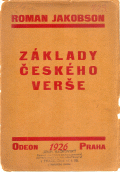
Česky: Základy českého verše. Praha: Odeon, 1926, 142 str. (1926d)
Deutsch: Über den tschechischen Vers. Unter besonderer Berücksichtigung des russischen Verses. Postilla Bohemica 8–10. Konstanzer Hus-Gesellschaft. Bremen: K-Presse, 1974, 204 pp. (Translation based on a collation of the Russian and Czech editions.)
Rev.: N. S. Trubetzkoy, Slavia 2, 1925, 452-460 (online: Kramerius.lib.cas).
RJCB 1923a. — Reprint: SW V, 1 (3-121), with the addition of the Eng. tr. of the afterword to the Czech edition (1926b, 1926d).
Ѡ
„Заметка о древнеболгарском стихосложении“, in: Izvestija Otdelenija russkogo jazyka i slovesnosti Rossijskoj Akademii Nauk 1919 g., 24, No. 2, 1023, pp. 351-358.
The article is dated 1917.
RJCB 1923b: Zametka o drevne-bolgarskom stichosloženii. — Reprint: SW IX-1 (7-14) [A Note on Old Bulgarian Versification].
Ѡ
„Několik zpráv o práci v oboru slovanské filologie na dnešní Ukrajině“, Slavia 1, 1922, č. 4, str. 634-636.
RJCB 1923c. — Reprint: SW IX-1 (144-147).
Online: Kramerius.lib.cas.
Ѡ
R. J. & Petr Bogatyrev: (a) II. „О народном русском театре“, (b) IV. „Программа по собиранию сведений о народном театре“, in: Петр Богатырев, Чешский кукольный и русский народный театр,
Сборники
по теории
поетического
языка. Выпуск
VI. Берлин / (Berlin-Petrograd), ОПОЯЗ-МЛК, Государственное
издательство, 1923, pp. 19-28, 91-121.
RJCB 1923d [1923d(a): O narodnom russkom teatre + 1923d(b): Programma po sobiraniju svedenij o narodnom teatre]. — Reprint: SW (a) IX-1 (148-152) [Russian Folk Theatre] + (b) IX-1 (153-166) [Guidelines for collecting Data about Folk theater].
Ѡ
R. J. & Petr Bogatyrev: Славянская
филология в
России за
годы войны и
революции. I. Язык и фольклор. Berlin: ОПОЯЗ (Tipog. Kymmer i Ko.), 1923, 8°, 63 pp.
[Содержание:] Язык.
Поэтика.
Фольклор.
Отражение фольклора в нов. рус. литературе.
Былины и исторические песни.
Духовные стихи.
Лирическая песня.
Сказки и легенды.
Театр.
Заговоры.
Верования.
Материальная культура.
Инородческий фольклор.
Editio melior. — See prev. ed. 1922a.
RJCB ---- (1923ee: Slavjanskaja filologija v Rossii za gody vojny i revoljucii). — Reprint: SW IX-1 (74-120) [Slavic Philology in Russia during the Years of War and Revolution].
Ѡ
1924
„Старочешские стихотворения, сложенные однорифменными четверостишиями (8a · 4)“, Slavia 3, 1924—1925, str. 272-315.
RJCB 1924a: Staročešskie stixotvorenija, složennye odnorifmennymi četverostišijami (8a · 4). — Reprint: SW VI, 26 (538-583).
Online: Kramerius.lib.cas.
Ѡ
1925
„O Králově České prosodii“, Kritika 2, 1925, č. 3, str. 110-114.
RJCB 1925a. — Reprint: SW IX-1 (167-172) [On Král’s Czech Prosody].
Online: ndk.cz.
Ѡ
„Konec básnického umprumáctví a živnostnictví“, in: Pásmo. Revue internationale moderne 1, 1925 (Brněnský Devětsil), Nr. 13–14 (květen), str. 1-2.
Français: „Le langage de communication et le langage poétique“, in: Change 10, 1972, p. 102.
Deutsch: „Schluß mit der dichterischen Kleinkrämerei“, in: 1988a, pp. 196-203.
RJCB 1925b. — Reprint: SW IX-1 (173-177) [The End of “Umprumism” and Small Scale Undertaking in Poetry]. — 1996a, pp. 562. — 1997a, pp. 81-86. — 2017a, pp. 29.
Ѡ
„Stanislav Neumann: Vesennie ritmy“, Nové Rusko / Новая Россия 1, Nr. 5-6, 1925 (Praha), p. 164.
Tr. from Czech by R. J.
RJCB 1925c. — Reprint: SW ∅.
Ѡ
„Ein neuer Beitrag zur slavischen Verslehre: E. Sievers' Die altslawischen Verstexte von Kiew und Freising“, Prager Presse, 5. VII. 1925 (Praha), pp. 7-8.
RJCB 1925d. — Reprint: SW IX-1 (178-182) [A New Contribution to Slavic Versology].
Ѡ
„Eine Monographie über die russische Sprache“, Prager Presse, 27. X. 1925 (Praha), p. 6.
Sergej Iosifovič Karcevskij, Russkij jazyk. Čast’ pervaja, Grammatika. Posobije dlja staršich klassov srednej školy. Praga: Plamja, 1925, 125 pp.
RJCB ---- (1925ee). — Reprint: SW IX-1 (183-184) [A Monograph about the Russian Language].
Ѡ
„Eine Monographie über Alexander Blok“, Prager Presse, 4. XI. 1925 (Praha), p. 6.
Naděžda Filaretovna Melniková-Papoušková, A. A. Blok. Praga, Plamja, 1925, 140 pp.
RJCB ---- (1925ff). — Reprint: SW IX-1 (185-186) [A Monograph about Alexander Blok].
Ѡ
1926
 Základy českého verše. Edice Odeon, sv. 9. Obálka a titulní list podle návrhu Karla Teigeho. Praha: Odeon (typ. A. Novotný), 1926 (duben), 140 + (4) str. Základy českého verše. Edice Odeon, sv. 9. Obálka a titulní list podle návrhu Karla Teigeho. Praha: Odeon (typ. A. Novotný), 1926 (duben), 140 + (4) str.
Obsah /141-142/:
Předmluva (1926b) /5-16/
I. Úvodní poznámky /17-18/
Hlava první. Základní problémy prosodie
II. Dnešní stav české nauky o verši /19-21/
III. Jazyk a verš /22-25/
IV. Dosavadní prosodické doktriny /25-28/
V. Přízvuk a kvantita pod fonologickým zorným úhlem /28-32/
VI. Mezislovný předěl a jeho funkce ve verši /32-38/
VII. Nařízené a faktické fraseování /38-41/
VIII. Srovnávací charakteristika fonologických a mimogramatických prvků /41-45/
IX. Stabilita fonologických prvků v emocionální řeči. Metody emfatického dloužení v češtině jako svědectví stability českých kvantitativních poměrů /45-50/
X. Několik systémů veršování s hlediska fonologického /50-53/
XI. Míra trvání rytmických jednotek /53-55/
Hlava druhá. Revise učení teoretiků přízvučného básnictví o českém přízvuku a kvantitě
XII. Srovnávací charakteristika "Počátků" a Královy prosodie /57-58/
XIII. Slabost českého přízvuku /58-59/
XIV. Poměr mezi přízvukem a kvantitou jako fakty českého jazykového povědomí /59-60/
XV. Otázka vlivu přízvuku na kvantitu /61-63/
XVI. Stupeň stability přízvučných a dlouhých slabik /64-65/
XVII. Rým jako měřítko úlohy kvantity, přízvuku a mezislovného předělu /65-75/
XVIII. Přízvuk a emfase /75-77/
XIX. Posunutí vrcholu přízvuku v dvouslabičných slovech /77/
XX. Posunutí vrcholu přízvuku ve slovech trojslabičných /78-80/
XXI. Rozbor námitek proti údajům přístrojů o posunutí vrcholu přízvuku /80-81/
XXII. Rozbor námitek proti pozorováním o posunutí vrcholu přízvuku prováděným prostým uchem /82-84/
XXIII. Dva typy mimogramatických variací /84-85/
XXIV. Posunutí přízvuku s hlediska českého jazykového povědomí /85-86/
XXV. Alternace přízvuku /86-87/
XXVI. Přenos přízvuku s předložky na jméno /87-91/
XXVII. Posunutí vrcholu přízvuku jako stylistická variace /91-96/
XXVIII. Akustický obsah českého přízvuku a kvantity /96-98/
XXIX. Posunutí přízvuku ve verši. Kompromisy mezi přízvukem a kvantitou jako základními prvky veršování /98-101/
XXX. Poměr mezi dlouhými a krátkými slabikami /102-105/
XXXI. Percentuální poměr délek a krátkosti v češtině; kvantita dvojhlásek a zavřených slabik /105-109/
XXXII. Rytmický slovník /110-111/
XXXIII. Otázka přízvučného a kvantitativního rytmu jazykového /111-112/
Hlava třetí. V čem tkví příčiny vítězství přízvučného veršování?
XXXIV. Bezpředmětnost argumentace přízvučníků /113-116/
XXXV. Pokus stanoviti vztah mezi veršováním a fonologickým systémem /116-119/
XXXVI. Cizojazyčné vlivy na veršování /119-120/
Poznámky /121-137/
Seznam zkratek a jiné vysvětlivky /139-140/
Rev.: A. Frinta, Listy filologické 53-2/3, 1926, 176-184 (online: jstor.org / libgen).
RJCB 1926b (+ 1926d). — Reprint: SW ∅. — 1996a. — V. orig. version 1923a.
Ѡ
„F. Trávníček: Příspěvky k nauce o českém přízvuku. (Spisy filosofické fakulty Masarykovy university v Brně, č. 7.) V Brně, 1924. Str. 52. Za 8 Kč“, Slavia 4, 1926, str. 805-816.
Written in Czech, Prague, 1925.
English: „Contributions to the Study of Czech Accent“, SW I, 37 (614-625).
RJCB 1926a. — Reprint: SW ∅.
Online: Kramerius.lib.cas.
Ѡ
„K diskusi o české prosodii“, Národní osvobození, roč. III., v neděli 8. VIII. 1926 (Praha), č. 215, str. 4.
RJCB 1926c. — Reprint: SW IX-1 (187-190) [On the Discussion about Czech Prosody].
Online: digitalnistudovna.army.
Ѡ
„Nikolaj Durnovo“, Prager Presse, 4. XI. 1926 (Praha), pp. 3-4.
RJCB 1926d. — Reprint: SW IX-1 (191-193) .
Ѡ
1927
Фонетика
одного
северно-великорусского
говора с
намечающейся
переходностью. (lit. Jarkovský), Praha 1927, 4°, pp. 82 + (3) (cyklostylováno).
Москва, август 1916 г. — Статя вышла в
форме
литографированной
брошюры в Праге.
Written in 1916. Mimeographed.
RJCB 1927a: Fonetika odnogo severno-velikorusskogo govora s namečajuščejsja perexodnost'ju. — Reprint: SW I, 36 (571-613).
Ѡ
Spor duše s tělem. O nebezpečném času smrti. S úvodí studií [„Dvě staročeské skladby o smrti“] R. Jakobsona. Národní knihovna IV. Praha: Ladislav Kuncíř, 1927, 111 str.
English: „Two Old Czech Poems on Death“ (with repr. reconstruction or the texts, done in collaboration with Stanislav Petíra).
RJCB 1927b. — Reprint: SW VI, 28 (589-658). — 2002c.
Ѡ
„Vladimir Majakovskij“, Národní osvobození, roč. IV., v úterý 26. IV. 1927 (Praha), č. 115, str. 3.
RJCB 1927c. — Reprint: SW IX-1 (194-195).
Online: digitalnistudovna.army.
Ѡ
1928
„O hláskoslovném zákonu a o teleologickém hláskosloví“ (Zprávy: Pražský linguistický kroužek. Podle referátů sestavil B. T. [Boh. Trnka]), Časopis pro moderní filologii 14, 1928, březen, str. 183-184.
Brief extract from a paper delivered in the Prague Linguistic Circle, January 13, 1927.
English: „The Concept of the Sound Law and the Teleological Criterion“, in: SW I, 2 (1-2).
Reprinted in: Approaches to English Historical Linguistics: An Anthology, ed. R. Lass. New York: Holt, Rinehart and Winston, 1969, pp. 8-9.
RJCB 1928a. — Reprint: SW ∅.
Online: Kramerius.lib.cas.
Ѡ
„Quelles sont les méthodes les mieux appropriées à un exposé complet et pratique de la
phonologie d´une langue quelconque? Argumentation“, in: Premier Congrès International de Linguistes,
Propositions. Nijmegen (Nimègue): Librairie Richelle, 1928, pp. 36-39.
S. Karcevskij and N. Trubetzkoy approved and countersigned the proposal.
Repr. in: Actes du Ier Congrès International de Linguistes du 10–15 avril, 1928, Leiden, 1930, pp. 33-36.
RJCB 1928b. — Reprint: SW I, 3 (3-6).
Ѡ
„K odstraňování dlouhých souhlásek v češtině“, Slavia 7 (Věnováno Jiřímu Polívkovi k sedmdesátým narozeninám), 1928—1929, str. 25-32.
Written in Prague, 1927.
English (extract): „On the Elimination of Long Consonants in Czech“, in: SW I, 38 (626-628).
RJCB 1928c. — Reprint: SW ∅.
Online: Kramerius.lib.cas.
Ѡ
R. J. & Jurij Tynjanov: „Проблемы изучения литературы и языка“, in: Novyj Lef, No. 12, 1928, (Dec.), pp. 35-37.
Written in Russian during Jurij Tynjanov’s visit to Prague in the winter of 1928.
По-русски: 1977c; v. SW V, 31 (564-566).
Français: „Les problèmes des études littéraires et linguistiques“, in: Théorie de la littérature: Textes des formalistes russes, ed. Tzvetan Todorov. Paris: Éditions du Seuil, 1965, pp. 138-140; repr. in 1973h, 56-68.
English: „Problems of Literary and Linguistic Studies“, in: New Left Review 37, 1966, pp. 59-61.
English: „Problems in the Study of Literature and Language“, in: SW III, 2 (3-6).
English: „Problems of Literary and Linguistic Studies“ (tr. H. Eagle), in: Readings in Russian Poetics: Formalist and Structuralist Views, ed. L. Matejka & K. Pomorska. Cambridge (Mass.): MIT Press, 1971, pp. 79-81; repr. in: Poetics Today 2/1, 1980, pp. 29-31; in: 1985m, 25-27.
English: in: The Structuralists from Marx to Lévi-Strauss, ed. R. & F. De George. New York: Doubleday-Anchor, 1972, pp. 81-83.
Česky: „Problémy zkoumání jazyka a literatury“ (tr. Maita Arnautová), in: Poetika, rytmus, verš, ed. Ju. M. Lotman. Praha: Svět Sovětů, 1968, str. 11-13.
Česky: „Problémy zkoumání literatury a jazyka“ (tr. Miroslav Červinka), in: 1969j, str. 17-19.
Deutsch-russisch: „Probleme der Literatur- und Sprachforschung“, in: Texte der
russischen Formalisten 2, ed. W.-D. Stempel. München: Fink, 1972, pp. 386-391. — Repr. Kursbuch 5, 1966, pp. 74-76; repr.
Methodendiskussion 1, ed. J. Hauff et al. Frankfurt: Athenaum, 1971, pp. 157-159. Repr. in: 1979e, 63-66.
RJCB 1928d: Problemy izučenija literatury i jazyka. — Reprint: SW ∅.
Ѡ
„Wandlungen in der Sprachwissenschaft: Vom I. Internationalen Linguistenkongreß in Haag“, Prager Presse, 25. IV. 1928 (Praha).
Français (part.): „Mutations en linguistique: Sur le 1er Congrès International des Linguistes, de la Haye“, Change 10 (1972), pp. 185-187.
RJCB 1928e. — Reprint: SW IX-1 (196-198) [Shifts in Linguistics: From the First International Congress of Linguists in the Hague].
Ѡ
1929
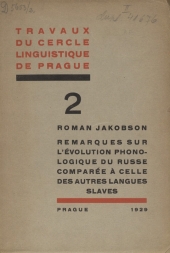
Remarques sur l'évolution phonologique du russe comparée à celle des autres langues slaves. Travaux du Cercle Linguistique de Prague 2. Prague: Jednota československých matematiků a fysiků (Imprimerie de l'état, Prague), 1929, pp. 118 + (2).
Table des matières /117-118/:
Avant-Propos /3/.
I. Notions fondamentales /5/.
1. Le système phonologique. Le phonème. — 2. Types d’oppositions phonologiques. Corrélations. — 3. Phonèmes de couple et hors couple.
— 4. Rapports entre les éléments disjoints et les éléments corrélatifs. — 5. L’archiphonème et ses variantes. — 6. Répertoire du système phonologique du russe littéraire.
— 7. Rapports entre les variantes des phonèmes et des archiphonèmes.
II. Remarques sur les problèmes actuels de la phonologie historique comparée /12/.
1. Extension de l’application de la méthode historique comparative. — 2. Antinomie existant entre la linguistique synchronique et la linguistique diachronique, et moyen de la surmonter.
— 3. Typologie des mutations. — 4. Les « lois phoniques ». — 5. Lois des rapports réciproques des corrélations. — 6. Importance de l’acoustique pour la phonologie historique.
III. Remarques sur l’évolution du système phonologique du protoslave /19/.
1. Première et seconde palatalisations mutatives des gutturales. — 2. Influence des consonnes palatales sur les voyelles suivantes.
— 3. Influence réciproque des voyelles et des liquides à l’intérieur des diphtongues. — 4. Influence des voyelles sur les consonnes précédentes.
— 5. Unification de la syllabe. — 6. Sort ultérieur des produits des palatalisations mutatives des gutturales. — 7. Les diphtongues du protoslave. L’évolution des diphtongues hétérogènes et leurs variantes dialectales.
— 8. Elimination des diphtongues homogènes. — 9. Evolution des diphtongues à nasale. — 10. Tendance fondamentale de l’évolution des diphtongues. — 11. Différenciation qualitative des voyelles longues et des voyelles brèves. — 12. Evolution des diphtongues « voyelle longue + n ». — 13. Remaniement des rapports de quantité. — 14. Redistribution des consonnes prothétiques et ses conséquences. — 15. Répertoire des consonnes palatales et variantes dialectales de leur évolution. — 16. Différences dialectales dans le répertoire des voyelles formant groupe avec les consonnes molles de couple et dans le traitement de l’affriquée ӡ. — 17. Lien existant entre le sort de ѣ et le traitement dialectal du groupement ӡ’ä. — Dépendance de l’évolution des diphtongues à nasale à l’égard du traitement de ѣ. — 19. Limitation du rôle de j.
IV. Changement protorusse de je- initial en o- et faits similaires des autres langues slaves /38/.
1. La question de la cause du changement de e- initial en o-. — 2. Conditions de la chute de j devant e au commencement du mot.
— 3. Parallèle bulgare. — 4. Parallèle sorabe. — 5. Parallèle tchécoslovaque. — 6. Isoglosse hypothétique de l’élimination du groupe « j initial + e + consonne molle » et essai d’explication.
V. Faits dialectaux du protorusse /45/.
1. La fusion de c avec č en russe septentrional.
— 2. Le traitement du représentant de «sk devant oi» en russe septentrional. — 3. Les autres dialectismes; caractère disparate des isoglosses.
VI. Conséquences de la chute des jers faibles pour les idiomes slaves /48/.
1. La chute des jers faibles comme facteur de dislocation du protoslave. — 2. Conséquences de la chute des jers faibles pour la corrélation «caractère sonore ~ caractère sourd des consonnes».
— 3. Conséquences de la chute des jers faibles pour la corrélation «groupement mou ~ groupement dur» et subséquement, pour l’accent et la quantité. — 4. Mutations du tchèque. — 5. Mutations du bulgare occidental et confrontation de ces mutations avec celles du tchèque. — 6. Mutations du kachoube septentrional et problème des phases accentologiques des langues slaves occidentales.
VII. Institution de la corrélation «caractère mou ~ caractère dur des consonnes» en russe et dans d’autres langues slaves, et faits connexes /60/.
1. Traitement des consonnes sonores palatales. — 2. Traitement de l’opposition des voyelles prépalatales et postpalatales.
— 3. Particularités de l’institution de la corrélation «caractère mou ~ caractère dur des consonnes» en ukrainien.
— 4. Fractionnement de la langue russe en dialectes par suite de la chute des jers faibles. — 5. Particularités phonologiques du blanc-russe.
— 6. Les diphtongues et le rôle de v prothétique en ukrainien. — 7. En grand-russe. — 8. En blanc-russe septentrional. — 9. L’évolution du bulgare oriental en comparaison avec celle de l’ukrainien. — 10. Place de ce type phonologique dans le monde linguistique slave.
VIII. Faits communs au grand-russe et étrangers aux autres dialectes russes /80/.
1. Classification des faits connexes de la chute des jers faibles du point de vue de leur puissance d’expansion.
— 2. Innovations propres au grand-russe enregistrées par Troubetzkoy. — 3. Elimination en grand-russe de i, y réduits.
IX. Altérations dialectales russes du vocalisme atone /82/.
1. Critique des hypothèses déduissant l’«akanje» des rapports de quantité en vieux russe.
— 2. Essai de déduction de l’«akanje» des rapports d’intensité. — 3. Les types d’«akanje» dissimilatif. — 4. L’«akanje» et les autres types de transformation du vocalisme atone. — 5. Variétés d’«akanje» non dissimilatif. — 6. Conditions de la genèse de l’«akanje» et de son expansion vers le sud. — 7. Relations génétiques réciproques entre les différents types d’«akanje». — 8. Expansion de l’«akanje» vers le nord.
X. Quelques conclusions /95/.
1. Impossibilité de séparer un fait du système linguistique d’avec ce système. — 2. Propagation des innovations linguistiques. — 3. Dislocation de la langue commune. — 4. Tendance à une linguistique structurale dans le cadre de l’idéologie contemporaine.
Notes /102/. Sur la transcription /110/. Index des auteurs et des ouvrages cités /111/.
Ecrit à Prague en 1927—1928.
RJCB 1929a. — Reprint: SW I, 4 (7-116).
Ѡ
„Jan Baudouin de Courtenay“, Slavische Rundschau I, 1929, Nr. 10, Dezember, pp. 809-812.
Repr. in: Portraits of Linguists 1, ed. T. A. Sebeok; Indiana Univ. Press, Bloomington (Ind.) 1966, pp. 533-537.
RJCB 1929b. — Reprint: SW II, 36 (389-393).
Online: books.google.
Ѡ
R. J. & Petr Bogatyrev: „Die Folklore als eine besondere Form des Schaffens“, in: Donum Natalicium Schrijnen. Nijmegen/Utrecht, N. V. Dekker & Van de Vegt, 1929, pp. 900-913.
Geschrieben in Prag.
Repr. in: Strukturalismus in der Literaturwissenschaft, ed. H. Blumensath. Köln: Kiepenheuer & Witsch, 1972, pp. 13-24.
Česky: „Folklór jako zvláštní forma tvorby“, in: P. Bogatyrev: Souvislosti tvorby. Praha: Odeon, 1971, pp. 36-47.
По-русски: „Foľklor kak osobaja forma tvorčestva“, in: P. Bogatyrev: Voprosy teorii narodnogo iskusstva, Iskusstvo, Moskva 1971, pp. 369-383.
English: „Folklore as a special form of creation“ (Translation by John M. O'Hara. Introduction by Felix J. Oinas), Folklore Forum 13: 1, 1980, 1-21. (Online: scholarworks.iu.edu; archive.org.)
English: „Folklore as a Special Form of Creativity“, in: The Prague School: Selected Writings, 1929—1946, ed. P. Steiner. Austin: Univ. of Texas Press, 1982, pp. 32-46.
RJCB 1929c. — Reprint: SW IV, 2 (1-15).
Ѡ
„Zur vergleichenden Forschung über die slavischen Zehnsilbler“, in: Slavistische Studien. Heft 5. Franz Spina zum sechzigsten Geburtstag von seinen Schülern. Redigiert von Ferdinand Liewehr. Reichenberg (Čechoslovakei), Verlag Gebrüder Stiepel, 1929, pp. 7-20.
Cp. Disertace Pražské university. 1882—1945. II. Německá universita. Praha: Universita Karlova, 1965, s. 75: „31. Zur vergleichenden Forschung über die slawischen Zehnsilber.“ — Dissertationsbetreuer: Gerhard Gesemann – Franz Spina.
Cp. 1933c.
RJCB 1929d. — Reprint: SW IV, 4 (19-37).
Online: ndk.cz.
Ѡ
Nejstarší české písně duchovní. Vydal a poznámkami provází Roman Jakobson. Národní knihovna VI. Praha: Ladislav Kuncíř, 1929, 48 + (4) str.
Obsah:
Úvod /7/
Hospodyne, pomyluj ny! /13/
Svatý Václave /29/
Slovo do světa stvořenie /37/
O ilustracích /41/. Bibliografické poznámky /44/
Ref.: Fr. Tichý, Slavia 9, 613—615 (online: Kramerius.lib.cas).
Cf. „Odpověď dr. Františku Tichému“, 1931n.
RJCB 1929e. — Reprint: SW VI, 17 (355-375).
Ѡ
„Thèses présentées au Premier Congrès des philologues slaves“, in: Travaux du Cercle Linguistique de Prague 1, 1929, pp. 5-29.
Collectively with members of the Prague Linguistic Circle: N. M. Durnovo, Bohuslav Havránek, Vilém
Mathesius, Jan Mukařovský, Nikolaj S. Trubetzkoy, and Bohumil Trnka.
S. Rudy (p. 11): „The overall framework of the text was
organized by Vilém Mathesius. Some sections were drafted by individual scholars, others —
collectively; all were discussed and agreed upon collectively. Jakobson's attribution as to the
details of the composition of the Theses
were communicated in two letters of 1969 to Jean-Pierre Faye (see 1969k); unfortunately,
misprints in that edition obscure the matter. For purposes of clarity, we list the parts of the
theses by title with the correct attribution by Jakobson as established from
his own annotated copy of Change 3 (1969) and the published correction (see 1970q)."
I. "Problèmes de méthode découlant de la conception de la langue comme système et importance de la dite conception pour les langues slaves" — R. J.
II. "Tâches à aborder par l'étude d'un système linguistique, du système slave en particulier": a) "Recherches relatives à l'aspect phonique de la langue" — R. J.; b) "Recherches sur le mot et le groupement des mots" — V. M.; c) "Théorie des procédés syntagmatiques" — V. M.
III. "Problèmes des recherches sur les langues de diverses fonctions": a) "Sur la fonctions de la langue" — R. J., "Sur la langue littéraire" — B. H., c) "Sur la langue poétique" — J. M. & R. J.
IV. "Les problèmes actuels du slave d'église" — N. D.
V. "Problèmes d'une transcription phonétique et phonologique dans les langues slaves" — coll.
VI. "Principes de la géographie linguistique, leur application et leur rapport à la géographie ethnographique en territoire slave" — coll. (?).
VII. "Problèmes slaves relatifs à un atlas linguistique, surtout lexical" — N. T.
VIII. "Problèmes de méthode de la lexicographie slave" — N. T.
IX. "Importance de la linguistique fonctionnelle pour la culture et la critique des langues slaves" — coll.
Česky: I. sjezd slovanských filologů v Praze 1929, sekce II, These k diskusi.
По-русски: „Tezisy Pražskogo lingvističeskogo kružka“, in: Pražskij lingvističeskij kružok: Sbornik statej, ed. N. A. Kondrašov; Izdatel'stvo Progress, Moskva 1967, pp. 17-41.
Deutsch: „Methodische Probleme, die aus der Konzeption der Sprache als System erwachsen, und die Wichtigkeit dieser Konzeption für die slawischen Sprachen“, in: Der modeme Strukturbegriff, ed. H. Naumann, Wissenschaftliche Buchgesellschaft, Darmstadt 1973, pp. 16-45.
English: „Theses Presented to the First Congress of Slavic Philologists in Prague, 1929“, in: The Prague School: Selected Writings, 1929—1946, ed. P. Steiner, Univ. of Texas Press, Austin 1983, pp. 3-31.
RJCB 1929f. — Reprint: SW IX-1 (203-214) [Roman Jakobson’s contributions to the Prague Linguistic Circle Theses].
Ѡ
„Über die heutigen Voraussetzungen der russischen Slavistik“, Slavische Rundschau 1, 1929, Nr. 8, Oktober, pp. 629-646.
RJCB 1929g. — Reprint: SW IX-1 (215-230) [Today’s Preconditions for Russian Slavistics]. — 1988a, pp. 50-70.
Online: books.google.
Ѡ
„Kus literární pavědy“, Plán 1, 1930, č. 10-11, str. 593-597.
RJCB 1929h. — Reprint: SW IX-1 (234-239) [A Piece of Literary Pseudo-scholarship].
Ѡ
„Nové práce o úloze církevněslovanských prvků v spisovné ruštině“ (Pražský linguistický kroužek), Časopis pro moderní filologii 15, 1929, str. 174.
RJCB 1929i. — Reprint: SW IX-1 (202) [New Studies on the Role of Church Slavonic Elements in Literary Russian].
Online: Kramerius.lib.cas.
Ѡ
„Romantické všeslovanství — nová slavistika“, in: Čin 1, 31. X. 1929 (Praha), č. 1, str. 10-12.
RJCB 1929j. — Reprint: SW II, 711-712 (part.). — IX-1 (231-233) [Romantic Panslavism vs. New Slavistics]
Ѡ
„Dem Gedächtnis Jan Wiktor Porzezińskis“, Prager Presse, 17. III. 1929 (Praha)
RJCB 1929k. — Reprint: SW IX-1 (199-201) [To the Memory of Jan Wiktor Porzeziński].
Ѡ
„Mladenov, Stefan: Geschichte der bulgarischen Sprache. Mit einer Karte. Berlin und Leipzig 1929. Walter de Gruyter & Co. (Grundriß der slavischen Philologie und Kulturgeschichte. Herausgegeben von R. Trautmann und M. Vasmer. Gr-8°, 354 S.“ (Literatur: Bulgarisch; sign. R. J.), Slavische Rundschau 1, 1929, Nr. 8, Oktober, pp. 682-684.
RJCB 1929l. — Reprint: SW IX-1 (240-242) [Review of Stefan Mladenov’s Geschichte der bulgarischen Sprache].
Online: books.google.
Ѡ
1930
„Масарик о языке“, Центральная Европа 3, 1930, pp. 270-276.
По-русски (revised): „Языковые проблемы в трудах Т. Г. Масарика“, in: SW II, 41 (468-476).
Česky: „Jazykové problémy v Masarykově díle“. In: Masaryk a řeč. Praha: Pražský linguistický kroužek, 1931, pp. 29-47. (Online: ndk.cz.) — Přetištěno z Vůdce generací. Masarykův sborník, sv. V, 1931, pp. 396-414.
English (tr. of Cz. version): „Problems of Language in Masaryk's Writings“, in: T. G. Masaryk in Perspective: Comments and Criticism, ed. M. Čapek & K. Hrubý. New York: SVU Press, 1981, pp. 63-82.
RJCB 1930a. — Reprint: SW ∅.
Ѡ
„O překladu veršů“, Plán 2, 1930, pp. 9-11.
Repr. in: 1997, pp. 93-95.
English: „On the Translation of Verse“, in: SW V, 2 (131-134).
RJCB 1930b. — Reprint: SW ∅.
Ѡ
R. J. & Friedrich Slotty: „Die Sprachwissenschaft auf dem ersten Slavistenkongreß in Prag vom 6.–13. Oktober 1929“, Indogermanisches Jahrbuch 14, 1930, pp. 384-391.
RJCB 1930c. — Reprint: SW IX-1 (243-249) [Linguistics at the First Congress of Slavists in Prague, Oct. 6–13, 1929].
Ѡ
„Von einer Generation, die ihre Dichter vergeudet hat“, Slavische Rundschau 2, 1930, pp. 481-495.
German abridged version of 1931f.
RJCB 1930d. — Reprint: SW ∅.
Ѡ
1931
К характеристике
евразийского
языкового
союза, Études phonologiques I. Paris: Издание Евразийцев [Izdanie Evrazijcev] (Imprimerie de Navarre), 1931, 8°, 59 + (1) pp.
Статья
написана в
Праге летом 1930
г. и напечатана
в Париже в 1931 г.
RJCB 1931c. — Reprint: SW I, 7 (144-201).
Ѡ
„Die Betonung und ihre Rolle in der Wort- und Syntagmaphonologie“, in: Travaux du Cercle Linguistique de Prague 4, 1931, pp. 164-183.
Vorgetragen 19. XII. 1930 in der Prager Phonologischen Konferenz.
RJCB 1931a. — Reprint: SW I, 5 (117-136).
Ѡ
„Über die phonologischen Sprachbünde“, in: Travaux du Cercle Linguistique de Prague 4, 1931, pp. 234-240.
Vorgetragen 20. XII. 1930 in der Prager Phonologischen Konferenz.
Français: „Les unions phonologiques de langues“, in: Le Monde Slave 1, 1931, pp. 388-395.
По-русски (revised): „О фонологических языковых союзах“, in: Евразия в свете языкознания. Praha: Izdanie Evrazijcev, 1931, pp. 7-12.
English: „On the Theory of Phonological Associations among Languages“, in: A Reader in Historical and Comparative Linguistics, ed. A. R. Keiler. New York: Holt, Rinehart and Winston, 1972, pp. 241-252.
Deutsch in: Beiträge zur genetischen und arealen Sprachklassifikation, ed. T. Büttner. Darmstadt: Wissenschaftliche Buchgesellschaft, (im Druck /??/).
Deutsch in: 1988a, pp. 452-460.
RJCB 1931b. — Reprint: SW I, 6 (137-143)..
Ѡ
„Z fonologie spisovné slovenštiny“, in: Slovenská miscellanea: Sborník věnovaný Univ. Prof Dr. Albertu Pražákovi k třicátému výročí jeho literární činosti, ed. J. Jirásek & F. Tichý, Universum, Bratislava 1931, pp. 155-163.
English: „Phonemic Notes on Standard Slovak“, SW I, 9 (221-230).
RJCB 1931d. — Reprint: SW ∅.
Ѡ
R. J. & Petr Bogatyrev: „К проблеме
размежевания
фольклористики
и литературоведения“, Lud Słowiański II/2 B, (Kraków) 1931, pp. 229-233.
Тезисы, формулированые Р. Якобсоном и П. Богатыревым (Прага, 1929).
Slovensky: „K problému rozhraničenia folkloristiky a literárnej vedy“, in: Teória literatúry — Výbor z "Formálnej metódy", ed. M. Bakoš. Trnava: F. Urbánek, 1941, str. 104-106.
Česky: „K problému rozhraničení folkloristiky i literární vědy“, in: P. Bogatyrev: Souvislosti tvorby. Praha: Odeon, 1971, str. 58-59.
English: „On the Boundary between Studies of Folklore and Literature“, in: Readings in Russian Poetics: Formalist and Structuralist Views, ed. L. Matejka & K. Pomorska, Cambridge (Mass.): MIT Press, 1971, pp. 91-93.
RJCB 1931e. — Reprint: SW IV, 3 (16-18).
Ѡ
„О поколении, растратившем своих поэтов“, in: Roman Jakobson & Dmitrij Svjatopolk-Mirskij: Смерть Владимира Маяковского. Berlin: Petropolis Verlag, 1931, pp. 7-45.
Reprinted: De proprietatibus litterarum. Series practica, 70. The Hague–Paris: Mouton, 1975, pp. 8-34. (Online: vtoraya-literatura.)
Français: „La génération qui a gaspillé ses poètes“, in: 1973h, pp. 73-101.
English: „On a Generation that Squandered Its Poets“, in: Major Soviet Writers: Essays in Criticism, ed. E. J. Brown. New York / London: Oxford Univ. Press, 1973, pp. 7-32; repr. in: 1985m, pp. 111-132.
Deutsch: „Von einer Generation, die ihre Dichter vergeudet hat“, in: 1979e, pp. 158-191.
RJCB 1931f: O pokolenii, rastrativšem svoix poètov (in: Smerť Vladimira Majakovskogo). — Reprint: SW V, 18 (355-381). (Cf. 1930d.)
Ѡ
„Памяти Вячеслава Вячеславовича Ганки“, in: Центральная Европа 4, 1931, No. 5, pp. 268-275.
Separatum: Praga, Orbis, 1931, 7 str.
RJCB 1931g: Pamjati Vjačeslava Vjačeslavoviča Ganki. — Reprint: SW VI, 32 (696-703).
Ѡ
„Prinzipien der historischen Phonologie“, in: Travaux du Cercle Linguistique de Prague 4, 1931, pp. 247-267. (Cf. 1949a.)
English: „Principles of Historical Phonology“, in: A Reader in Historical and Comparative Linguistics, ed. A. R. Keiler. New York: Holt, Rinehart and Winston, 1972, pp. 121-138.
RJCB 1931h. — Reprint: SW ∅.
Ѡ
„О русском переводчике поэмы Гавличка «Крещение св. Владимира» (Из переписки М. П. Петровского с И. Коларжем)“, Центральная Европа 4, 1931, pp. 327-337.
RJCB 1931i: O russkom perevodčike poemy Gavlíčka 'Kreščenie sv. Vladimira (iz perepiski M. P. Petrovskogo s. I. Kolaržem). — Reprint: SW IX-1 (250-265) [On the Russian Translator of Havlíček’s Poem “The Baptism of Saint Vladimir” (From M. P. Petrovskij’s correspondence with I. Kolář)].
Ѡ
„Projet de terminologie phonologique standarisée“, in: Travaux du Cercle Linguistique de Prague 4, 1931, pp. 309-323.
RJCB 1931j. — Reprint: SW IX-1 (266-281) [A Project on Standardized Phonological Terminology].
Ѡ
„Tolstoj o Masaryke“, in: Центральная Европа 4, 1931, pp. 712-716. (Cf. 1933f.)
RJCB 1931k. — Reprint: SW ∅.
Ѡ
„Tolstoj o Masarykovi. Z neuveřejněné pozůstalosti Tolstého“, Literární noviny 5, 1931 (říjen), č. 18, str. 1.
RJCB 1931l. — Reprint: SW ∅.
Online: archiv.ucl.cas.
Ѡ
„Tolstoj über Masaryk: Aus den Papieren des Arztes Dušan Makovický“, Prager Presse, 28. X. 1931, pp. 1-2.
See expanded version 1933f.
RJCB 1931m. — Reprint: SW ∅.
Ѡ
„Odpověď dr. Františku Tichému“, Slavia 10, 1931, str. 396-400.
Reply to review of 1929e.
RJCB 1931n. — Reprint: SW IX-1 (289-293) [An Answer to Dr. František Tichý].
Online: Kramerius.lib.cas.
Ѡ
„Neue tschechoslovakische Arbeiten über die poetische Form (1929—1930)“, Slavische Rundschau 3, 1931, pp. 450-454.
RJCB 1931o. — Reprint: SW IX-1 (294-299) [New Czechoslovak Works on Poetic Form (1929—1930)].
Ѡ
„Neue Arbeiten zur Vergangenheit Karpathorusslands“, Slavische Rundschau 3, 1931, pp. 512-515.
RJCB 1931p. — Reprint: SW IX-1 (300-303) [New Works on the Past of Transcarpathia].
Ѡ
„Pesma o vojevanju Igorovu“, Slavische Rundschau 3, 1931, pp. 617-618.
Rev. of I. Šajković's translation.
RJCB 1931q. — Reprint: SW IX-1 (304-306) [Review of I. S. Šajkovic’s Serbian Translation of the “Lay of Igor”].
Ѡ
„Der russische Frankreich-Mythus“, Slavische Rundschau 3, 1931, pp. 636-642.
Rev. of O. Savič and I. Ehrenburg, My i oni. Francija.
RJCB 1931r. — Reprint: SW IX-1 (307-315) [The Russian Myth about France]. — V. 1988a, pp. 315-326.
Ѡ
„Vladislav Vančura: Markéta Lazarová“ (rev.), Literární noviny 5, 1931 (květen), č. 9, str. 3.
Signed (typo): K. Jakobson.
RJCB 1931s. — Reprint: SW IX-1 (286-288).
Online: archiv.ucl.cas.
Ѡ
„Der Genfer Linguistenkongreß“, Prager Presse, 13. IX. 1931.
RJCB 1931t. — Reprint: SW IX-1 (316-319) [The Geneva Congress of Linguists].
Ѡ
„Prof. Dr. Friedrich Slotty“, Prager Presse, 18. X. 1931.
RJCB 1931u. — Reprint: SW IX-1 (320-321).
Ѡ
„Principes de transcription phonologique (Propositions du Cercle linguistique de Prague)“, in: Travaux du Cercle Linguistique de Prague 4, 1931, pp. 323–326.
Collective text, no signature.
RJCB ---- (1931vv). — Reprint: SW IX-1 (282-285) [Principles of Phonological Transcription (Propositions of the Prague Linguistic Circle)].
Ѡ
1932
„Fonéma“, „Fonologie“, in: Ottův slovník naučný nové doby — Dodatky, II/1, 1932, str. 608, 611-612.
English: „Phoneme and Phonology“, SW I, 10 (231-233). — Repr. in: Approaches to English Historical Linguistics: An Anthology, ed. R. Lass. New York: Holt, Rinehart and Winston, 1969, pp. 6-7.
RJCB 1932a. — Reprint: SW ∅.
Ѡ
„Zur Struktur des russischen Verbums“, in: Charisteria Gvilelmo Mathesio quinquagenario a discipulis et Circuli Linguistici Pragensis sodalibus oblata. Pragae: Cercle Linguistique de Prague, 1932, pp. 74-84.
Geschrieben in Prag, 1931.
Repr. in: A Prague School Reader in Linguistics, ed. Josef Vachek. Bloomington (Ind.): Indiana Univ. Press, 1964, pp. 347-359.
Repr. in: Readings in Linguistics 2, ed. E. P. Hamp et al. Chicago: University of Chicago Press, 1966, pp. 22-30.
Repr. in: 1974d, pp. 55-67.
English: „Structure of the Russian Verb“, in: 1984b, pp. 1-14.
По-русски: „O strukture russkogo glagola“, in: 1985o, pp. 210-221.
RJCB 1932b. — Reprint: SW II, 2 (3-15).
Ѡ
„Musikwissenschaft und Linguistik“, Prager Presse, 7. XII. 1932.
Česky: „Hudební věda a lingvistika“, Opus Musicum 2/1, 1970, pp. 3-5.
Français: „Musicologie et linguistique“, in: Musique en jeu 5, 1971, pp. 57-59; repr. in 1973h, pp. 102-104.
English: „Musicology and Linguistics“, in: Sonus: A Journal of Investigations into Global Musical Possibilities 3, Nr. 2 (1983), pp. 12-15.
Repr. in: 1988a, pp. 281-285.
RJCB 1932c. — Reprint: SW II, 51 (551-553).
Ѡ
„André Vaillant: Les Chants épiques des Slaves du sud. Extrait de la Revue des Cours et Conférences (15 janvier, 15 février et 15 mars 1932). (Paris, 1932), 46 p.“ (rev.). Byzantinoslavica IV, Nr. 1, 1932, pp. 194-202.
Статья написана в Брне.
RJCB 1932d. — Reprint: SW IV, 5 (38-50) (Repub. under new title „Новый труд о югославянском епосе“).
Online: Kramerius.lib.cas.
Ѡ
Association Internationale pour les études phonologiques, Bulletin d'information, No. 1. Separatum. 1932. 6 pp.
Repr.: „Association Internationale pour les études phonologiques. Internationale Phonologische Arbeitsgemeinschaft. Bulletin d'informtion N 1“ (Juin 1932), ČMF 19, 1932, str. 59-64. (Online: Kramerius.lib.cas.)
RJCB 1932e. — Reprint: SW IX-1 (322-328) [International Association for Phonological Studies. Bulletin No. 1].
Ѡ
„O jednom typu literárních historiků“, in: Jarní almanach Kmene: Jízdní řád literatury a poesie, Praha 1932, str. 112-116.
Repr.: Estetika 4, 1968, str. 160-161.
RJCB 1932f. — Reprint: SW IX-1 (329-331) [On a Type of Literary Historians].
Ѡ
„O dnešním brusičství českém“, in: Spisovná čeština a jazyková kultura, Praha 1932, pp. 85-122.
Též zvl. otisk z Výhledů, (vl. nákl.), (Brno 1932), 8°, pp. 85-122.
RJCB 1932g. — Reprint: SW IX-1 (332-357) [About Contemporary Czech Purism].
Ѡ
„Neue Arbeiten über die südslavische dichterische Form“, Slavische Rundschau 4, 1932, pp. 275-279.
RJCB 1932h. — Reprint: SW IX-1 (358-364) [New Works on the South Slavic Poetic Form].
Ѡ
„Arbeiten über die tschechische dichterische Form“, Slavische Rundschau 4, 1932, pp. 506-510.
RJCB 1932i. — Reprint: SW IX-1 (365-369) [Works on the Czech Poetic Form].
Ѡ
„Neue Arbeiten N. van Wijks über das Altkirchenslavische“, Prager Presse, 14. IV. 1932, p. 8.
RJCB 1932j. — Reprint: SW IX-1 (370-372) [New Works by N. van Wijk on Old Church Slavonic].
Ѡ
„Die Lautwissenschaften“, Prager Presse, 24. VII. 1932, p. 9.
RJCB 1932k. — Reprint: SW IX-1 (373-375) [The Sciences of Sound].
Ѡ
„Prof. Vilém Mathesius: Zu seinem 50. Geburtstag“, Prager Presse, 3. VIII. 1932, p. 6.
RJCB 1932l. — Reprint: SW IX-1 (376-378) [Professor Vilém Mathesius: On the Occasion of his Fiftieth Birthday].
Ѡ
„Die entschwindende Welt: Ein Film der sterbenden Folklore. Prof. Dr. Úlehla als Filmregisseur“, Prager Presse, 11. IX. 1932.
Repr. in: 1988a, pp. 251-255.
RJCB 1932m. — Reprint: SW IX-1 (379-383) [The Disappearing World — A Film about Dying Folklore: Prof. Dr. Úlehla as Filmmaker].
Ѡ
„Ukázky z chystané monografie o šlágrech V & W“, in: Tucet melodií z Osvobozeného divadla. Složil Jaroslav Ježek. Slova Voskovec & Werich. Kresby Adolf Hoffmeister. Praha, Hudební matice Umělecké Besedy, 1933.
RJCB 1932n. — Reprint: SW IX-1 (384-386) [Excerpts from a Monograph in Preparation on V&W’s Theatre Songs].
Ѡ
1933
„La Scuola Linguistica di Praga“, La Cultura XII, Nr. 3, 1933, pp. 633-641.
Scritto a Brno nel 1932 e tradotto da Bruno Migliorini. — Cf. „O předpokladech pražské linguistické školy“, 1934c.
RJCB 1933a. — Reprint: SW II, 49 (539-546).
Ѡ
„Úpadek filmu?“, Listy pro umění a kritiku 1, 1933, str. 45-49.
Written in Czech in Prague, 1932. The English translation by E. Sokol, revised by author, first appeared in 1976.
Repr.: 1969j, pp. 150-156.
Français:: „Décadence du cinéma?“, in: Revue d'Esthétique 26, Nr. 2-3-4 (Avril—Déc. 1973), pp. 69-76; repr. in: 1973h, pp. 105-112.
English: „Is the Film in Decline?“ (tr. E. Sokol), in: Semiotics of Art: Prague School Contributions, ed. L. Matejka & I. Titunik, MIT Press, Cambridge (Mass.) 1976, pp. 145-152; repr. in H. Eagle: Russian Formalist Film Theory, Michigan Slavic Publications, Ann Arbor (Mich.) 1981, pp. 161-166.
RJCB 1933b. — Reprint: SW III, 51 (732-739).
Ѡ
„Über den Versbau der serbokroatischen Volksepen“, in: Proceedings of the International Congress of Phonetic Sciences. First Meeting of the Internationale Arbeitsgemeinschaft für Phonologie. Amsterdam July 3–8 1932. In: Archives néerlandaises de phonétique expérimentale, special issue, VIII–IX, Joh. Ensched, 1933, pp. 44-53.
Vorgetragen am Ersten Internationalen Kongress der Phonetischen Wissenschaften (Amsterdam, 5. VII. 1932).
Srpski: „O strukturi stiha srpshohrvatskih narodnih epova“, in: 1966q, pp. 146-156.
Cp. 1929d (about deseterac).
RJCB 1933c. — Reprint: SW IV, 6 (51-60).
Online: coli.uni-saarland (ICPhS1932).
Ѡ
„Bolgarskij pjatistopnyj jamb v sopostavlenii s russkim“, in: Sbornik v čest' na Prof L. Miletič, Izdanie na Makedonskija Naučen Institut, Sofia 1933, pp. 108-117.
RJCB 1933d. — Reprint: SW V, 3 (135-146).
Ѡ
„Pravení o jinochu a o dívce. Staroruská povídka“, in: Milostný almanach Kmene pro jaro 1933. Redigovala Libuše Vokrová. Upravila Toyen. V Praze, Kmen, Klub moderních nakladatelů, 1933, str. 94-101.
Podává Roman Jakobson. — „Doslov překladatelův“ /98-101/.
RJCB 1933e. — Reprint: SW IX-1 (387-391) [A tale about a young man and a young woman: an old Russian story].
Online: ndk.cz.
Ѡ
„Masaryk vu par Tolstoï“, Le Monde Slave 1, 1933, pp. 384-391.
Revised and expanded version of 1931k.
RJCB 1933f. — Reprint: SW IX-1 (392-400) [Masaryk as Seen by Tolstoy: A Document from D. Makovický’s Archive in the National Museum in Prague].
Ѡ
„Aleksandr Matveevič Peškovskij (geb. 1878)“, Prager Presse, 11. IV. 1933.
RJCB 1933g. — Reprint: SW IX-1 (401) .
Ѡ
„Aus der deutschen Russistik“, Prager Presse, 21, VII. 1933, p. 6.
Rev.: Louise Wanstrat, Beiträge zur Charakteristik des russischen Wortschatzes. Leipzig, Markert & Petters 1933. — Anton Paschen, Die semasiologische und stilistische Funktion der trat/torot-Alternationen in der altrussischen Literatursprache. Heidelberg, Winter, 1933.
RJCB 1933h. — Reprint: SW IX-1 (402-404) [German Contributions to Russian Studies].
Ѡ
„Die Slavistik auf dem Linguistenkongreß in Rom“, Prager Presse, 12. X. 1933, p. 6f.
RJCB 1933i. — Reprint: SW IX-1 (405-406) [Slavistics at the Congress of Linguists in Rome].
Ѡ
„Odpověď výboru Pražského linguistického kroužku na Hallerovy posudky
sborníku Kroužku o »Spisovné češtině a jazykové kultuře«“, Naše řeč 17: 6-7, 1933, str. 204-209.
Signed: Členové výboru Pražského linguistického kroužku: B. Havránek, R. Jakobson, V. Mathesius, J. Mukařovský, J. Rypka, B. Trnka, M. Weingart.
Reply by Jiří Haller: „K tomu poznamenávám:“, Naše řeč 17: 6-7, 1933, str. 209-217 (Kramerius.lib.cas).
RJCB ---- (1933jj). — Reprint: SW IX-1 (407-413) [Response by the Executive Committee of the Prague Linguistic Circle].
Online: Kramerius.lib.cas.
Ѡ
„Havránek, Bohuslav“, Ottův slovník naučný nové doby — Dodatky, II/1, 1933, str. 1054.
Sign.: R.–
RJCB ---- (1933kk). — Reprint: SW IX-1 (414).
Ѡ
1934
„Co je poesie?“, Volné směry 30, 1933—1934, str. 229-239.
First delivered as a lecture in Czech in the Artist Society Mánes, Prague.
English: „What Is Poetry?“ (tr. Michael Heim - abbreviated[?]), in: Semiotics of Art: Prague School Contributions, ed. L. Matejka & I. Titunik. Cambridge (Mass.), MIT Press, 1976, pp. 164-175. — Repr. in: SW III, 52 (740-750, abbreviated[?]).
Deutsch: „Was ist Poesie? (Ein Referat)“, in: 1970m, pp. 7-27.
Deutsch-tschechisch: „Was ist Poesie?“, in: Texte der russischen Formalisten 2, ed. by W.-D. Stempel. München, Fink, 1972, pp. 392-417; repr. in: 1979e, pp. 67-82.
Français: „Qu'est-ce que la poésie?“, in: Poétique 2, No. 7, 1971, pp. 297-307; repr. in: 1973h, pp. 113-126; repr. in: 1977g, pp. 31-49.
Italiano: „Che cos'è la poesia?“, in: 1985n, pp. 42-55.
Slovensky: „Co je poezia?“, in: Mikuláš Bakoš (zostavil a preložil), Teória literatúry, Trnava, Fr. Urbánek, 1941, pp. 170-181.
RJCB 1934a. — Reprint: SW ∅. — 1969j, pp. 20-32. — 1990. — 1993. — 1996a, pp. 23-33.
Online: ndk.cz.
Ѡ
„Verš staročeský“, in: Československá vlastivěda 3: Jazyk. Vyšlo za odborné redakce univ. prof. dra Oldřicha Hujera. Praha, Sfinx Bohumil Janda, 1934, str. 429-459.
English: „Old Czech Verse“, in: SW VI, 23 (417-465).
RJCB 1934b. — Reprint: SW ∅.
Online: ndk.cz.
Ѡ
„O předpokladech pražské linguistické školy“, in: Index 6/1, 1934, pp. 6-9. — (Cf. 1933a.)
RJCB 1934c. — Reprint: SW IX-2 (1-7) [The Premises of the Prague Linguistic School].
Ѡ
„Slavische Sprachfragen in der Sovjetunion“, Slavische Rundschau 6, 1934, pp. 324-343.
RJCB 1934d. — Reprint: SW IX-2 (8-25) [Slavic Language Questions in the Soviet Union].
Ѡ
„Metrica Slava“, in: Enciclopedia Italiana 23, 1934, pp. 112-113.
See revised and expanded revision: 1936c.
RJCB 1934e. — Reprint: SW ∅.
Ѡ
„Perpetuum mobile kyvadla: Pokus o montáž“, Listy pro umění a kritiku 2, 1934, str. 73-79.
RJCB 1934f. — Reprint: SW IX-2 (26-34) [The Perpetuum Mobile of a Pendulum: Attempt at a Montage].
Ѡ
„М. П. Штокмар:
Библиография
работ по стихосложению.
Москва 1933, 184 стр.“ (rev.), Slavia 13, 1934, pp. 416-431.
RJCB 1934g: M. P. Štokmar: Bibliografija rabot po stichosloženiju. — Reprint: SW IX-2 (35-54) [Review of M. P. Štokmar, 1933].
Online: Kramerius.lib.cas.
Ѡ
1935
„Les enclitiques slaves“, in: Atti del III Congresso internazionale dei linguisti, Roma, 1933. Firenze: Tipografia Enrico Ariana, 1935, pp. 384-390.
Communication au Troisième Congrès International de Linguistes, Rome, 25. X. 1933.
RJCB 1935a. — Reprint: SW II, 3 (16-22).
Ѡ
„Randbemerkungen zur Prosa des Dichters Pasternak“, Slavische Rundschau 7, 1935, pp. 357-374.
Expanded German version of 1935n.
English: „Marginal Notes on the Prose of the Poet Pasternak“, in: Pasternak: Modern Judgments, ed. D. Davie & A. Livingstone. London: Macmillan and Co., 1969, pp. 131-151. — 1972: 2nd edn. Nashville-London: Aurora.
Français: "Notes marginales sur la prose du poète Pasternak“, in: Poétique 2/7, 1971, 308-321; repr. in: 1973h, 127-144; repr. in: 1977g, 51-75.
Srpski: „Marginalije uz prozu pesnika Pasternaka“, in: 1966q, pp. 54-71.
RJCB 1935b. — Reprint: SW V, 22 (416-432). — Repr. in: 1979e, pp. 192-211.
Ѡ
„Poznámky k dílu Erbenovu: I. O mythu; II. O verši“, Slovo a slovesnost 1, 1935, str. 152-164, 218-229.
Repr. (abbrev.) in: 1969j, pp. 266-281.
RJCB 1935c. — Reprint: SW V, 26 (510-537) (abbrev.). — 1996a (500-530).
Online: I (s. 152): Kramerius.lib.cas. — II (s. 218): Kramerius.lib.cas.
Ѡ
„K časovým otázkám nauky o českém verši. I. Staročeský verš a rukopisy. II. Český verš před tisíci lety“, Slovo a slovesnost 1, 1935, pp. 46-53.
English (part II): „Czech Verse of a Thousand Years Ago“, in: SW VI, 16 (347-354).
RJCB 1935d. — Reprint: SW IX-2 (55-68) [Current Issues in the Study of Czech Verse].
Online: Kramerius.lib.cas.
Ѡ
„Slezsko-polská cantilena inhonesta ze začátku XV. století“ (Une chanson silésienne du commencement du XV. siècle), in: Národopisný věstník českoslovanský 27–28, 1935, str. 56-84.
Též: Zvláštní otisk z Národopisného Věstníku Českoslovanského. Tiskem Pražské akciové tiskárny v Praze II, Lützowova 3. [1935], 31 str.
English: „A Silesian-Polish cantilena inhonesta from the Beginning of the Fifteenth Century“, in: SW VI, 34 (738-772). (Cf. 1935v.)
RJCB 1935e. — Reprint: SW ∅.
Online: digitalniknihovna.cz/cbvk. — Kramerius.cbvk. — nulk.cz (OCR).
Ѡ
„T. G. Masaryk, monografie Zdeňka Nejedlého“ (rev.), Slovo a slovesnost 1, 1935, pp. 124-126.
RJCB 1935f. — Reprint: SW IX-2 (69-72) [Review of Z. Nejedlý, 1935].
Online: Kramerius.lib.cas.
Ѡ
„Otázkám jazyka básnického věnuje v poslední době zvýšenou pozornost také Naše věda“ (Rub literární vědy), Slovo a slovesnost 1, 1935, str. 130-132.
RJCB 1935g. — Reprint: SW IX-2 (73-76) [Questions of Poetic Language...].
Online: Kramerius.lib.cas.
Ѡ
„České prvky v polské kultuře. „Wzory greckie ,Bogurodzicy‘““, Slovo a slovesnost 1, 1935, str. 132.
RJCB 1935h. — Reprint: SW IX-2 (77) [Czech elements in Polish culture: Greek models of the Bogurodzica].
Online: Kramerius.lib.cas.
Ѡ
„Obecná linguistika v SSSR“ (Kronika), Slovo a slovesnost 1, 1935, pp. 187-188.
RJCB 1935i. — Reprint: SW IX-2 (78-80) [General Linguistics in the USSR].
Online: Kramerius.lib.cas.
Ѡ
„Strukturalismus mnoho těží z formalismu“ (Kronika: Přednášky v Pražském linguistickém kroužku v listopadu a prosinci 1934), Slovo a slovesnost 1, 1935, p. 192.
10. prosince. Diskuse o metodologických problémech v práci Mukařovského „Polákova Vznešenost přírody“ /190-192/.
Français: „Formalisme Russe, Structuralisme Tchèque (Conférences du Cercle linguistique de Prague)“, Change 3, 1969, pp. 59-60.
RJCB 1935j. — Reprint: SW ∅.
Ѡ
„Geopolitická linguistika?“, Slovo a slovesnost 1, 1935, pp. 252-253.
Sign.: Kžk = Kroužek.
RJCB 1935k. — Reprint: SW IX-2 (81-82) [Geopolitical Linguistics?].
Online: Kramerius.lib.cas.
Ѡ
Association Internationale pour les études phonologiques. Information Bulletin, No. 2. Prague 1935, 12 pp.
RJCB 1935l. — Reprint: SW IX-2 (83-95) .
Ѡ
„Linguistika“, in: Ottův slovník naučný nové doby — Dodatky III/2, 1935, pp. 149-162.
RJCB 1935m. — Reprint: SW IX-2 (96-101) [Linguistics].
Ѡ
„Kontury Glejtu“, in: Boris Pasternak, Glejt. Přeložila Svatava Pírková. Závěrečný text a poznámky Roman Jakobson. Obálka Antonín Pelc. Knihy Mánesa, sv. 23. Praha: Vydal S. V. U. (Spolek výtvarných umělců) Mánes, 1935, str. 149-162.
Cf. 1935b.
English: „The Contours of The Safe Conduct“, in: Semiotics of Art: Prague School Contributions, ed. L. Matejka & I. Titunik. Cambridge (Mass.): MIT Press, 1976, pp. 188-196.
RJCB 1935n. — Reprint: SW ∅.
Ѡ
„Česko-ruské styky v minulosti“ (rec.: A. Florovský, Češi a východní Slované), Lidové noviny, 26. V. 1935 (Brno).
Antonij Vasil'jevič Florovskij (1884—1968), Čechi i vostočnyje slavjane: očerki po istorii češsko-russkich otnošenij (X—XVIII vv.) (Práce Slovanského ústavu v Praze, sv. 13, 20), Slovanský ústav, Praha 1935—1947.
RJCB 1935o. — Reprint: SW IX-2 (102-103) [Czech-Russian Contacts in the Past].
Ѡ
„Gemeinsame Kultursprache“, Prager Presse, 6. VI. 1935, p. 2.
Repr. in: 1988a, pp. 71-76. — Cp. 1935q.
RJCB 1935p. — Reprint: SW ∅.
Ѡ
„Společná řeč kultury: Poznámky k otázkám vzájemných styků sovětské a západní vědy“, in: Země Sovětů 4, 1935 (červenec), pp. 109-111.
RJCB 1935q. — Reprint: SW IX-2 (104-107) [A Common Language of Culture: Notes on Issues of Mutual Contacts of Soviet and Western Scholarship].
Ѡ
R. J. & P. Bogatyrev: „Aufzeichnungen über Tolstoj. Aus unveröffentlichen Papieren von Albert Škarvan“, Prager Presse, 17. XI. 1935, p. 5.
RJCB 1935r. — Reprint: SW IX-2 (108-114) [Notes on Tolstoy: From Unpublished Papers by Albert Škarvan].
Ѡ
R. J. & P. Bogatyrev: „Unbekanntes über und von Tolstoj. Ein Brief Masaryks an N. N. Strachov“, Prager Presse, 20. XI. 1935, p. 8.
RJCB 1935s. — Reprint: SW IX-2 (115-119) [Unknown Materials on and about Tolstoy].
Ѡ
R. J. & P. Bogatyrev: „Tolstojs Wildheit und Sanftmut“, Prager Presse, 24. XI. 1935, p. 10.
RJCB 1935t. — Reprint: SW IX-2 (120-122) [Tolstoy Fury and Mildness].
Ѡ
„Nikolaj Jakovlevič Marr“, Slavische Rundschau 7, 1935, pp. 135-136.
Sign.: Rn.
RJCB 1935u. — Reprint: SW IX-2 (123-124).
Ѡ
„Zur Geschichte der tschechisch-polnischen Beziehungen“, Prager Rundschau 5, 1935, pp. 50-54.
Abridged German version of 1935e.
RJCB 1935v. — Reprint: SW ∅.
Ѡ
B. Havránek, R. Jakobson, V. Mathesius, J. Mukařovský, B. Trnka: „Úvodem“, Slovo a slovesnost 1, 1935, str. 1-7.
English: „By Way of Introduction“, in: Recycling the Prague Linguistic Circle, ed. M. K. Johnson. Ann Arbor (Mich.), Karoma, 1978, pp. 32-46.
RJCB 1935w. — Reprint: SW IX-2 (125-133) [By Way of Introduction].
Online: Kramerius.lib.cas.
Ѡ
„Formalistická škola a dnešní literární věda ruská". Přednášky. Rukopis. 1935.
RJCB ---- (1935xx). — 1st published: 2005a.
Ѡ
1936
„Beitrag zur allgemeinen Kasuslehre. Gesamtbedeutungen der russischen Kasus“, in: Travaux du Cercle Linguistique de Prague 6, 1936, pp. 240-288.
Geschrieben in Brno, 1935.
Repr. in: Readings in Linguistics 2, ed. E. P. Hamp et al. Chicago: Univ. of Chicago Press, 1966, pp. 51-89.
Repr. in: 1974d, pp. 77-124.
English: „Contributions to the General Theory of Case: General Meanings of the Russian Cases“, in: 1984b, pp. 59-103.
По-русски: „K obščemu učeniju o padeže: Obščee značenie russkogo padeža“, in: 1985o, pp. 133-175.
RJCB 1936a. — Reprint: SW II, 4 (23-71).
Ѡ
„Aktuelle Aufgaben der Bylinenforschung“ (rev.), Prager Presse, 26. IV. 1936, p. 10.
Rev.: Rudolf Trautmann: Die Volksdichtung der Grossrussen, I: Das Heldenlied. Heidelberg: Carl Winters Universitätsbuchhandlung, 1935, 457 Seiten. — Julian Krzyżanowski: Byliny, Forschungsinstitut für Osteuropa (Instytut naukowo-badawczy Europy Wschodniej), Wilno 1934, 164 Seiten. — Ernst Lewy: Parallelismus in der finnisch-karelischen Volksdichtung, Folklore Fellows Communications XLIV, Helsingfors 1934, 232 Seiten.
RJCB 1936b. — Reprint: SW IV, 7 (61-63).
Ѡ
„Metrika“, in: Ottův slovník naučný nové doby — Dodatky IV/1, 1936, str. 213-218.
Revised and expanded version of 1934e.
English: „Metrics“, in: SW V, 4 (147-159).
RJCB 1936c. — Reprint: SW ∅.
Ѡ
„Na okraj lyrických básní Puškinových“, in: Vybrané spisy A. S. Puškina 1: Lyrika. Redigují Alfred Bém a Roman Jakobson. Praha, Melantrich, a. s., 1936, str. 259-267. (Druhé vydání: 1937.)
Upravil Ladislav Sutnar. Mimo vydání obyčejné vyšlo 5 číslovaných výtisků na ručním papíře Vergé Blanc Pannekoek.
Repr.: Listy pro umění a kritiku 4, 16–17, 1936, str. 389-392.
English: „Marginal Notes on Puškin's Lyric Poetry“, SW V, 14 (281-286).
English: in: 1975j, pp. 45-50.
RJCB 1936d. — Reprint: SW ∅.
Ѡ
„O cestách k české poesii gotické“, Život 14, 1936, str. 57-63.
English: „On the Paths to Czech Gothic Poetry“, in: SW VI, 31 (691-695).
Italiano: „Come accostarsi alla poesia gotica ceca“, in: 1975k, pp. 147-153.
RJCB 1936e. — Reprint: SW ∅.
Ѡ
„Úvahy o básnictví doby husitské“, Slovo a slovesnost 2, 1936, str. 1-21.
Podkapitoly: 1. Měděný věk české poesie. 2. Divina officia in lingua prohibita. 3. Signum et signatum. 4. Mnozí řemeslníci spolu zarazili novú školu. 5. Hlas všeliký zvuč.
Str. 21, pozn. 14: Tuto studii jsem ve zkrácené formě přednesl 29. dubna 1935 v Pražském linguistickém kroužku.
English: „Remarks on the Poetry of the Hussite Era“, in: SW VI, 33 (704-737).
English (partial tr.): „Signum et signatum“, in: Semiotics of Art: Prague School Contributions, ed. L. Matejka & I. Titunik, MIT Press, Cambridge (Mass.) 1976, pp. 176-187.
Italiano: „Osservazioni sulla poesia dell'epocha hussita“, in: 1975k, pp. 155-200.
Deutsch (part.): „Dichtung und Gesellschaft“, in: 1979e, pp. 220-232.
RJCB 1936f. — Reprint: SW ∅. — 1969j (200-232, kráceno). — 1996a (363-388).
Online: Kramerius.lib.cas.
Ѡ
„Památce Agenora Artymoviče“ (Kronika: Přednášky v Pražském linguistickém kroužku od října do listopadu 1935: 4. listopadu), Slovo a slovesnost 2, 1936, str. 63-64.
RJCB 1936g. — Reprint: SW IX-2 (134) [To the Memory of Agenor Artymovič].
Online: Kramerius.lib.cas.
Ѡ
„Bádání o českém verši“ (Kronika: Bádání o verši českém a polském), Slovo a slovesnost 2, 1936, str. 121-122.
RJCB 1936h. — Reprint: SW IX-2 (135-138) [Research on Czech Verse].
Online: Kramerius.lib.cas.
Ѡ
„Odpověď K. Erbana na Jakobsonův posudek jeho příspěvků... odhaluje bezradnost“ (Kronika: Fakta mluví), Slovo a slovesnost 2, 1936, str. 133-135.
Sign.: rd. = redakce.
Reakce na odpověď Karla Erbana (Naše řeč XX, 1936, 64-67 [online Kramerius.lib.cas]) na Jakobsonův posudek jeho příspěvků (Sl. Sl. 1, 130, n.). (1935g)
RJCB 1936i: Fakta mluvi. — Reprint: SW IX-2 (139-142) [Facts Speak for Themselves].
Online: Kramerius.lib.cas.
Ѡ
„Kodaňská přehlídka dnešního jazykozpytu“ (Rozhledy), Slovo a slovesnost 2, 1936, str. 166-169.
RJCB 1936j. — Reprint: SW IX-2 (143-147) [A Pageant of Present-day Linguistics in Copenhague].
Online: Kramerius.lib.cas.
Ѡ
„Usměrněné názory na staročeskou kulturu“, Slovo a slovesnost 2, 1936, str. 207-221.
Ke knize Konrada Bittnera Deutsche und Tschechen (1936).
Srv. 1938i.
RJCB 1936k. — Reprint: SW IX-2 (148-166) [Curtailed Views of Old Czech Culture]. — 1969j (159-178).
Online: Kramerius.lib.cas.
Ѡ
„Um den russischen Wortschatz“, Slavische Rundschau 8, 1936, pp. 80-90.
Repr.: 1988a, pp. 327-334.
RJCB 1936l. — Reprint: SW IX-2 (167-176) [About the Russian Lexicon].
Ѡ
„Mathesius, Vilém“, in: Ottův slovník naučný nové doby — Dodatky IV/1, 1936, str. 132.
RJCB 1936m. — Reprint: SW IX-2 (177-178).
Ѡ
„Morféma“, in: Ottův slovník naučný nové doby — Dodatky IV/1, 1936, str. 341.
Sign.: R. J.
RJCB ---- (1936mm). — Reprint: SW IX-2 (198) [Morpheme].
Ѡ
„Neues zur Geschichte der altrussischen Literatur“ (rev.), Slavische Rundschau 8, 1936, pp. 255-262.
RJCB 1936n. — Reprint: SW IX-2 (179-187) [New Work on the History of Old Russian Literature].
Ѡ
„Památce G. I. Čelpanova“, in: Psychologie: Časopis pro teoretickou a užitou psychologii 2, nr. 2, 1936, pp. 41-43.
RJCB 1936o. — Reprint: SW IX-2 (188-189) [In Memory of G. I. Čelpanov].
Ѡ
„Ein Grundwerk zur tschechoslovakischen Sprachgeschichte“ (rec.: František Trávníček, Historická mluvnice československá), Prager Presse, 5. I. 1936, p. 10.
RJCB 1936p. — Reprint: SW IX-2 (190-193) [A Foundation for Czechoslovak Language History].
Ѡ
„Der IV. Internationale Linguistenkongreß in Kopenhagen“, Prager Presse, 12. IX. 1936, p. 5.
RJCB 1936q. — Reprint: SW IX-2 (194-196) [The Fourth International Congress of Linguists].
Ѡ
„Колыбельные“, in: Václav Kaprál, Uspávanky. Slova lidové poesie slovanské. Přeložil do němčiny (Schlummerlieder) Fritz Jurditsch. Do ruštiny (Kolybel’nyje) Roman Jakobson. (partitury). Brno, Pazdírek / Praha, Melantrich, 1936.
Translation by R. J. from Czech into Russian.
RJCB 1936r: Kolybel’nyje. — Reprint: SW ∅.
Ѡ
„Antoine Meillet gestorben“, Prager Presse 16, no. 261, 1936, Sept. 23, p. 3.
RJCB ---- (1936ss). — Reprint: SW IX-2 (197) [Antoine Meillet has Died].
Ѡ
1937
„Спорный
вопрос
древнерусского
правописания
(дъжгь, дъжчь)“, in: Zbornik lingvističkich i filološkich rasprava A. Beliću, Mlada Srbija, Belgrade 1937, pp. 39-45.
Статья,
написанная в
Брне в 1936 году,
вошла в Белићев
Зборник
(Београд, 1937).
RJCB 1937a: Spornyj vopros drevnerusskogo pravopisanija (d’’žg’, d’’žč’). — Reprint: SW I, 12 (247-253).
Ѡ
„Über die Beschaffenheit der prosodischen Gegensätze“, in: Mélanges de linguistique et de philologie offerts à J. van Ginneken. Paris: Klincksieck, 1937, pp. 25-33.
Geschrieben in Brno, 1936.
RJCB 1937b. — Reprint: SW I, 13 (254-261).
Ѡ
„Z zagadnień prozodji starogreckej“, in: Prace ofiarowane Kazimierzowi Wóycickiemu, Z zagadnień poetyki VI. Wilno 1937, pp. 73-88.
Written in Brno, April 1937.
English: „On Ancient Greek Prosody“, in: SW I, 14 (262-271).
RJCB 1937c. — Reprint: SW ∅.
Ѡ
„Antoine Meillet zum Gedächtnis“, Slavische Rundschau 9, 1937, pp. 24-26.
RJCB 1937d. — Reprint: SW II, 44 (497-500).
Ѡ
„Dopis Romana Jakobsona Jiřímu Voskovcovi a Janu Werichovi o noetice a semantice švandy“, in: 10 let Osvobozeného divadla 1927—1937 V + W. Praha, Fr. Borový, 1937, str. 27-34.
Contribution about „fun“ to the collective volume dedicated to the tenth anniversary of «Liberated Theater».
Deutsch: „Brief an Jiří Voskovec und Jan Werich über Noetik und Semantik von Jux“, in: Interscena 3, Nr. 1-2, 1969, pp. 23-25; repr. in: 1988a, pp. 515-521.
Italiano: „Lettera a Jiří Voskovec e Jan Werich sulla noesi e sulla semantica della facezia“, in: 1985n, pp. 117-123.
RJCB 1937e. — Reprint: SW III, 54 (757-762). — 1969j (299-304). — 1997a (87-92).
Ѡ
„Socha v symbolice Puškinově“, Slovo a slovesnost 3, 1937, str. 2-24.
English: „The Statue in Puškin's Poetic Mythology“, in: 1975j, pp. 1-45; repr. in: SW V, 13 (237-280).
Français: „La statue dans la symbolique de Pouchkine“, in: 1973h, pp. 152-189.
Italiano: „La statua nella simbologia di Puškin“, in: 1985n, pp. 75-116.
RJCB 1937f. — Reprint: SW ∅. — 1969j (307-342).
Online: Kramerius.lib.cas.
Ѡ
„Na okraj Eugena Oněgina“, in: Vybrané spisy A. S. Puškina 3: Eugen Oněgin. Román ve verších. Redigují Alfred Bém a Roman Jakobson. Praha, Melantrich, 1937, str. 257-265.
English: „Marginal Notes on Eugene Onegin“, in: 1975j, pp. 51-57; repr. in: A. Pushkin, Eugene Onegin, tr. W. Arndt. New York: Dutton, 1981 (2nd ed.), pp. xxxviii—xlvi; repr. in: SW V, 15 (287-293).
RJCB 1937g. — Reprint: SW ∅.
Ѡ
„Glosy k Legendě o sv. Prokopu“, in: XLIX ročenka Chudým dětem: Živý Vrchlický, Brno 1937, str. 65-77.
Též zvl. otisk: (Nákladem vlastním. Tiskl Pokorný a spol. v Brně [1937], 8°) 15 str.
RJCB 1937h. — Reprint: SW VI, 25 (528-537).
Ѡ
„Policejní konfidentka opěvovaná Puškinem a Mickiewiczem“, Lidové noviny, 3. I. 1937.
English (rev. & expand.): „The Police Accomplice Sung by Puškin and Mickiewicz“, in: 1975j, pp. 76-86.
RJCB 1937i. — Reprint: SW IX-2 (200-206) [The Police Informer Sung by Pushkin and Mickiewicz].
Ѡ
„Puškin v realistickém světle“, in: Program D 37 VI, (26. I. 1937), str. 133-136.
English: „Puškin in a Realistic Light“, in: 1975j, pp. 63-67.
RJCB 1937j. — Reprint: SW IX-2 (207-209) [Pushkin in a Realistic Light].
Ѡ
„Nespoutaný Puškin“, Lidové noviny, 14. II. 1937, str. 3.
English: „Puškin Unrestrained“, in: 1975j, pp. 68-75.
RJCB 1937k. — Reprint: SW SW IX-2 (210-216) [Pushkin Unrestrained].
Ѡ
„Puškinovy básně v překladu Ilji Bárta (Lidová knihovna, sv. 8. — Vydala Lidová kultura, Praha 1937, str. 136)“ (Rozhledy), Slovo a slovesnost 3, 1937, str. 122-124.
RJCB 1937l. — Reprint: SW IX-2 (217-220) [Pushkin's Poems in Ilja Bart's Translation].
Online: Kramerius.lib.cas.
Ѡ
„Základy středověku“ (Kronika), Slovo a slovesnost 3, 1937, str. 187-189.
K třetímu dílu Dějin lidstva vydávaných Melantrichem za redakce Josefa Šusty (1937, str. XLVI + 768).
RJCB 1937m. — Reprint: SW IX-2 (221-224) [Foundations of the Middle Ages].
Online: Kramerius.lib.cas.
Ѡ
„Staročeská píseň o bitvě u Varny 1444“ (Kronika), Slovo a slovesnost 3, 1937, str. 189-190.
K monografii Rud. Urbánka Vladislav Varnenčík. Skutečnost i legenda (V Praze, Kruh pro studium čs. dějin vojenských při Vědeckém ústavu vojenském, 1937, 225 str.).
RJCB 1937n. — Reprint: SW IX-2 (225-226) [An Old Czech Poem about the Battle of Varna].
Online: Kramerius.lib.cas.
Ѡ
„L'histoire du tchèque et du slovaque littéraires“, Le Monde Slave 4, 1937, pp. 353-366.
Repr. (partial): „Le Tchèque et le slovaque littéraires (à propos de B. Havránek)“, in: Change 3, 1969, pp. 100-105.
RJCB 1937o. — Reprint: SW IX-2 (227-237) [A History of Literary Czech and Slovak].
Ѡ
„Jazyk ruský“, in: Pedagogická encyklopedie 1, 1937, str. 555-556.
RJCB 1937p. — Reprint: SW IX-2 (238-240) [Russian Language].
Ѡ
„Die russische Totenklage“, Slavische Rundschau 9, 1937, pp. 247-249.
Rec.: E. Mahler, Die russische Totenklage.
RJCB 1937q. — Reprint: SW IX-2 (241-243) [The Russian Lamentation for the Dead].
Ѡ
„Russische Klagen“, Slavische Rundschau 9, 1937, pp. 404-405.
Rec.: Russkie plači, ed. G. Vinogradov, Leningrad, 1937.
RJCB 1937r. — Reprint: SW IX-2 (244-245) [Russian Lamentations].
Ѡ
„Nikolaj Konstantinovič Nikol’skij“, Lidové noviny, 24. III. 1937.
RJCB 1937s. — Reprint: SW IX-2 (248-250).
Ѡ
„Věda a noviny v pojetí Mágrově“, Lidové noviny, 6. IV. 1937, p. 9.
RJCB 1937t. — Reprint: SW IX-2 (251-252). — 2017a (14). [Scholarship and the Press in Mágr's Approach].
Ѡ
„Holger Pedersen sedmdesátníkem“, Lidové noviny, 7. IV. 1937.
RJCB 1937u. — Reprint: SW IX-2 (253) [Holger Pedersen is Seventy Years Old].
Ѡ
„Frank Wollmans Ideen zur slavischen Literaturgeschichte“, Prager Presse, 29. V. 1937.
RJCB 1937v. — Reprint: SW IX-2 (254-255) [Frank Wollman's Ideas about Slavic Literary History].
Ѡ
„Ljubomir Miletič zemřel“, Lidové noviny, 3. VI. 1937.
RJCB 1937w. — Reprint: SW IX-2 (256-257) [Ljubomir Miletić has Died].
Ѡ
„Olaf Broch — 70 Jahre“, Prager Presse, 4. IV. 1937, p. 6.
RJCB 1937x. — Reprint: SW IX-2 (258-260) [Olaf Broch is Seventy Years Old].
Ѡ
„Neznámé Bulharsko“, Lidové noviny, 5. IX. 1937.
RJCB 1937y. — Reprint: SW IX-2 (261-265) [Unknown Bulgaria].
Ѡ
„Rusko-český slovník“ (rec.), Lidové noviny, 12. IX. 1937.
RJCB 1937z. — Reprint: SW IX-2 (266-267) [A Russian-Czech Dictionary].
Ѡ
„Z nejstarších dějin polského a českého básnictví“, Lidové noviny, 9. X. 1937.
RJCB 1937α. — Reprint: SW IX-2 (268-269) [Concerning the Earliest History of Polish and Czech Poetry].
Ѡ
„K dějinám cyrilometodějství“, Lidové noviny, 19. X. 1937.
RJCB 1937β. — Reprint: SW IX-2 (270) [On the History of Cyrillo-Methodianism].
Ѡ
„Je země blízko pólu“, Lidové noviny, 7. XI. 1937.
Pseudonym: O. Jamal.
RJCB 1937γ. — Reprint: SW IX-2 (273-278) [There is a Country Near the Pole].
Ѡ
„Přehlédnutá památka velkomoravská“, Lidové noviny, 23. XII. 1937.
RJCB 1937δ. — Reprint: SW IX-2 (279-280) [An Overlooked Great Moravian Document].
Ѡ
„Svatý Alexius v slovanských literaturách“, Lidové noviny, 24. XII. 1937.
RJCB 1937ε. — Reprint: SW IX-2 (281-282) [Saint Alexius in Slavic Literatures].
Ѡ
„Pravost Slova o pluku Igorově“ (Kulturní kronika), Lidové noviny 45: 619, pátek 10. XII. ráno, 1937, s. 7.
RJCB 1937ζ. — Reprint: SW IX-2 (283-284) [On the Authenticity of The Lay of Igor's Campaign].
Online: kramerius.kr-olomoucky.
Ѡ
„Prof. Benveniste v Brně“, Lidové noviny 45, č. 136, 17. III. 1937, str. 9.
Sign.: alg.
RJCB ---- (1937θθ). — Reprint: SW IX-2 (246-247) [Prof. Benveniste in Brno].
Ѡ
„E. V. Aničkov zemřel“, Lidové noviny 45, č. 551, 3. XI. 1937, str. 7.
Sign.: R. Jn.
RJCB ---- (1937ιι). — Reprint: SW IX-2 (271-272) [E. V. Aničkov has Died].
Ѡ
„Prof. Hjelmslev in Prag“, Prager Presse 17, no. 291, 22. X. 1937, p. 8.
Sign.: R. J.
RJCB ---- (1937κκ). — Reprint: SW IX-2 (285) [Professor Hjelmslev in Prague].
Ѡ
1938
„Die Arbeit der sogenannten «Prager Schule»“, in: Bulletin du Cercle Linguistique de Copenhague III, 1938, pp. 6-8.
Vortrag im Kopenhagener Linguistischer Zirkel am 12. September 1936.
Repr. in: 1974d, pp. 31-34.
Français: „Le travail de 'l'École de Prague'“, in: Change 3, 1969, pp. 93-97.
RJCB 1938a. — Reprint: SW II, 50 (547-550).
Ѡ
„Die Reimwörter Čech–Lech“, Slavische Rundschau 10, 1938, Nr. 6 (Franz Spina zum Gedächtnis), pp. 10-15.
RJCB 1938b. — Reprint: SW II, 57 (605-610).
Online: archive.org.
Ѡ
„K Puškinovým ohlasům lidové poesie“, in: Vybrané spisy A. S. Puškina 4: Povídky veršem a prózou. Ohlasy lidové poesie. Redigují Alfred Bém a Roman Jakobson. Praha, Melantrich, 1938, str. 248-254.
English: „On Puškin's Responses to Folk Poetry“, in: 1975j, pp. 58-62; repr. in: SW V, 16 (294-298).
RJCB 1938c. — Reprint: SW ∅.
Ѡ
„K popisu Máchova verše“, in: Torso a tajemství Máchova díla. Sborník pojednání Pražského linguistického kroužku, ed. Jan Mukařovský. Praha, Fr. Borový, 1938, str. 207-278.
English: „Toward a Description of Mácha's Verse“, in: SW V, 23 (433-485).
RJCB 1938d. — Reprint: SW ∅.
Ѡ
„Z dějin staročeského zpěvného básnictví“, in: SaS 4, 1938, pp. 41-44.
RJCB 1938e. — Reprint: SW VI, 18 (376-380).
Ѡ
„Význam ruské filologie pro bohemistiku“, in: SaS 4, 223-239.
RJCB 1938f. — Reprint: SW VI, 37 (792-814).
Ѡ
R. J. & B. Havránek & F. Trávníček: „Sboru pro výzkum Slovenska a Podkarpatské Rusi při Slovanském ústavě“, [1938], 4 str.
Rec. František Rut Tichý: Vývoj současného spisovného jazyka na Podkarpatské Rusi. Knihovna Sboru pro výzkum Slovenska a Podkarpatské Rusi při Slovanském ústavu v Praze, sv. 11. Praha: Orbis, 1938.
Sign.: Boh. Havránek, R. Jakobson, Frant. Trávníček.
RJCB 1938g. — Reprint: SW IX-2 (352-359) [To the Council for Research on Slovakia and Sub-Carpathian Russia at the Slavic Institute].
Ѡ
„Sur la théorie des affinités phonologiques des langues“, in: Actes du IV Congres International des Linguistes, Copenhague, 1936. Copenhagen: Librairie Einar Munksgaard, 1938, pp. 48-58. — (Cf. rev. vers. 1949b.)
RJCB 1938h. — Reprint: SW ∅.
Ѡ
„Není pravda, že... (Odpověď na brožuru K. Bittnera „Deutsche und Tschechen. Eine Erwiderung“, Brno, s. a.)“ (Kronika), Slovo a slovesnost 4, 1938, str. 117-123.
Srv. 1936k.
RJCB 1938i. — Reprint: SW IX-2 (286-296) [It is not True That... - A Rejoinder to K. Bittner's Brochure Deutsche und Tschechen: Eine Erwiderung; Brno, n. y.].
Online: Kramerius.lib.cas.
Ѡ
„O souhláskách“ (Kronika: Přednášky v Pražském linguistickém kroužku od prosince 1937 do března 1938: 21. března), Slovo a slovesnost 4, 1938, str. 192.
Czech abstract of 1939a.
RJCB 1938j. — Reprint: SW IX-2 (297-298) [On Consonants].
Online: Kramerius.lib.cas.
Ѡ
„Franz Spina“, Slavische Rundschau 10, 1938, Nr. 6 (Franz Spina zum Gedächtnis), pp. 1-5.
RJCB 1938k. — Reprint: SW IX-2 (299-303).
Online: archive.org.
Ѡ
„Ruské výpravy do budoucna“, Lidové noviny, roč. 46, 1938, č. 1, příloha 1. I. 1938.
Repr. in: 1997, pp. 96-101.
RJCB 1938l. — Reprint: SW IX-2 (304-309) [Russian Expeditions into the Future].
Ѡ
„Srdce československého trélistu“, Lidové noviny, 7. V. 1938.
RJCB 1938m. — Reprint: SW IX-2 (310-312) [The Heart of the Czechoslovak Trillium].
Ѡ
„Diskuse o spolupráci a kritice na levici (Rád odpovídám na dotaz Bloku...)“ (příspěvek k diskusi), in: Čtvrtletník skupiny Blok 3, 1938 (Brno), pp. 86-87.
Français (part.): „Discussion sur le travail en commun et la critique à gauche“, in: Change 10, 1972, pp. 94-98.
RJCB 1938n. — Reprint: SW IX-2 (313-315) [Jakobson's answer to the Blok Questionnaire].
Ѡ
„Podvržená milenka básníkova“, Lidové noviny, 13. III. 1938.
RJCB 1938o. — Reprint: SW IX-2 (316-321) [The Poet's Fake Lover].
Ѡ
„Nikolaj Trubeckoj zemřel. Geniální slavista“, Lidové noviny, roč. 46, čís. 324, 29. VI. 1938 (středa, ráno), str. 2-3.
ln – Vídeň 28. června.
RJCB 1938p. — Reprint: SW IX-2 (322-324) [Nikolaj Trubetzkoy has died: an ingenious slavicist].
Online: kramerius.kr-olomoucky.
Ѡ
„Mezinárodní sjezd pro fonetiku“, Lidové noviny, 29. VII. 1938.
RJCB 1938q. — Reprint: SW IX-2 (325-327) [An International Congress of Phonetics].
Ѡ
„Professor František Trávníček 50 Jahre“, Prager Presse, 17. VIII. 1939, p. 8.
RJCB 1938r. — Reprint: SW IX-2 (328-331) [Professor František Trávníček is Fifty Years Old].
Ѡ
„Vasilij Zlatovlasý, králevič české země“, Lidové noviny, 28. VIII. 1938.
RJCB 1938s. — Reprint: SW IX-2 (332-336) [Vassilij the Golden-haired - Ruler of Bohemia: an Old Russian Story].
Ѡ
„Fr. Spina jako vědec“, Lidové noviny, 20. IX. 1938.
RJCB 1938t. — Reprint: SW IX-2 (337-338) [Fr. Spina as a Scholar].
Ѡ
„Ruský ohlas české lidové hry“, Lidové noviny, 15. X. 1938, p. 6.
RJCB 1938u. — Reprint: SW IX-2 (339-340) [A Russian Echo of a Czech Folk Play].
Ѡ
„K vydání staročeského Jiříkova vidění (Několik poznámek ke kritice a výkladu textu)“, Listy filologické 65, 1938, str. 47-57.
Pseudonym: Knud Jensen.
RJCB 1938v. — Reprint: SW IX-2 (341-351) [On an Edition of the Old Czech George's Vision: Some Remarks on the Critique and Interpretation of the Text].
Online: Kramerius.lib.cas.
Ѡ
„Pražský linguistický kroužek“, in: Ottův slovník naučný nové doby — Dodatky V/1, 1938, p. 92?.
RJCB ---- (1938ww). — Reprint: SW IX-2 (360-361) [Prague Linguistic Circle].
Ѡ
„Jazykověda v republikánském Španělsku“, Lidové noviny, roč. 46, č. 161, 30. 3. 1938, str. 7.
Sign.: R. Jn.
Též o marrismu, srv. Bohumil Vykypěl, Linguistica Brunensia 62/2, 2014, s. 139.
RJCB ---- (1938xx). — Reprint: SW ∅.
Online: Kramerius.kr-olomoucky.
Ѡ
1939
„Observations sur le classement phonologique des consonnes“, in: Proceedings of the Third International Congress of Phonetic Sciences, Ghent, 1938, ed. E. Blancquaert & W. Pée, Laboratory of Phonetics of the University, Ghent 1939, pp. 34-41.
Communication présentée d´abord au Cercle Linguistique de Prague (v. le résumé dans Slovo a slovesnost IV (1938, p. 192), puis au Troisième Congrès International des Sciences Phonétiques, Gand 1938.
Repr. in: Phonological Theory. Evolution and Current Practice, ed. by V. Makkai. New York: Holt, Rinehart and Winston, 1972, pp. 305-309.
Repr. in: 1973g, 123-130.
RJCB 1939a. — Reprint: SW I, 15 (272-279). (Cf. 1938j.)
Ѡ
„van Wijk, N., Phonologie, een hoofdstuk uit de structurele taalwetenschap (La Haaye, Martinus Nijhoff, 1939)“ (rec.), in: Acta Linguistica 1, 1939, pp. 123-129.
Ecrit à Charlottenlund, Danemark, juin 1939.
RJCB 1939b. — Reprint: SW I, 17 (311-316) (new title): „Un manuel de phonologie générale“.
Ѡ
„Signe zéro“, in: Mélanges de linguistique offerts à Charles Bally. Genève: Librairie de l'Université, 1938, pp. 143-152.
Écrit à Brno en 1937.
Repr. in: Readings in Linguistics, 2, ed. E. P. Hamp et al. Chicago: University of Chicago Press, 1966, pp. 109-115.
Deutsch: „Das Nullzeichen“, in: 1974f, pp. 44-53.
Italiano: „Segno zero“, in: Universali linguistica, ed. F. Ravazzoli. Milano: Feltrinelli, 1979, pp. 85-95.
English: „The Zero Sign“, in: 1984b, pp. 151-160.
По-русски: „Nulevoj znak“, in: 1985o, pp. 222-230.
RJCB 1939c. — Reprint: SW II, 18 (211-219).
Ѡ
„Nikolaj Sergeevič Trubetzkoy (16. April 1890-25. Juni 1938)“, in: Acta Linguistica I, 1939, pp. 64-76.
Geschrieben in Charlottenlund (Dänemark), Juni 1939.
Repr. in: Portraits of Linguists 2, ed. T. A. Sebeok. Bloomington (Ind.): Indiana University Press, 1966, pp. 526-542.
Français: „Nikolaj Sergeevič Trubetzkoy (16 avril 1890-25 juin 1938)“, in: 1973g, pp. 296-311.
RJCB 1939d. — Reprint: SW II, 45 (501-516).
Ѡ
„Собака Калин царь“, Slavia 17, 1939—1940, pp. 82-98.
Dedication: „Светлой памяти Всеволода Федоровича Миллера.“
Статья написана в начале марта 1939 года в Брне и опубликована того же года под псевдонимом O. Jansen (Oslo).
Pseudonym: Olaf Jansen.
Bylina about Il’ya and Kalin.
RJCB 1939e: Sobaka Kalin car’. — Reprint: SW IV, 8 (64-81).
Online: Kramerius.lib.cas.
Ѡ
„Český podíl na církevněslovanské kultuře“, in: Co daly naše země Evropě a lidstvu 1. Od věrozvěstů k národnímu obrození, ed. Vilém Mathesius. Praha: Evropský Literární Klub, 1939, pp. 9-20.
Pseudonym: Olaf Jansen.
English: „The Czech Part in Church Slavonic Culture“, in: SW VI, 7 (129-152).
Viz 2. vydání 1940xa.
RJCB 1939f. — Reprint: SW ∅. — 1969j (179-199) (abbrev.). — 1996a.
Online: digitalniknihovna.cz.
Ѡ
„Český vliv na staropolské písemnictví“, in: Co daly naše země Evropě a lidstvu 1. Praha, 1939, pp. 48-51.
Pseudonym: Olaf Jansen.
Viz 2. vydání 1940xb.
Italiano: „La letteratura polacca medievale e la cultura ceca“, in: 1975k /233-252/.
Po polsku: „Polska literatura średniowieczna a Czesi“, in: Kultura 1953.
RJCB 1939g. — Reprint: SW VI, 35 (773-781) (new title: „Český vliv na středověkou literaturu polskou“).
Online: digitalniknihovna.cz.
Ѡ
„Le développement phonologique du langage enfantin et les cohérences correspondantes dans les langues du monde“, in: Vme Congrès International des Linguistes, Bruxelles, 1939, Résumés des communications, Imprimerie Sainte Catherine, Brugges 1939, pp. 27-28. (Abstract of 1949c.)
RJCB 1939h. — Reprint: SW IX-2 (362-363) [The Phonological Development of Child Language and Corresponding Phenomena in the Languages of the World].
Ѡ
„Cesta svaté Doroty z Čech na Rus“, Lidové noviny, 5. II. 1939.
RJCB 1939i. — Reprint: SW IX-2 (364-368) [St. Dorothy's Journey from Bohemia to Russia].
Ѡ
1940
„Das Nullzeichen“, Bulletin du Cercle Linguistique de Copenhagen V, 1938—1939, pp. 12-14.
Im Cercle Linguistique de Copenhague, Juni 1939, vorgetragen.
Repr. in: 1974d, pp. 132-134.
Repr. in: Semiotik, together with tr. of Fr. version (1939c). — forthcoming/??/.
RJCB 1940a. — Reprint: SW II, 19 (220-222).
Ѡ
„(Letter to V. Chlebnikov (Feb. 1914) about new experiments in poetry"), in: Majakovskij — Materialy i issledovanija. Moskva: Akademija Nauk SSSR, 1940, pp. 385-386.
Repr. in: N. Chardžiev & V. Trenin: Poetičeskaja kul'tura Majakovskogo. Moskva: Iskusstvo, 1970, p. 37.
RJCB 1940b. — Reprint: SW ∅.
Ѡ
„Къ брадобрию приидохъ и рекохъ“ (incipit), in: Tridcať dnej 1940, No. 9–10, p. 104.
Translation of Majakovskij's poem „Ničego ne ponimajut“ [Ничего не понимают] into Old Church Slavic — 1918.
RJCB 1940c. — Reprint: SW ∅. — Будетлянин науки. Воспоминания, письма, статьи, стихи, проза, ed. Bengt Jangfeldt (Moskva 2012), p. 209.
Ѡ
„Český podíl na církevněslovanské kultuře“, in: Co daly naše země Evropě a lidstvu 1. Od věrozvěstů k národnímu obrození. Úvody k oběma částem napsal a celé dílo redigoval Vilém Mathesius. Nové cíle; svazek 843. Praha: Sfinx, Bohumil Janda, 1940 (2. vyd.), pp. 9-20.
Pseudonym: Olaf Jansen.
Viz 1. vydání 1939f.
Online: archive.org.
Ѡ
„Český vliv na staropolské písemnictví“, in: Co daly naše země Evropě a lidstvu 1. Úvody k oběma částem napsal a celé dílo redigoval Vilém Mathesius. Nové cíle; svazek 843. Praha: Sfinx, Bohumil Janda, 1940 (2. vyd.), pp. 48-51.
Pseudonym: Olaf Jansen.
Viz 1. vydání 1939g.
Online: archive.org.
Ѡ
1941
Kindersprache, Aphasie und allgemeine Lautgesetze. Uppsala: Almqvist & Wiksells, 1941, 83 pp. (Preprinted from Språkvetenskapliga Sällskapets i Uppsala Förhandlingar, 1940—1942. Uppsala Universitets Årsskrift, 1942: 9, pp. 1-83.)
Dedication: „Til min venn Alf."
Repr.: Frankfurt: Suhrkamp, 1969, 144 pp.
English: Child Language, Aphasia, and Phonological Universals. Translated by Allan R. Keiler. Janua linguarum. Series minor, 72. The Hague–Paris: Mouton Publishers, 1968, 101 pp. — Online: 1980 (3rd printing).
Français: „Langage enfantin, aphasie et lois générales de la structure phonique“, in: 1969i, pp. 13-101.
Italiano: „Linguaggio infantile, afasie e leggi foniche generali“, in: 1971k, pp. 9-104.
RJCB 1941a. — Reprint: SW I, 19 (328-401).
Ѡ
R. J. & John Lotz: Axiomatik eines Verssystems am mordwinischen Volkslied dargelegt. (Thesen zu einem Vortrag im Ungarischen Institut am ach-ten April 1941.) Stockholm: Ungerska Institutet, 1941, 7 pp.
English (revised): „Axioms of a Versification System — Exemplified by the Mordvinian Folksong“, in: Acta Instituti Hungarici Universitatis Holmiensis, Series B, Linguistica 1 (1941—1945), Stockholm, 1952, pp. 5-13. — Repr. in: SW V, 5 (160-166).
Deutsch (tr. of revised Eng. tr.): „Axiomatik eines Verssystems am mordwinischen Volkslied dargelegt“, in: Literaturwissenschaft und Linguistik 3. Ed. Jens Ihwe. Frankfurt: Athenäum, 1971, pp. 79-85.
RJCB 1941b. — Reprint: SW ∅.
Ѡ
„Tatarische Nachklänge in der russischen Volksepik“, in: Det Norske Videnskaps-Akademi i Oslo, Årbok 1940, pp. 4-5.
RJCB 1941c. — Reprint: SW IX-2 (369) [Tatar Echoes in in Russian Folk Epic].
Ѡ
„(Letter to Ernst Emsheimer about the etymology of Gilyak names for the Jew's-Harp)“, in: Ernst Emsheimer: „Über das Vorkommen und die Anwendungsart der Maultrommel in Sibirien und Zentralasien“, Ethnos 5, 1941, Nr. 3-4, p. 119.
RJCB 1941d. — Reprint: SW IX-2 (370).
Online: libgen.
Ѡ
„The City of Learning: The Flourishing Period of the Jewish Culture in Medieval Prague“, in: American Hebrew, Dec. 5, 1941.
RJCB 1941e. — Reprint: SW IX-2 (371-379).
Ѡ
1942
Češství Komenského. (Proslov Romana Jakobsona při oslavě Comeniově v École libre des
hautes études, New York, 5. prosince 1942.) New York 1942, 8 pp.
English: „The Czech Comenius“, in: Cross Currents: A Yearbook of Central European Culture, 1983, pp. 207-210.
RJCB 1942a. — Reprint: SW VI, 40 (846-849).
Ѡ
„Неизвестные стихи Маяковского“, in: Novosel'e, No. 2, 1942, pp. 57-62.
RJCB 1942b: Neizvestnye stichi Majakovskogo. — Reprint: SW IX-2 (380-384) [Unknown Verses by Majakovskij].
Ѡ
„The Paleosiberian Languages“, American Anthropologist 44, 1942, pp. 602-620.
RJCB 1942c. — Reprint: SW IX-2 (385-407).
Online: jstor.org.
Ѡ
„Československo-skandinávské přátelství“, New-Yorské listy, Jan. 17, 1942.
RJCB 1942d. — Reprint: SW IX-2 (408-410) [Czechoslovak-Scandinavian Friendship].
Ѡ
„Český předek Puškinův“, in: Obzor 2, 1942, Nr. 2 (Feb.), p. 9.
RJCB 1942e. — Reprint: SW IX-2 (411-412) [Pushkin's Czech Ancestor].
Ѡ
„Oldřich Hujer“, in: New-Yorské listy, June 28, 1942.
RJCB 1942f. — Reprint: SW IX-2 (413-414).
Ѡ
„O úkolech evropských vědců v Americe“, in: New-Yorské listy, Aug. 9, 1942.
RJCB 1942g. — Reprint: SW IX-2 (415-418) [Tasks for European Scholars in America].
Ѡ
„Švédský příspěvek k dějinám staročeské kultury (Astrid Baecklund, Das Stockholmer Abecedarium)“ (rev.), in: New-Yorské listy, Oct. 7, 1942.
RJCB 1942h. — Reprint: SW ∅.
Ѡ
„Fr. Boas, hrdina práce“, in: New-Yorské listy, Dec. 27, 1942.
RJCB 1942i. — Reprint: SW IX-2 (419-421) [Fr. Boas – a Hero of Work].
Ѡ
1943
Moudrost starých Čechů. Odvěké základy národního odboje. New York: Nákladem Československého kulturního kroužku v New Yorku, 1943, 231 + (9) pp.
Obsah:
[Úvod] (dedikace: S. P. [Svatavě Pírkové]) /3/.
IX. století: Velká Morava
Nejstarší slovanské říše /11/.
První československá báseň /14/.
Vznik moravské mise dle místních dobových pramenů /18/.
První slovanský spisovný jazyk /19/.
Východní vliv na počátky československé kultury /20/.
Západní sousedé Velké Moravy /25/.
Ani Západ, ani Východ /33/.
Světový přínos moravské mise /37/.
Podrývání kořenů /44/.
Dějinný odkaz /54/.
Přemyslovské knížetství
X. století. Šíření velkomoravské tradice /55/.
XI. století. Kapitola svatoprokopská /63/.
České knížetství a Rusko /67/.
Stopy kultury českého knížetství v zahraničí katolickém /76/.
Zašlé slovanské kmeny /84/.
XII. věk — léta hubená /91/.
XIII. století: přemyslovské království
Obrození tradice /100/.
Domnělá zněmčilost /102/.
Zájmová pospolitost slovanská /110/.
XIV. století — věk lucemburský
Rozvoj národního básnictví /115/.
Básnické začátky doby lucemburské jako projev mnohověké kontinuity [v obsahu: Literární začátky] /119/.
Časná polnice husitských bojů /126/.
Dobrá rozprava o Němcích /136/.
Předhusitský rozmach /149/.
Husitská revoluce a její dědictví
Společná rovnost /158/.
Přirozený jazyk /172/.
Neměnné směrnice [v obsahu: Německé] /184/.
Výstrahy věrných Čechů /200/.
[Mapy:] Velkomoravská říše a okolní země na sklonku IX. století (podle Dějin lidstva, vydaných J. Šustou III, 1937) /232/.
Český stát a okolí na sklonku X. století (podle téhož pramene) /233/.
Koruna Česká za Přemysla II. (podle sborníku Idea československého státu I, 1936) /234/. Koruna Česká za Karla IV. (podle téhož pramene) /235/.
Mapy /236/. [Ediční poznámka] /236/. Od téhož autora v New Yorku vyšlo /237/. Knihy vydané Kulturním kroužkem československým v New Yorku /238/.
Původně otištěno v jednadvaceti pokračováních ve víkendové příloze Nedělní New-Yorské listy 53, 1943, leden-srpen. —
Excerpta: Kvart 4, 1945—1946, pp. 239-241; Listy 1, 1946—1947, pp. 33-50; Host do domu 15, 1968, nr. 12, pp. 1-9.
Cf. Jan Lehár, "Roman Jakobson: Moudrost starých Čechů. Nedokončená polemika o smysl českých dějin“, Česká literatura 43, 1995, str. 39-56.
RJCB 1943b. — Reprint: SW IX-2 (432-538) [The Wisdom of the Old Czechs: Ancient Foundations of National Resistance]. — 2015. — 2017a.
Ѡ
„Polish-Russian Cooperation in the Science of Language“, in: Bulletin of the Polish Institute of Arts and Sciences in America I, 1943, pp. 970-974.
Summary of a paper read May 23, 1943 in the Polish Institute of Arts and Sciences in America.
RJCB 1943a. — Reprint: SW II, 39 (451-455).
Ѡ
„Russian Books“, in: Rare Books (Published for the Friends and Clients of H. P. Kraus, New York) 2, Nr. 4, 1943, pp. 1-6.
RJCB 1943c. — Reprint: SW IX-2 (422-427).
Ѡ
„Vědecký život Československé republiky“, in: New-Yorské listy, Oct. 28, 1943.
RJCB 1943d. — Reprint: SW IX-2 (428-431) [The Academic Life of the Czechoslovak Republic].
Ѡ
1944
„Franz Boas' Approach to Language“, in: International Journal of American Linguistics, X, 1944, Nr. 4, pp. 188-195.
Written in Cornwall Bridge, Connecticut, summer 1943.
Repr. in: Portraits of Linguists, 2, ed. T. A. Sebeok, Indiana University Press, Bloomington (Ind.) 1966, pp. 127-139.
RJCB 1944a. — Reprint: SW II, 42 (447-488).
Ѡ
„Saint Constantin et la langue syriaque“, in: AIPHOS 7, 1939—1944, pp. 181-186.
RJCB 1944b. — Reprint: SW VI, 8 (153-158).
Ѡ
„Some Russian Echoes of Czech Hagiography: I. The Translation of St. Venceslav's Relics; II. The Hermit Ivan and John the Baptist; III. Adolf the Martyr“, in: AIPHOS 7, 1939—1944, pp. 155-180.
Česky: „Některé ruské ohlasy české hagiografie. I. Přenesení ostatků sv. Václava“, in: 1996b, str. 72-86.
RJCB 1944c. — Reprint: SW VI, 39 (820-845).
Ѡ
„Nécrologie: B. Baxa, J. Chlumský, O. Fischer, V. A. Francev, A. Fuchs, V. Groh, O. Hujer, E.
A. Ljackij, B. Ljapunov, G. L. Lozinskij, B. Mendl, A. Novák, D. Orel, J. Páta, D. Rasovskij,
F. I. Ščerbatskoj, J. Schránil, A. M. Seliščev, F. Siedlecki, N. S. Trubetzkoy, J. Uher, D. N.
Ušakov, M. Weingart, N. van Wijk, G. Winter“, in: AIPHOS 7, 1939—1944, pp. 504, 509, 516-518, 520, 527, 530, 532-535, 537-541, 544-547.
RJCB 1944d. — Reprint: SW ∅.
Ѡ
(Review of George L. Trager: Introduction to Russian). in: The Slavonic and East European Review 22, 1944, Nr. 60, pp. 120-133.
RJCB 1944e. — Reprint: SW ∅.
Ѡ
„A Note on Aleut Speech Sounds“, & "A List of Works Relating to the Aleut Language“, in: Bulletin of the New York Public Library, August 1944.
Repr. in: A. Yarmolinsky: Aleutian Manuscript Collection. New York: New York Public Library, 1944, pp. 9-12.
RJCB 1944f. — Reprint: SW ∅.
Ѡ
„Slovo o polku Igoreve“, in: Novoseľe, No. 14–15, 1944, pp. 46-62.
Contents: 1. "Prozaičeskij perevod“, 46-59; 2. „Po povodu perevoda“, 59-62.
RJCB 1944g. — Reprint: SW ∅.
Ѡ
„The Significant Features of Indo-European“ (lecture resume), in: American Association for the Advancement of Romance Philology, Bulletin No. 3 (May 1944), p. 1.
RJCB 1944h. — Reprint: SW ∅.
Ѡ
„Sosir — der foter fun der moderner lingvistik“, in: YIVO Bleter 24, 1944, pp. 67-78.
RJCB 1944i. — Reprint: SW ∅.
Ѡ
„(Letter to Ernst Emsheimer about the Gilyak name for the Shaman Drum)“, in: Ernst Emsheimer: „Zur Ideologie der lappischen Zaubertrommel“, Ethnos 9, 1944, Nr. 3-4, p. 145.
RJCB 1944j. — Reprint: SW ∅.
Online: libgen.
Ѡ
1945
„On Russian Fairy Tales“, in: Russian Fairy Tales. Translated by Norbert Guterman (from the collections of A. N. Afanas'ev). 100 illustrations by A. Alexeieff. New York: Pantheon, 1945 (2nd ed. 1977), pp. 631-656.
Commentary written in 1944.
Repr. in: Introduction to Structuralism, ed. M. Lane. London–New York: Basic Books, 1970, pp. 184-201.
Deutsch "Russische Märchen“, in: 1974f, pp. 225-246.
Italiano: „Sulle fiabe russe“, in: 1975k, pp. 335-357.
Srpski: „O ruskim bajkama“, in: 1966q, pp. 32-53.
RJCB 1945a. — Reprint: SW IV, 9 (82-100).
Ѡ
„The Beginnings of National Self-Determination in Europe“, The Review of Politics 7, 1945, pp. 29-42.
Repr. in: Readings in the Sociology of Language, ed. J. A. Fishman. The Hague–Paris: Mouton, 1968, pp. 585-596.
Italiano: „Gli inizi dell'autodeterminazione nazionale in Europa“, in: 1975k, pp. 113-127.
Deutsch: „Der Anfang der nationalen Selbstbestimmung in Europa“, in: 1988a, pp. 461-480.
Česky: „Počátek národního sebeurčení v Evropě“, in: 1996b, str. 11-24.
RJCB 1945b. — Reprint: SW VI, 6 (115-128).
Ѡ
„Two Words on Bywords“, in: The Russians Say It This Way, comp. and ed. by D. Gurvitch and A. Herenroth. New York 1945, pp. 5-6.
RJCB 1945c. — Reprint: SW ∅.
Ѡ
„Foreword“, in: Taschenwörterbuch der russischen und deutschen Sprache. New York: International University Press, 1945, pp. iii-iv.
RJCB 1945d. — Reprint: SW ∅.
Ѡ
„Foreword“, in: Taschenwörterbuch der spanischen und deutschen Sprache. New York, International University Press, 1945, pp. vii-viii.
RJCB 1945e. — Reprint: SW ∅.
Ѡ
(Letter to J. Hadamard about internal speech), in: J. Hadamard: The Psychology of Invention in the Mathematical Field. Princeton (N. J.): Princeton University Press, 1945, pp. 96-97.
Deutsch (Zitation): „Einstein und die Wissenschaft der Sprache“, in: E. Holenstein: Von der Hintergehbarkeit der Sprache. Frankfurt: Suhrkamp, 1980, p. 161.
RJCB 1945f. — Reprint: SW ∅.
Ѡ
„Stručná zpráva o mé badatelské práci během r. 1939—1945 (Kodaň — Oslo — Uppsala — New York)“, (dated: říjen 1945, send as attachment probably to Bohumil Havránek).
Na poli bohemistiky
Na poli ruského jazyka a literatury
Na poli srovnávací slovanské jazykovědy
Na poli jazyků orientálních
Na poli obecného jazykozpytu
Na poli bohemistiky
RJCB ---- (1945gg). — Reprint: SW ∅. — V. first ed.: 2001b.
Ѡ
1946
„Henri Grégoire: investigateur de l'épopée“, in: Byzantina Metabyzantina I, 1946, pp. 20-22.
Écrit à New York.
Repr.: Flambeau 47, 1964, pp. 330-336.
RJCB 1946a. — Reprint: SW IV, 10 (101-105).
Ѡ
„Polish Scholarship and Pushkin“, in: ASEER 5, 1946, Nr. 12–13, pp. 88-92.
RJCB 1946b. — Reprint: SW ∅.
Ѡ
1947
„A List of Works Relating to the Kamchadal Language and to the Language of Russianized Kamchadals“, in: Bulletin of the New York Public Library, November 1947.
Repr. in: A. Yarmolinsky: Kamchadal and Asiatic Eskimo Manuscript Collections: A Recent Accession. New York: The New York Public Library, 1947, pp. 11-13.
RJCB 1947a. — Reprint: SW ∅.
Ѡ
1948
„Russian Conjugation“, Word 4, 1948, pp. 155-167.
Written in Hunter, N. Y., fall 1948.
Repr. in: 1984b, pp. 15-26.
По-русски: „Russkoe sprjaženie“, in: 1985o, pp. 198-209.
RJCB 1948a. — Reprint: SW II, 9 (119-129).
Ѡ
„Quelques remarques sur l'édition critique du Slovo, sur sa traduction en langues modernes et sur la reconstruction du texte primitif“, in: La Geste du Prince Igor’. Texte établi, traduit et commenté sous la direction d’Henri Grégoire, de Roman Jakobson et de Marc Szeftel, assisté de J. A Joffe (AIPHOS VIII), New York 1948, pp. 5-37.
Écrit à New York en 1945—1946.
RJCB 1948b. — Reprint: SW IV, 11 (106-132).
Ѡ
„Édition critique du Slovo“, in: La Geste ..., 1948, pp. 38-78.
Cette édition critique fut préparée au cours des années 1944—1947. Les corrections introduites sont dans l’édition italienne (1954f).
RJCB 1948c. — Reprint: SW IV, 11 (133-163).
Ѡ
„Altérations du texte et leurs corrections“, in: La Geste ..., 1948, pp. 81-96.
RJCB 1948d. — Reprint: SW IV, 11 (150-160).
Ѡ
„Essai de reconstruction du Slovo dans sa langue originelle“, in: La Geste ..., 1948, pp. 150-178.
Rédigé au cours des années 1944—1946.
RJCB 1948e. — Reprint: SW IV, 11 (164-190, odd-numbered pages).
Ѡ
„Traduction du Slovo en russe moderne“, in: La Geste ..., 1948, pp. 181-200.
RJCB 1948f. — Reprint: SW IV, 11 (164-191, even-numbered pages).
Ѡ
„L'authenticité du Slovo“, in: La Geste ..., 1948, pp. 235-360, 363-380.
RJCB 1948g. — Reprint: SW IV, 11 (192-300).
Ѡ
„Tasks and Aims of Comparative Slavic Literature (Abstract)“, in: Program of the Sixty-Third Annual Meeting, PMLA 63, 1948, Nr. 2 (Dec.), pp. 7-8.
RJCB 1948h. — Reprint: SW ∅.
Ѡ
(Review of Trudy otdela drevnerusskoj literatury 5), in: ASEER 7, 1948, pp. 375-376.
RJCB 1948i. — Reprint: SW ∅.
Ѡ
(Review of Zeitschrift für slavische Philologie 19), in: ASEER, 1948, p. 383.
RJCB 1948j. — Reprint: SW ∅.
Ѡ
(Review of Slovo a slovesnost 10), in: ASEER, 1948, pp. 383-384.
RJCB 1948k. — Reprint: SW ∅.
Ѡ
„Study of Armenian History Held Vital“, in: The Armenian Mirror Spectator 26, 1948, No. 9 (no. 845), Aug. 21, 1f.
RJCB 1948l. — Reprint: SW ∅.
Ѡ
1949
„Principes de phonologie historique“, in: N. S. Troubetzkoy: Principes de phonologie, tr. J. Cantineau. Paris, 1949, pp. 315-336. (Revised version of 1931h.)
Présenté à la Réunion phonologique internationale à Prague, 20 décembre 1930; publié en allemand dans TCLP IV (1931); remanié pour les Appendices aux Principes de phonologie de N. S. Trubetzkoy, traduits par Jean Cantinaeu (Paris, 1949).
Deutsch: „Prinzipien der historischen Phonologie“, in: Sprachwandel: Reader zur diachronischen Sprachwissenschaft, ed. D. Cherubim. Berlin–New York: W. de Gruyter, 1975, pp. 78-98.
English: „Principles of Historical Phonology“, in: Readings in Historical Phonology: Chapters in the Theory of Sound Change, ed. P. Baldi & R. N. Werth. University Park (Penn.): Pennsylvania State University Press, 1978, pp. 103-120.
По-русски: „Principy istoričeskoj fonologii“, in: 1985o, pp. 116-132.
RJCB 1949a. — Reprint: SW I, 8 (202-220).
Ѡ
„Sur la théorie des affinités phonologiques entre les langues“, in: N. S. Troubetzskoy: Principes ..., 1949, pp. 351-365. (Rev. version of 1938h.)
Rapport au Quatrième Congrès International de Linguistes, Copenhague, août 1936, publié dans les Actes de ce Congrès (1938), remanié et inclu comme supplément dans la version française des Principes de Phonologie par N. S. Trubetzkoy (Paris, 1949).
Italiano: „Sulla teoria delle affinità fonologiche tra le lingue“, in: Linguistica generale, strutturalismo, linguistica storica, ed. Tristano Bolelli. Pisa: Nistri-Lischi, 1971, pp. 23-37.
По-русски: „O teorii fonologičeskich sojuzov meždu jazykami“, in: 1985o, pp. 92-104.
RJCB 1949b. — Reprint: SW I, 11 (234-246).
Ѡ
„Les lois phoniques du langage enfantin et leur place dans la phonologie générale“ (Supplément), in: N. S. Troubetzkoy: Principes ..., 1949, pp. 367-379. (Cf. 1939h.)
Communication préparée à Charlottenlund, Denmark, en été 1939, pour le Cinquième Congrès International des Linguistes convoqué à Bruxelles, septembre 1939.
English: „The Sound Laws of Child Language and Their Place in General Phonology“, in: 1971j, pp. 7-20; repr. in: Child Language: A Book of Readings, ed. A. Bar-Adon & W. F. Leopold. Englewood Cliffs (N. J.): Prentice-Hall, 1971, pp. 75-82.
Italiano: „Le leggi foniche del linguaggio infantile e il loro posto nella fonologia generale“, in: Linguistica generale, strutturalismo, linguistica storica, ed. Tristano Bolelli. Pisa: Nistri Lischi, 1971, pp. 38-50.
По-русски: „Zvukovye zakony detskogo jazyka i ich mesto v obščej fonologii“, in: Principy tipologičeskogo analiza jazykov različnogo stroja. Moskva: Nauka, 1972, pp. 246-257; — repr. in: 1985o, pp. 105-115.
RJCB 1949c. — Reprint: SW I, 18 (317-327).
Ѡ
„On the Identification of Phonemic Entities“, in: Travaux du Cercle Linguistique de Copenhague V, (presented to Louis Hjelmslev), 1949, pp. 205-213.
Written in Hunter, N. Y., Summer 1949.
Repr. in: Phonological Theory: Evolution and Current Practice, ed. V. Makkai. New York: Holt, Rinehart and Winston, 1972, pp. 318-322.
RJCB 1949d. — Reprint: SW I, 22 (418-425).
Ѡ
R. J. & John Lotz: „Notes on the French Phonemic Pattern“, Word 5, 1949, pp. 151-158.
Written by Roman Jakobson and John Lotz in Hunter, N. Y., 1949.
RJCB 1949e. — Reprint: SW I, 23 (426-434).
Ѡ
Slavic Languages. New York: Columbia University, Department of Slavic Languages, 1949, 26 pp.
2nd, rev., edn.: Slavic Languages: A Condensed Survey. New York: Columbia University Press, 1955, 36 pp.
Ch. I. „Comparative Slavic Phonology“, — SW I, 21 (413-417).
Ch. II. „Comparative Slavic Grammar“, — SW II, 8 (115-118). (The last chapter of condensed survey, which was written in Hunter, N. Y., summer 1948.)
Srpski: „Komparativna slovenska fonologija“, in: 1966q (ch. I.), pp. 279-284.
RJCB 1949f. — Reprint: SW ∅.
Ѡ
„The Phonemic and Grammatical Aspects of Language in Their Interrelations“, in: Actes du Sixième Congrès International des Linguistes (Paris, Juillet, 1948). Paris: Klincksieck, 194, pp. 5-18 + 601 (corrections).
Report to the Sixth International Congress of Linguists (Paris, July 1948).
Français: „L'aspect phonologique et l'aspect grammatical du langage dans leurs interrelations“, in: 1963m, pp. 161-175.
Italiano: „L'aspetto fonematico e l'aspetto grammaticale del linguaggio nelle loro relazioni reciproche“, in: 1966r, pp. 135-148.
Deutsch: „Das Ineinandergreifen des phonologischen und grammatischen Aspekts in der Sprache“, in: 1974d, pp. 140-153.
RJCB 1949g. — Reprint: SW II, 7 (103-114).
Ѡ
R. J. & Marc Szeftel: „The Vseslav Epos“, in: Russian Epic Studies. Edited by Roman Jakobson and Ernest J. Simmons. Memoirs of the American Folklore Society, volume 42, 1947. Philadelphia: American Folklore Society, 1949, pp. 13-86.
Written in New York, 1946—1948.
RJCB 1949h. — Reprint: SW IV, 12 (301-368).
Online: archive.org.
Ѡ
Notes on General Linguistics: Its Present State and Crucial Problems (mimeographed). New York: Rockefeller Foundation, 1949, 48 pp.
RJCB 1949i. — Reprint: SW ∅.
Ѡ
„Notes autobiographiques de N. S. Troubetzkoy“, in: N. S. Troubetzkoy: Principes de phonologie, tr. J. Cantineau. Paris 1949, pp. xv-xxix.
Deutsch: „Autobiographische Notizen von N. S. Trubetzkoy“, in: N. S. Trubetzkoy: Grundzüge der Phonologie. Göttingen: Vandenhoeck & Ruprecht, 1958, pp. 273-288. — 2nd edn.: 1962. — 6th edn.: 1977.
English: „Autobiographical Notes on N. S. Trubetzkoy“, in: N. S. Trubetzkoy: Principles of Phonology. Berkeley–Los Angeles: University of California Press, 1969, pp. 309-323.
Italiano: „Notizie autobiografiche de N. S. Trubeckoj“, in: N. S. Trubetzkoy: Fondamenti di fonologia. Torino: Einaudi, 1971, pp. xvii.xxxvii.
RJCB 1949j. — Reprint: SW ∅.
Ѡ
„The Structure of Gilyak and Marrism“, New York 1949, pp. 5 + 2.
Mimeographed Program of the paper delivered on Sept. 8, 1949, at the 29th International Congress of Americanists.
RJCB 1949k. — Reprint: SW ∅.
Ѡ
„Preface“, in: Uriel Weinreich: College Yiddish, an introduction to the Yiddish language and to Jewish life and culture. New York: Yiddish Scientific Institute, 1949, pp. 7-8.
Yivo Institute for Jewish Research, New York 1984 (5th rev. ed.).
RJCB 1949l. — Reprint: SW ∅.
Ѡ
„A Handbook of Slavic Studies, edited by L. I. Strakhovsky“ (review), in: Saturday Review of Literature 32, 1949, Nr. 24 (June 11), pp. 18sq.
RJCB 1949m. — Reprint: SW ∅.
Ѡ
(Letter to Gladys A. Reichard about language and synesthesia), in: Word 5, 1949, pp. 226, 230-231.
RJCB 1949n. — Reprint: SW ∅.
Ѡ
1950
„O stichotvornych reliktach rannego srednevekov'ja v češskoj literaturnoj tradicii“, in: Slavistična Revija 3, (presented to F. Ramovš) 1950, pp. 267-273.
RJCB 1950a. — Reprint: SW VI, 19 (381-388).
Ѡ
„Slavic Mythology“, in: Funk and Wagnalls Standard Dictionary of Folklore, Mythology and Legend II. New York: Funk and Wagnalls, 1950, pp. 1025-1028. — V. „Slavic Gods and Demons“, SW VII, 1 (3-11).
RJCB 1950b. — Reprint: SW ∅.
Ѡ
„Les catégories verbales“, in: Cahiers Ferdinand de Saussure 9, 1950, p. 6. (Early draft of 1957c.)
Deutsch: „Versuch einer Klassifizierung von Verbkategorien“, sec. 2 of „Verschieber, Verbkategorien und das russische Verb“, in: 1974d, 39-41.
RJCB 1950c. — Reprint: SW ∅.
Ѡ
„Letter on connections between the Czech and Russian poetic avant-garde“, in: A. M. Ripellino, Storia della poesia ceca contemporanea. Roma: Edizioni d'Argo, 1950, p. 26.
Repr.: Rome, Edizioni e/o, 19812, p. 44.
Français: „Lettre à Angelo Maria Ripellino“, Change 3, 1969, p. 92.
RJCB 1950d. — Reprint: SW ∅.
Ѡ
1951
„On the Correct Presentation of Phonemic Problems“, in: Symposium V, 1951 (Dept. of Romance Languages, Syracuse Univ., N. Y.), Nr. 2 (November), pp. 328-335.
Written in Cambridge, Mass., 1951.
RJCB 1951a. — Reprint: SW I, 24 (435-442) („For the Correct Presentation of Phonemic Problems“).
Ѡ
„M. Vasmer, Russisches etymologisches Wörterbuch, Issues 1-3“ (review), in: Word 7: 2, 1951, pp. 187-191.
RJCB 1951b. — Reprint: SW II, 59 (620-649) (Republished, incorporating 1952d, 1955b, 1959f, under new title: "While Reading Vasmer's Dictionary“).
Online: libgen.
Ѡ
R. J. & Gojko Ružičić: „The Serbian Zmaj Ognjeni Vuk and the Russian Vseslav Epos“, in: AIPHOS X (Mélanges Henri Grégoire 2), Brussels 1951, pp. 343-355.
Written in Hunter, New York, summer 1949.
Srpski: R. J. i Gojko Ružičić: „Srpski Zmaj Ognjeni Vuk i ruski ep o Vseslavu“, in: 1966q, pp. 21-31.
RJCB 1951c. — Reprint: SW IV, 13 (369-379).
Ѡ
„Preface“, in: Karl Heinrich Menges: The Oriental Elements in the Vocabulary of the Oldest Russian Epos, the Igor' Tale. Slovo o pъlku Igorevě. Supplement to Word. Journal of the Linguistic Circle of New York VII. Monograph no. 1. December 1951, pp. v–vi.
Written in Milton, N.Y., summer 1951.
По-русски: „Predislovie R. O. Jakobsona k pervomu izdaniju“, in: K. G. Menges: Vostočnye elementy v «Slove o polku Igoreve», Leningrad, Nauka, 1979, pp. 13-15.
RJCB 1951d. — Reprint: SW IV, 15 (411-413) (new title: The Oriental Elements in the Vocabulary of the Oldest Russian Epos).
Ѡ
„Foreword“, in: W. E. Harkins: The Russian Folk Epos in Czech Literature. New York: King's Crown Press, 1951, pp. v-vi.
RJCB 1951e. — Reprint: SW ∅.
Ѡ
1952
„On Slavic Diphthongs Ending in a Liquid“, in: Slavic Word 1, 1952, pp. 2-6 (= Word 8, 1952, Nr. 4, December, pp. 306-310).
RJCB 1952a. — Reprint: SW I, 25 (443-448).
Ѡ
„Langues paléosibériennes“, in: Les Langues du Monde, ed. A. Meillet & M. Cohen. Paris: Centre National de la Recherche Scientifique, 1952, pp. 276-278, 403-431.
Excerpta (new title), "Texte guilyak“, in: SW II, 6 (98-102).
(Supplément à l´étude "Langues paléosibériennes" écrite à Lidingö, Suède, été 1940.)
RJCB 1952b. — Reprint: SW ∅.
Ѡ
„Vestiges of the Earliest Russian Vernacular“, in: Slavic Word 1, 1952, pp. 46-51 (= Word 8, Nr. 4, pp. 350-355).
Repub., incorporating 1953e, in: SW II, 58 (611-619).
RJCB 1952c. — Reprint: SW ∅.
Ѡ
„New Slavic Etymological Dictionaries“, in: Slavic Word 1, 1952, pp. 83-90 (= Word 8, Nr. 4, pp. 387-394).
Repub., incorporating items 1951b, 1955b, 1959f, under new title, "While Reading Vasmer's Dictionary“, in: SW II, 59 (620-649).
RJCB 1952d. — Reprint: SW ∅.
Ѡ
„The Puzzles of the Igor' Tale on the 150th Anniversary of its First Edition“, in: Speculum 27, January 1952, pp. 43-66.
Dedicated to the memory of Samuel Hazzard Cross.
Written in 1950—1951, Cambridge, Mass., and Hunter, New York.
RJCB 1952e. — Reprint: SW IV, 14 (380-410).
Online: jstor.org.
Ѡ
„Studies in Comparative Slavic Metrics“, in: Oxford Slavonic Papers III, 1952, pp. 21-66.
This paper is based on an Ilchester lecture delivered in the University of Oxford on 10 May 1950.
Repub. under new title, "Slavic Epic Verse: Studies in Comparative Metrics“, in: SW IV, 16 (414-463).
RJCB 1952f. — Reprint: SW ∅.
Ѡ
„The Archetype of the First Edition of the Igor Tale“, Harvard Library Bulletin 6: 1, Winter 1952, pp. 5-13.
With an Appendix by William A. Jackson, p. 14.
RJCB 1952g. — Reprint: SW IV, 17 (464-473).
Online: lib.harvard.edu
Ѡ
R. J. & C. Gunnar M. Fant & Morris Halle: Preliminaries to Speech Analysis. The Distinctive Features and their Correlates. Technical Report, No. 13, January. Acoustics Laboratory. Massachusetts Institute of Technology, 1952, 8 + 53 pp.
Second pprinting with additions and corrections, May 1952, viii + 58 pp. 1955. 1961.
Revised edition, including 1962b. Cambridge, Mass.: Massachusetts Institute of Technology, The MIT Press, [1963], viii + 64 pp. (Online: libgen.)
Repub. as appendix in: SW VIII.
По-русски (tr. of 1st edn.): „Vvedenie v analiz reči“, in: Novoe v lingvistike 2, Izdatel'stvo Inostrannoj literatury, Moskva 1961, pp. 173-230.
RJCB 1952h. — Reprint: SW ∅.
Ѡ
„The Elementary Quanta of Language“, in: The Journal of the Acoustical Society of America 24, 1952, pp. 581.
RJCB 1952i. — Reprint: SW ∅.
Ѡ
1953
„דער יילדישער קלאנגען באשטאנד אין פארגלייר מיטן סלאווישן ארום“ (יאַקאָבטאָן ראָמאַן), in: יידישע שפּראך / Yidishe Shprakh XIII (in honor of Judah Joffe), 1953, pp. 70-83.
Written 1943, New York.
По-русски: „Звуковые
особенности,
связывающие
идиш с его
славянским окружением“, in: SW I, 20 (402-412). (Original Russian version published for the first time.)
Repr. in: Judah A. Joffe Book. New York: Yivo Institute, 1958, pp. 207-220 (The Yiddish Sound Structure in Its Slavic Environment).
RJCB 1953a: The Yiddish Sound Pattern and Its Slavic Environment. — Reprint: SW ∅.
Ѡ
R. J. & E. Colin Cherry & Morris Halle: „Toward the Logical Description of Languages in Their Phonemic Aspect“, in: Language 29, 1953, pp. 34-46.
Written jointly in Cambridge, Mass., 1952.
По-русски: „K voprosu o logičeskom opisanii jazykov v ich fonologičeskom aspekte“, in: Novoe v lingvistike 2, Izdateľstvo Inostrannoj literatury, Moskva 1962, pp. 279-298.
Česky: „K logickému popisu jazyků v jejich fonologickém aspektu“, in: Theorie informace a jazykověda, ed. L. Doležel. Praha: Nakladatelství Československé Akademie Věd, 1963, pp. 100-113.
Repr. in: Phonological Theory: Evolution and Current Practice, ed. V. Makkai. New York: Holt, Rinehart and Winston, 1972, pp. 323-332.
RJCB 1953b. — Reprint: SW I, 26 (449-463).
Ѡ
(Statements:) I. „Lexicon meaning and grammatical meaning“, pp. 279-280; II. "The cultural
equivalent of the phoneme“, pp. 284-286; III. „Linguistic change“, pp. 292-293; IV. „Pattern in linguistics“,
pp. 310-314, in: An Appraisal of Anthropology Today, ed. S. Tax et al. Chicago: University of Chicago Press, 1953.
Statements made at the International Symposium on Anthropology (New York, June 1952).
Repr.: IV. "Pattern in Linguistics (Contribution to Debates with Anthropologists)“, in: SW II, 20 (223-228).
RJCB 1953c. — Reprint: SW ∅.
Ѡ
„From the Point of View of Linguistics“, in: Results of the Conference of Anthropologists and Linguistics (Indiana University Publications in Anthropology and Linguistics, Memoir 8, 1953), Chapter 2, pp. 11-21.
Concluding report at the Conference of Anthropologists and Linguists, Indiana University, July 21-30, 1952.
Repub. under new title, "Results of a Joint Conference of Anthropologists and Linguists“, in: SW II, 52 (554-567).
Français: „Le langage commun des linguistes et des anthropologues: Résultats d´une conférence interdisciplinaire“, in: 1963m, pp. 25-42.
Italiano: „Antropologi e linguisti: bilancio di un convegno“, in: 1966r, pp. 5-21.
RJCB 1953d. — Reprint: SW ∅.
Ѡ
„A. V. Arcixovskij and M. N. Tixomirov, Novgorodskie gramoty na bereste (1953)“ (review), in: Slavic Word 2, 1953, pp. 83-85 (= Word 9, 1953, pp. 407-409).
Repub., incorporating 1952c, under new title, "Vestiges of the Earliest Russian Vernacular“, in: SW II, 58 (611-619).
RJCB 1953e. — Reprint: SW ∅.
Ѡ
„The Kernel of Comparative Slavic Literature“, in: Harvard Slavic Studies 1, 1953, pp. 1-71.
Italiano: „Il nucleo della letteratura slava comparata“, in: 1975k, pp. 7-79.
RJCB 1953f. — Reprint: SW VI, 1 (1-64).
Online: archive.org.
Ѡ
„B. O. Unbegaun and J. C. G. Simmons, A Bibliographical Guide to the Russian Language (1953)“ (review), in: Slavic Word 2, 1953, pp. 76-83 (= Word 9, 1953, 400-407).
RJCB 1953g. — Reprint: SW ∅.
Ѡ
(Letter about the original character of Charles University), in: Kultura 74, 1953, Nr. 12, pp. 156-157.
RJCB 1953h. — Reprint: SW ∅.
Ѡ
„Foreword“, in: Milada Součková: A Literature in Crisis: Czech Literature 1938—1950, New York 1953, pp. v-ix.
RJCB 1953i. — Reprint: SW ∅.
Ѡ
1954
„Tetrad' knjazja Belosel'skogo“, in: A. Solov'ev & R. Jakobson: Slovo o polku Igoreve v perevodach konca vosemnadcatogo veka (Studies in Russian Epic Tradition 1), E. J. Brill, Leiden 1954, pp. 31-52.
RJCB 1954a. — Reprint: SW IV, 18 (474-493).
Ѡ
„Comparative Slavic Studies“, in: The Review of Politics 16, 1954, pp. 67-90.
Italiano: „Gli studi slavi comparativi“, in: 1975k, pp. 81-105.
RJCB 1954b. — Reprint: SW VI, 2 (65-85) (repub. with new title: „Slavism as a Topic of Comparative Studies“).
Ѡ
„St. Constantine's Prologue to the Gospels“, in: St. Vladimir's Seminary Quarterly, Summer 1954, pp. 19-23.
Česky: „Prolog sv. Konstantina k Evangeliím“, in: 1996b, str. 55-57.
RJCB 1954c. — Reprint: SW VI, 10 (191-206) (revised and expanded version). See also 1963k.
Ѡ
„Minor Native Sources for the Early History of the Slavic Church“, in: Harvard Slavic Studies 2, 1954, pp. 39-74.
Česky: „Menší domácí prameny k rané minulosti slovanské církve“, in: 1996b, str. 25-54.
RJCB 1954d. — Reprint: SW VI, 9 (159-190).
Ѡ
„Preface“, in: Serbocroatian Heroic Songs, collected by Milman Parry, ed. and trans. Albert
B. Lord, 1. Cambridge—Belgrade / Harvard University Press — Serbian Academy of Sciences, 1954, pp. xi-xii.
RJCB 1954e. — Reprint: SW ∅.
Ѡ
„Testo critico annotato“, in: Cantare della Gesta di Igor, intro. & trans. R. Poggioli. Torino, Einaudi, 1954, pp. 87-208.
Contains reconstruction of the text, pp. 87-197 (even-numbered pages) and „Note del redattore dell'edizione critica“, pp. 201-208.
RJCB 1954f. — V. 1948c.
Ѡ
1955
„Aphasia as a Linguistic Problem“, in: On Expressive Language. Ed. Heinz Werner. Worcester (Mass.), Clark University Press, 1955, pp. 69-81.
Presented at the Clark University Conference on Expressive Language Behaviour, 1953.
Repr. in: Psycholinguistics, ed. S. Saporta. New York 1961, pp. 419-427.
Repr. in: 1971j, pp. 37-48: Aphasia as a Linguistic Topic.
Français: „L'aphasie comme problème linguistique“, in: 1969i, pp. 103-117.
Italiano: „L'afasia come problema linguistico“, in: 1971k, pp. 105-120.
RJCB 1955a. — Reprint: SW II, 21 (229-238).
Ѡ
„While Reading Vasmer's Dictionary“, in: Slavic Word 4, 1955 (= Word 11, Nr. 4, 611-617).
Repub., incorporating 1951b, 1952d, 1959f, in: SW II, 59 (620-649).
RJCB 1955b. — Reprint: SW ∅.
Ѡ
„K. Taranovski: Ruski dvodelni ritmovi, 1-2“ (review), in: Slavic Word 4, 1955 ( = Word 11, Nr. 4, 644-647).
Repub., under new title, "Russian Binary Meters“, in: SW V, 6 (167-169).
RJCB 1955c. — Reprint: SW ∅.
Ѡ
Ivan Fedorov's Primer of 1574. Facsimile edition. With commentary by Roman Jakobson and
Appendix by William A. Jackson. Cambridge (Mass.): Harvard College Library, 1955, 45 pp. + 24 plates. Preprinted from Harvard Library Bulletin 9: 1, (Winter 1955), pp. 5-45.
Contents: I. Introductory remarks /5-13/. II. The content and sources of Ivan Fedorov's Primer /13-27/. III. The place of the Lvov Manual among the other Church Slavonic primers and its historical significance /27-39/. Appendix (William A. Jackson) /40-42/. Publications cited /42-45/. + 24 plates.
Rev. Alexandre V. Soloviev, Speculum 32:1, 1957, 166-169 (online: libgen).
RJCB 1955d. — Reprint: SW ∅.
Online: lib.harvard.edu. — archive.org.
Ѡ
„Unpublished Majakovskij“, Harvard Library Bulletin 9: 2, Spring 1955, pp. 285-287 + 2 plates.
RJCB 1955e. — Reprint: SW ∅.
Online: lib.harvard.edu
Ѡ
„The Origin of Russia. By H. Paszkiewicz“ (review), in: The American Historical Review 61, 1955, pp. 106-108.
RJCB 1955f. — Reprint: SW ∅.
Ѡ
1956
R. J. & Morris Halle (co-author of part I): Fundamentals of Language. Janua Linguarum 1. The Hague: Mouton, 1956, x + 87 pp.
Contents:
Foreword (Leiden, October 1955) R. J. /V-VI/
Part I. „Phonology and Phonetics“ /1-51/
Part II. „Two Aspects of Language and Two Types of Aphasic Disturbances“ /53-82/
Supplement: Selected list of studies in general phonology (1931—1955) /85-87/
Written in Orleans and Cambridge, Mass., 1955. The published in a slightly revised and shortened version in the Manual of phonetics, ed. L. Kaiser (Amsterdam 1957).
Page X: The first study is an expanded version of the paper to appear in the Handbook
of Phonetics, initiated by the International Committee for Phonetic Sciences and
prepared for publication by the North Holland Publishing Company, Amsterdam.
The second study is based on the author's essay written for a collective
volume At the Beginning Was the Word, Harper, New York, and on a few
passages of his paper „Aphasia as a Linguistic Problem“ from the symposium
On Expressive Language, Clark University Press, Worcester, Mass., 1955.
2nd rev. edn. The Hague: Mouton, 1971, 96 pp.
Deutsch: Grundlagen der Sprache, ed. & tr. G. F. Meyer. Schriften zur Phonetik, Sprachwissenschaft und Kommunikationsforschung 1. Berlin: Akademie Verlag, 1960, viii + 74 pp.
Translations and reprintings of part I:
Rev. version: „Phonology in Relation to Phonetics“, in: Manual of Phonetics, ed. L. Kaiser. Amsterdam 1957, pp. 215-251. (Further revised 1968f.)
Partial repr.: „Phonemic Patterning“, in: Psycholinguistics, ed. S. Saporta. New York 1961, pp. 346-350.
По-русски: „Fonologija i ee otnošenie k fonetike“, in: Novoe v lingvistike 2, Izd-vo Innostrannoj literatury, Moskva 1962, pp. 231-278.
Français: „Phonologie et phonétique“, in: 1963m, pp. 103-149.
Italiano: „Fonetica e fonologia“, in: 1966r, pp. 79-124.
Deutsch: „Phonologie und Phonetik“, in: 1974f, pp. 54-106.
Srpski: „Fonologija i fonetika“, in: 1966q, pp. 218-268.
Translations and reprintings of part II:
Repr. in: 1971j, pp. 49-73.
Variant version: „The Cardinal Dichotomy in Language“, in: Language: An Inquiry into Its Meaning and Function, ed. R. N. Anshen. New York: Harper and Row, 1957, pp. 155-173.
Français: „Deux aspects du langage et deux types d'aphasies“, in: Les temps modernes 17, no. 188 (1962), pp. 853-880; repr. in: 1963m, 43-67.
Italiano: „Due aspetti del linguaggio e due tipi di afasia“, in: 1966r, pp. 22-45.
Partial repr.: „The Twofold Character of Language“, in: Language and Thought, ed. D. C. Hildum. Princeton (N. J.): Princeton Univ. Press, 1967, pp. 51-67, 171-176.
Česky: „Dva aspekty jazyka a dva typy afatických poruch“, in: 1969j, pp. 51-72.
Deutsch (partial tr.): „Der Doppelcharakter der Sprache: Die Polarität zwischen Metaphorik und Metonymik“, in: Literaturwissenschaft und Linguistik: Ergebnisse und Perspektiven 1: Grundlagen und Voraussetzungen, ed. J. Ihwe; Athenäum, Frankfurt 1971, pp. 323-333; — repr. in: Theorie der Metapher, ed. A. Haverkamp, Wissenschaftliche Buchgesellschaft, Darmstadt 1983, pp. 163-174.
Deutsch: „Zwei Seiten der Sprache und zwei Typen aphatischer Störungen“, in: 1974f, pp. 117-141.
RJCB 1956a. — Reprint: Part I: SW I, 27 (464-504). Part I: SW II, 22 (239-259)
Online: archive.org.
Ѡ
„Die Verteilung der stimmhaften und stimmlosen Geräuschlaute im Russischen“, in: Festschrift für Max Vasmer, ed. M. Woltner & H. Bräuner. Wiesbaden, Harrassowitz, 1956, pp. 199-220.
Geschrieben in Concord, Mass., 1955.
RJCB 1956b. — Reprint: SW I, 28 (505-509).
Ѡ
R. J. & Justinia Besharov (translated) & Harry A. Wolfson (annotated): „An Old Russian Treatise on the Divine and Human Word“, in: St. Vladimir's Seminary Quarterly 4 (Summer), (New York) 1956, pp. 45-50.
Written in Milton, N. Y., June 1955.
Repub. (new title): „One of the Speculative Anticipations: An Old Russian Treatise on the Divine and Human Word“, in: SW II, 34 (369-374).
Italiano: „Un trattato antico-russo sulla parola divina e umana“, in: 1975k, pp. 275-282.
RJCB 1956c. — Reprint: SW ∅.
Ѡ
„Sergej Karcevskij. August 28, 1884—November 7, 1955“, in: Cahiers Ferdinand de Saussure XIV, 1956, p. 9-16.
Written in Nassau, Bahama Isl., January 1956.
Repr. in: Portraits of Linguists 2, ed. T. A. Sebeok, Indiana University Press, Bloomington (Ind.) 1966, pp. 533-537.
RJCB 1956d. — Reprint: SW II, 46 (517-521).
Ѡ
„Balladic Byliny Recorded in the South-Ladoga Basin“, in: Slavic Folklore, ed. A. Lord (Journal of the American Folklore Society, No. 273), 1956, pp. 236-238.
RJCB 1956e. — Reprint: SW IV, 19 (494-498).
Ѡ
„Novye stroki Majakovskogo: I. Tekst i primečanija; II. Kommentarij k pozdnej lirike Majakovskogo“, in: Russkij literaturnyj archiv, published under the auspices of the Harvard College Library and the Department of Slavic Languages and Literatures of Harvard University, 1, 1956, pp. 173-206.
Part II repub. under new title, "K pozdnej lirike Majakovskogo“, in: SW V, 19 (382-405).
RJCB 1956f. — Reprint: SW ∅.
Ѡ
1957
„Mufaxxama — the 'Emphatic' Phonemes in Arabic“, in: Studies Presented to Joshua Whatmough on His Sixtieth Birthday, ed. E. Pulgram, Mouton, The Hague 1957, pp. 105-115.
Written in Cambridge, Mass., 1956.
Repr. in: Phonology: Selected Readings, ed. E. C. Fudge, Penguin, Harmondsworth 1973, pp. 159-177.
Repr. in: Readings in Arabic Linguistics, ed. S. H. AI-Ani, Indiana University Linguistics Club, Bloomington (Ind.) 1978, pp. 269-283.
RJCB 1957a. — Reprint: SW I, 29 (510-522).
Ѡ
„Notes on Gilyak“, in: Studies Presented to Yuen Ren Chao (Bulletin of the Institute of History and Philology, Academia Sinica, 29, 1957), pp. 255-281.
This paper, begun in Besserud, Norway, was first discussed in Alf Sommerfelt´s Oslo seminar during the winter of 1939—1940, elaborated in Stockholm, spring 1941, and on way from Göteborg to New York, freighter «Remmaren», May 20—June 4, 1941 (see Toni Cassirer, Aus meinem Leben mit Ernst Cassirer, New York, 1949, p. 261), resumed and completed in Skeikampen, Norway, August 1957. (SW II 97.)
RJCB 1957b. — Reprint: SW II, 5 (72-97).
Ѡ
Shifters, Verbal Categories, and the Russian Verb. Cambridge (Mass.): Russian Language Project, Department of Slavic Languages and Literatures, Harvard University, 1957, 14 pp. —. (Cf. earlier draft, 1950c.)
Prepared in Cambridge, Mass., 1956, for the project "Description and Analysis of Contemporary Standard Russian“, sponsored by the Department of Slavic Languages and Literatures, Harvard University, under a grant from the Rockefeller Foundation, and published by this Department in 1957. Parts I—II are a synopsis of two papers delivered in 1950: „Les catégories verbales“ (1950) and „Overlapping of code and message in language“, University of Michigan.
Français: „Les embrayeurs, les catégories verbales, et le verbe russe“, in: 1963m, pp. 176-196.
Italiano: „Commutatori, categorie verbali e il verbo russo“, in: 1966r, pp. 149-169.
По-русски: „Šiftery, glagol'nye kategorii i russkij glagol“, in: Principy tipologičeskogo analiza jazykov različnogo stroja. Moskva: Nauka, 1972, pp. 195-113.
Deutsch: „Verschieber, Verbkategorien und das russische Verb“, in: 1974d, pp. 35-54.
Repr. in: 1984b, pp. 41-58.
RJCB 1957c. — Reprint: SW II, 10 (130-147).
Ѡ
„The Relationship between Genitive and Plural in the Declension of Russian Nouns“, in: Scando-Slavica 3, (presented to Olaf Broch), 1957, pp. 181-186.
Written in Cambridge, Mass., in 1956.
Repr. in: 1984b, pp. 135-140.
RJCB 1957d. — Reprint: SW II, 11 (148-153).
Ѡ
„Stichotvornye citaty v velikomoravskoj agiografii“, in: Slavistična Revija 10, (presented to Rajko Nahtigal), 1957, pp. 111-118.
RJCB 1957e. — Reprint: SW VI, 14 (277-285).
Ѡ
„Staročeská báseň o prvotním hříchu“, Listy filologické 5 (80: 2), 1957, str. 204-210.
Dedikace: Vzácnému znalci staročeského písemnictví Františku Ryšánkovi k osmdesátinám.
Ad: A. Patera, „Staročeské zbytky o Adamovi a Evě ze XIV století“, ČČM 58, 1884, str. 238—249. (Online: ndk.cz.)
English: „An Old Czech Poem on Original Sin“, in: SW VI, 29 (659-665).
RJCB 1957f. — Reprint: SW ∅.
Online: jstor.org. — libgen.
Ѡ
„Řeč a písemnictví českých židů v době přemyslovské“, in: Kulturní sborník Rok, ed. L. Matejka. New York: Moravian Library, 1957, pp. 35-46.
RJCB 1957g. — Reprint: SW ∅.
Ѡ
„Izučenie slavjanskich jazykov i sravnitel'noe slavjanovedenie v Soedinennych Štatach Ameriki za poslevoennoe desjatiletie“, in: Beogradski medjunarodni slavistički sastanak (15.-21. IX. 1955), 1957, pp. 415-428.
RJCB 1957h. — Reprint: SW ∅.
Ѡ
Fragmenta Chilandarica. Facsimile edition prefaced by R. Jakobson (Monumenta Musicae
Byzantinae, 5, A: Sticherarium, 'Preface', pp. 7-9; B. Hirmologium). Copenhagen, 1957.
RJCB 1957i. — Reprint: SW ∅.
Ѡ
R. J. & Gerta Hüttl-Worth & John Fred Beebe: Paleosiberian Peoples and Languages: A Bibliographical Guide. Behavior science bibliographies . New Haven: HRAF Press, 1957, 222 pp.
RJCB 1957j. — Reprint: SW ∅.
Online: archive.org. — archive.org.
Ѡ
„A Short Sketch of the Paleosiberian Peoples and Languages“, in: 1957j, pp. 218-222.
RJCB 1957k. — Reprint: SW ∅.
Ѡ
1958
„Typological Studies and their Contribution to Historical Comparative Linguistics“, in: Proceedings of the 8th International Congress of Linguists, 5-9 August, Oslo 1957, Oslo University Press, Oslo 1958, pp. 17-25, 33-35.
Report in the First Plenary Session of the Eighth International Congress of Linguists, Oslo, 5 August 1957.
Français: „Les études typologiques et leur contribution à la linguistique historique comparée“, in: 1963m, pp. 68-77.
По-русски: „Tipologičeskie issledovanija i ich vklad v sravnitel'no-istoričeskoe jazykoznanie“, in: Novoe v lingvistike 3, ed. J. A. Zvegincev, Izdatel'stvo Inostrannoj literatury, Moskva 1963, pp. 95-105.
Italiano: „Gli studi tipologici e il loro contributo alla linguistica storica comparata“, in: 1966r, pp. 46-55.
Srpski: „Tipološke studije i njihov doprinos komparativnoj lingvistici“, in: 1966q, pp. 269-278.
Repr. in: A Reader in Historical and Comparative Linguistics. Ed. A. R. Keiler. New York: Holt, Rinehart and Winston, 1972, pp. 299-305.
RJCB 1958a. — Reprint: SW I, 30 (523-532).
Ѡ
„Морфологические
наблюдениа
над славянским
склонением
(Состав
русских
падежных форм)“, in: American Contributions to the 4th International Congress of Slavists. The Hague: Mouton, 1958, pp. 127-156. (With an English summary „Morphological Inquiry into Slavic Declension“, pp. 154-156.)
Deutsch (tr. of English summary): „Morphologische Untersuchung der Deklination im Slavischen (Die Struktur der russischen Kasusformen) (Zusammenfassung)“, in: 1974d, pp. 125-128.
English, "Morphological Observations on Slavic Declension (The Structure of Russian Case Forms)“, in: 1984b, pp. 105-133.
Repr. in: 1985o, pp. 176-197.
RJCB 1958b. — Reprint: SW II, 12 (154-183), with Eng. summary (179-181) and 1962n (181-183).
Ѡ
„Izučenie Slova o polku Igoreve v Soedinennych Štatach Ameriki“, in: Trudy Otdela drevnerusskoj literatury AN SSSR 14, (presented to V. Adrianova-Peretc), 1958, pp. 103-121.
RJCB 1958c. — Reprint: SW IV, 20 (499-517).
Ѡ
„Medieval Mock Mystery (The Old Czech Unguentarius)“, in: Studia philologica et litteraria in honorem L. Spitzer. Ed. A. G. Hatcher & K. L. Selig. Bern: Francke Verlag, 1958, pp. 245-265.
Italiano: „Il mistero parodistico medievale (L'Unguentarius in antico ceco)“, in: 1975k, pp. 201-231.
Français: „Le mystère burlesque du Moyen Age (L'Unguentarius vieux tchèque)“, in: Critique 30, No. 322 (mars 1974), pp. 261-289.
Deutsch: „Mittelalterliches Spottmysterium (Der alttschechische Salbenkrämer“, in: 1988a, pp. 335-364.
RJCB 1958d. — Reprint: SW VI, 30 (666-690).
Ѡ
„Powstanie pojęcia fonemu w lingwistyce polskiej i światowej“, in: Sprawozdania z Prac Naukowych Wydzialu Nauk Spolecznych 1, 1958, Nr. 6, pp. 48-53.
RJCB 1958e. — Reprint: SW ∅.
Ѡ
„To whom it may concern“ (1958).
RJCB ---- (1958ff). — Reprint: SW ∅. — V. first ed.: 2001b.
Ѡ
1959
„R. I. Avanesov: Fonetika sovremennogo russkogo literaturnogo jazyka (Izdatel´stvo Moskovskogo universiteta, 1956)“ (review), in: IJSLP I, 1959, Nr. 2, pp. 286-289.
Repub. under new title, "A New Outline of Russian Phonology“, in: SW I, 31 (533-537).
RJCB 1959a. — Reprint: SW ∅.
Ѡ
R. J. & Morris Halle: „Supplementary Note“, in: E. Petrovici, "La distinction entre trois sortes de n et l — non diésés, diésés et palatals — en roumain et en slave“, in: IJSLP 1, 1959, Nr. 2, pp. 192-194.
Repub., under new title, "Note on the Tonality Features of Roumanian Consonantal Phonemes“, in: SW I, 40 (661-663).
RJCB 1959b. — Reprint: SW ∅.
Ѡ
„On Linguistic Aspects of Translation“, in: On Translation, ed. R. Brower, Harvard Univ. Press, Cambridge (Mass.) 1966, pp. 232-239. — 2nd edn. New York: Oxford Univ. Press.
Français: „Aspects linguistiques de la traduction“, in: 1963m, pp. 78-86.
Italiano: „Aspetti linguistici della traduzione“, in: Il Verri 19, 1966, pp. 98-106; repr. in: 1966r, pp. 56-64.
Deutsch: „Linguistische Aspekte der Übersetzung“, in: 1974d, pp. 154-161; repr. in: 1988a, pp. 481-491.
Deutsch (neu): „Linguistische Aspekte der Übersetzung“, in: Übersetzungswissenschaft, ed. W. Wilss, Wissenschaftliche Buchgesellschaft, Darmstadt 1981, pp. 189-198.
По-русски: „O lingvističeskich aspektach perevoda“, in: Voprosy teorii perevoda v zarubežnoj lingvistike, ed. V. Komissarov. Moskva: Meždunarodnye otnošenija, 1978, pp. 16-24. — Repr. in: 1985o, pp. 361-368.
RJCB 1959c. — Reprint: SW II, 23 (260-266).
Ѡ
„Linguistic Glosses to Goldstein's 'Wortbegriff'“, in: Journal of Individual Psychology 15, (dedicated to Kurt Goldstein), 1959, pp. 62-65.
Italiano: „Glosse linguistiche al Wortbegriff di Goldstein“, in: 1971k, pp. 121-128.
Deutsch: „Linguistische Randbemerkungen zu Goldsteins 'Wortbegriff'“, in: 1974d, pp. 135-139.
RJCB 1959d. — Reprint: SW II, 24 (267-271).
Ѡ
„Boas' View of Grammatical Meaning“, in: The Anthropology of Franz Boas. Essays on the Centennial of His Birth, ed. W. Goldschmidt (American Anthropologist 61, Nr. 5, part 2; Memoir 89), 1959, pp. 139-145.
Written in the Center for Advanced Study in the Behavioral Sciences (Stanford, California), 1959.
Français: „La notion de signification grammaticale selon Boas“, in: 1963m, pp. 489-496.
Italiano: „La nozione di significato grammaticale secondo Boas“, in: 1966r, pp. 170-178.
Deutsch: „Der Begriff der grammatischen Bedeutung bei Boas“, in: 1974d, pp. 68-76.
По-русски: „Vzgljady Boasa na grammatičeskoe značenie“, in: 1985o, pp. 231-238.
RJCB 1959e. — Reprint: SW II, 43 (489-496).
Ѡ
„Marginalia to Vasmer's Russian Etymological Dictionary (R—Ja)“ (review), in: IJSLP 1, 1959, Nr. 2, pp. 265-278.
Repub., incorporating 1951b, 1952d, 1955b, under new title, "While Reading Vasmer's Dictionary“, in: SW II, 59 (620-649).
RJCB 1959f. — Reprint: SW ∅.
Ѡ
„За и против
Виктора Шкловского“, in: IJSLP 1, 1959, Nr. 2, pp. 305-310.
RJCB 1959g: Za i protiv Viktora Šklovskogo. — Reprint: SW V, 20 (406-412) (repub. under new title: „Достоевский
в отголосках
Маяковского“ (Dostoevskij v otgoloskach Majakovskogo)).
Ѡ
„Boris Viktorovič Tomaševskij (1890—1957)“, in: IJSLP 1, 1959, Nr. 2, pp. 313-316.
RJCB 1959h. — Reprint: SW V, 28 (545-548).
Ѡ
Trois conférences données à Bucarest les 3 et 6 oct. 1958. Institut de linguistique de
l'Académia de la République Populaire Roumaine, Bucarest 1959, pp. 93 (mimeographed).
Contents: I. Les problèmes les plus actuels de l'étude des sons du langage; II. Discussions sur la linguistique
mathématique; III. Sur les méthodes d´analyse de la langue.
RJCB 1959i. — Reprint: SW ∅.
Ѡ
„A. R. Luria and F. Ja. Judovič: Reč' i razvitie psichičeskich processov u rebenka“ (review), in: IJSLP 1, 1959, Nr. 2, pp. 279-280.
RJCB 1959j. — Reprint: SW ∅.
Ѡ
„R. L. Osvalt: Russian Loan Words in Southwestern Pomo“, in: IJSLP 1, 1959, Nr. 2, p. 286.
RJCB 1959k. — Reprint: SW ∅.
Ѡ
„I. P. Eremin and D. S. Lichačev: Chudožestvennaja proza Kievskoj Rusi“ (review), in: IJSLP 1, 1959, Nr. 2, pp. 304-305.
RJCB 1959l. — Reprint: SW ∅.
Ѡ
„Gyula Laziczius“, in: IJSLP 1, 1959, Nr. 2, p. 348.
RJCB 1959m. — Reprint: SW ∅.
Ѡ
R. J. & C. H. van Schooneveld: „Introductory Note“, in: Description and Analysis of
Contemporary Standard Russian, 1-3, ed. R. Jakobson & C. H. van Schooneveld, vol. 1
(Morris Halle, The Sound Pattern of Russian), Mouton, The Hague 1959, pp. 5-8.
RJCB 1959n. — Reprint: SW ∅.
Ѡ
„O pozycji i perspektywach współczesnej poetyki“, in: Nowa kultura 10, 1959, Nr. 46 (503), Nov. 15, p. 3.
RJCB 1959o. — Reprint: SW ∅.
Ѡ
1960
„Why 'Mama' and 'Papa'?“, in: Perspectives in Psychological Theory: Essays in Honor of Heinz Werner. Ed. by Bernard Kaplan & Seymour Wapner. New York: International Universities Press, 1960, pp. 124-134.
Written in Stanford, California, 1959.
Repr. in: 1971j, pp. 21-29.
Repr. in: Child Language: A Book of Readings, Ed. A. Bar-Adon & W. F. Leopold. Englewood Cliffs (N. J.): Prentice-Hall, 1971, pp. 212-217.
Français: „Pourquoi 'Papa' et 'Maman'?“, in: 1969i, pp. 119-130.
Italiano: „Perche 'mamma' et 'papa'?“, in: 1971k, pp. 131-141.
Deutsch: „Warum 'Mama' und 'Papa'?“, in: 1974f, pp. 107-116.
RJCB 1960a. — Reprint: SW I, 32 (538-545).
Ѡ
„The Gender Pattern of Russian“, in: Studii şi Cercetări Lingvistice 11 (Omagiu lui Al. Graur), 1960, Nr. 3, pp. 541-543.
Written in Stanford, California, 1959.
RJCB 1960b. — Reprint: SW II, 13 (184-186). — Repr. in: 1984b, pp. 141-143.
Ѡ
„Kazańska szkola polskiej lingwistyki i jej miejsce w światowym rozwoju fonologii“, in: Biuletyn Polskiego Towarzystwa Językoznawczego XIX, 1960, pp. 3-34.
The Polish version of this study was based on the paper given at a meeting of the Linguistic Committee of the Polish Academy of Sciences on January, 1958, in Warsaw, under the title "The Origin of the Concept of Phoneme in Polish World Linguistics".
English: „The Kazan' School of Polish Linguistics and Its Place in the International Development of Phonology“, in: SW II, 37 (394-428).
Français: „L'école de linguistique polonaise de Kazan et sa place dans le développement international de la phonologie“, in: 1973g, 1960, pp. 199-237.
RJCB 1960c. — Reprint: SW ∅.
Ѡ
„Linguistics and Poetics“, in: Style in Language. Ed. T. A. Sebeok. Cambridge (Mass.): MIT Press, 1960, pp. 350-377.
Originally presented as a lecture at the Conference on Style held at Indiana University in the spring of 1958, then developed into an essay in Stanford, California, in 1959.
Repr. in: Essays on the Language of Literature, ed. by S. Chatman and S.R.Levin, 296-322. Boston: Houghton Miff1in, 1967.
Repr. in: Critical Texts: Plato to the Present Day, ed. W. D. Maxwell-Mahon, Perskor Publishers, Johannesburg 1979, pp. 258-286.
Français: „Linguistique et poétique“, in: 1963m, pp. 209-248; repr. in: J. Sumpf, Introduction à la stylistique du français. Paris: Librarie Larousse, 1971, pp. 95-131; — repr. in: Genèse de la pensée linguistique, ed. A. Jacob. Paris: Librarie Armand Colin, 1973, pp. 212-224.
Italiano: „Linguistica e poetica“, in: 1966r, pp. 181-218.
Italiano (nuova traduzione): „Linguistica e poetica“, in: Letteratura e strutturalismo, ed. L. Rosiello; N. Zanichella, Bologna 1974, pp. 71-82.
Česky: „Lingvistika a poetika“, in: 1969j, str. 73-116. — in: 1996a, str. 74-105. — přetištěno in: Průvodce po literární teorii 20. století, Brno: Host, 2012, str. 370-379. Online: ucl.cas.
Deutsch: „Linguistik und Poetik“, in: Literaturwissenschaft und Linguistik: Ergebnisse und Perspektiven 2, Nr. 1: Zur linguistischen Basis der Literaturwissenschaft, ed. J. Ihwe, Athenäum, Frankfurt 1971, pp. 142-178; repr. in: Strukturalismus in der Literaturwissenschaft, ed. H. Blumensath. Köln: Kiepenheuer & Witsch, 1972, pp. 118-147; repr. in: Literaturwissenschaft und Linguistik 1. Ed. J. Ihwe. Frankfurt: Fischer Athenaum Verlag, 1972, pp. 99-135.
Deutsch (neu): „Linguistik und Poetik“, in: 1979e, pp. 83-121.
По-русски: „Лингвистика и поетика“, in: Strukturalizm: „za" i "protiv", ed. E. Basin & M. Poljakov. Moskva: Progress, 1975, pp. 193-230.
Srpski: „Lingvistika i poetika“, in: 1966q, pp. 285-326.
RJCB 1960d. — Reprint: SW III, 4 (18-51).
Ѡ
„Poetyka w świetle językoznawstwa“, Pamiętnik literacki 51, 1960, pp. 431-473.
Written in Warsaw, Autumn 1959, as the Polish version of 1960d. — Extracts under the title „Polish Illustrations to 'Linguistics and Poetics'“, in: SW III, 5 (52-62).
RJCB 1960e. — Reprint: SW ∅.
Ѡ
„Wklad językoznawstwa do krytycznej analizy tekstu Słowa o wyprawie Igora“, in: Zeszyty Naukowe Uniwersytetu Jagiellońskiego, Prace Jęykoznawcze, No. 3, 1960, pp. 301-302.
По-русски (original version): „Rol' jazykoznanija v ekzegeze Slova o polku Igoreve“, pub. as SW IV, 21 (518-519); — repr. in: 1985o, pp. 421-422.
RJCB 1960f. — Reprint: SW ∅.
Ѡ
„Строка Махи о зове горлицы“, International Journal of Slavic Linguistics and Poetics 3, 1960, pp. 87-108.
Česky: „Máchův verš o hrdliččině hlasu“, in: 1969j, pp. 245-264.
Italiano: „Il verso di Mácha sul richiamo della tortora“, in: 1985n, pp. 124-148.
RJCB 1960g: Stroka Machi o zove gorlicy. — Reprint: SW V, 24 (486-504).
Ѡ
„Z zagadnień struktury czeskiego poematu romantycznego“, Pamiętnik literacki 51, 1960, pp. 389-409.
Polish variant of 1960g. — Extracts pub. under new title, "Uwaga: Poemat Máchy na polskim tle“, in: SW V, 25 (505-509).
RJCB 1960h. — Reprint: SW ∅.
Ѡ
„Великая Моравия или Великая над Моравой?“, in: Ezikovedsko-etnografski izsledvanija v pamet na akademik Stojan Romanski, Bulgarian Academy of Sciences, Sofia 1960, pp. 483-486.
Written in Cambridge, Mass., 1959.
RJCB 1960i: Velikaja Moravija ili Velikaja nad Moravoj? — Reprint: SW VI, 4 (95-100).
Ѡ
„Nepovšimnuté filiace: I. Kunhutina skladba a modlitby Milíčovy; II. Slovanské duchovní dějiny v pojetí Jana Amose Komenského“, in: Scando-Slavica VI, 1969, pp. 26-34.
Italiano (Pt. II): „La storia ecclesiastica degli slavi nella concezione Jan Amos Komenský“, in: 1975k, pp. 267-273.
RJCB 1960j. — Reprint: SW (part I:) VI, 27 (584-588); (part II:) VI, 41 (850-854).
Ѡ
„Metajęzyk w kręgu zagadnień lingwistycznych“, in: Sprawozdania Poznańskiego Towarzystwa Przyjaciół Nauk 53, 1960, pp. 157-158.
RJCB 1960k. — Reprint: SW ∅.
Ѡ
1961
„Introduction“, in: Structure of Language and its Mathematical Aspects, ed. R. Jakobson, (Proceedings of Symposia in Applied Mathematics XII, American Mathematical Society), 1961, pp. v—vi.
Inaugural address to the Symposium held in New York City, April 14–15 1960, and sponsored by the American Mathematical Society, the Association for Symbolic Logic, and The Linguistic Society of America.
Deutsch: „Die Struktur der Sprache und ihre mathematischen Aspekte“, in: 1988a, pp. 437-439.
RJCB 1961a. — Reprint: SW II, 53 (568-569).
Ѡ
„Linguistics and the Theory of Communication“, in: Structure of Language..., 1961, pp. 245-252. — V. (new title) "Linguistics and Communication Theory“, in: SW II, 54 (570-579).
Presented in the Symposium on Structure of Language and Its Mathematical Aspects, New York, 15 April 1960.
Français: „Linguistique et théorie de la communication“, in: 1963m, 87-99.
По-русски: „Lingvistika i teorija svjazi“, in: Istorija jazykoznanija XIX—XX vekov v očerkach i izvlečenijach 2, ed. V. A. Zvegincev, Prosveščenie, Moskva 1965 (3. izd.), pp. 435-444.
Italiano: „Linguistica e teoria della comunicazione“, in: 1966r, pp. 65-76.
Srpski: „Lingvistika i teorija komunikacije“, in: 1966q, pp. 182-194.
RJCB 1961b. — Reprint: SW ∅.
Ѡ
„Поэзия
грамматики и
грамматика
поэзии“, in: Poetics Poetyka Poètika, ed. D. Davie et al., Mouton—PWN, The Hague—Warszawa 1961, pp. 397-417.
Originally presented as a lecture at the International Conference for Poetics in Warsaw, 1960.
Repr. in: Semiotika, ed. Ju. S. Stepanov, Raduga, Moskva 1983, pp. 462-482.
Česky (část): „Poezie gramatiky a gramatika poezie“, in: 1969j, pp. 117-140.
Deutsch: „Poesie der Grammatik und Grammatik der Poesie“, in: 1979e, pp. 233-263.
English (partial tr.): „Two Poems by Puškin“, in: 1985m, pp. 47-58 (of sections 2 and 4), v. SW III, pp. 72-75, 78-86.
Srpski: „Poezija gramatike i gramatika poezije“, in: 1966q, pp. 72-96.
RJCB 1961c: Poezija grammatiki i grammatika poezii. — Reprint: SW III, 6 (63-86). (Cf. the reworked Eng. version, 1968c.).
Ѡ
„Struktura na poslednoto Botevo stihotvorenie“, in: Ezik i literatura 16, 1961, pp. 1-14.
По-русски (original version): „К
структуре
последных
стихов Хр.
Ботева“, in: SW III, 35 (519-533), with addendum (cf. 1981d).
RJCB 1961d. — Reprint: SW ∅.
Ѡ
„The Slavic Response to Byzantine Poetry“, in: XIIme Congrès International des Études Byzantines, Ochride, 1961 (preprint, Belgrade—Ochride 1961), Belgrade 1963 (definitive, corrected edition), pp. 249-265.
Česky: „Slovanské ohlasy byzantské poezie“, in: 1996b, str. 87-105.
RJCB 1961e. — Reprint: SW VI, 12 (240-259).
Ѡ
R. J. & E. van Schooneveld: „Foreword“, in: Tönnies Fenne's Low German Manual of Spoken Russian — Pskov 1607 1, ed. L. L. Hammerich, R. Jakobson, E. van Schooneveld, T. Starck, & Ad. Stender-Petersen. Copenhagen: Royal Danish Academy of Sciences and Letters, 1961, pp. 5-31.
RJCB 1961f. — Reprint: SW ∅.
Ѡ
(Letter to Gordon Wasson about Holger Pedersen's etymology of the fungal name in the Indo-European languages), in: Botanical Museum Leaflets 19, Nr. 7, 1961, p. 150.
RJCB 1961g. — Reprint: SW ∅.
Ѡ
1962
Selected writings I: Phonological Studies. ’S-Gravenhange, Mouton & Co., 1962 (1st edition), XII + 678 pp.
Contents (see the 2nd edition)
RJCB SW I. — 1971 (2nd expanded edition). — 2002 (3rd edition)
Ѡ Ѡ Ѡ
„Zur Struktur des Phonems“, in: SW I, 16 (280-310).
Zwei an der Universität von Kopenhagen in Mai 1939 gehaltene Vorträge (unveröffentlicht).
RJCB 1962a. — Reprint: SW ∅.
Ѡ
R. J. & Morris Halle: „Tenseness and Laxness“, in: SW I, 34 (550-555).
Written in Stanford, California, March 1961, for the Commemorative Volume to Daniel Jones (London 1962).
Repr. in: 2nd edn. of 1952h (1963).
Repr. in: In Honour of Daniel Jones, ed. D. Abercrombie et al., Longmans, London 1964, pp. 96-101.
Français: „Tension et laxité“, in: 1963m, pp. 150-157.
Italiano: „Tensione e lassità“, in: 1966r, pp. 125-131.
RJCB 1962b. — Reprint: SW ∅.
Ѡ
„Retrospect“, in: SW I, 39 (631-658). (Incorporates 1962r.)
February, 1962. «In these pages I have utilized my communication to the Fourth International Congress of Phonetic Sciences (Helsinki, September 7, 1961), „The Phonemic Concept of Distinctive Features“, which is to appear in the Proceedings of that Congress (s´Gravenhage, 1962).» (SW I, p. 658.)
Slovensky (part.): „Retrospektiva“, in: Romboid 2, 1966, pp. 33-37.
Français: „Le concept linguistique des traits distinctifs: Réminiscence et méditations“, in: 1973g, pp. 131-166; repr. in: 1985l, pp. 29-61.
RJCB 1962c. — Reprint: SW ∅.
Ѡ
„On the Rumanian Neuter“, in: Cercetări de lingvistică 3, 1958/1962, supplement, Mélanges linguistiques offerts à Emil Petrovici, 1961, pp. 237-238.
Written in the Center for Advanced Study in the Behavioral Sciences (Stanford, California), 1958.
Deutsch: „Über das Neutrum im Rumänischen“, in: 1974d, pp. 129-131.
RJCB 1962d. — Reprint: SW II, 14 (187-189).
Ѡ
„Diskussionsbeitrag“, in: Zeichen und System der Sprache 2, 1961, pp. 50-56. (Schriften zur Phonetik, Sprachwissenschaft und Kommunikationsforschung IV.) Berlin: Akademie Verlag, 1962.
Vorgetragen in Erfurt, 2. Oktober 1959, am 1. Internationalen Symposium «Zeichen und System der Sprache».
Repr. in: 1974d, pp. 7-13.
Repr. in: 1988a, pp. 427-436.
По-русски: „Vystuplenie na 1-om meždunarodnom simpoziume 'Znak i sistema jazyka'“, in: Istorija jazykoznanija XIX—XX vekov v očerkach i izvlečenijach 2, ed. V. A. Zvegincev, Prosveščenie, Moskva 1965, (3. izd.), pp. 395-402.
Italiano: „Segno e sistema del linguaggio (Contributo alla discussione)“, in: 1978f, pp. 99-109.
English: „Sign and System of Language: A Reassessment of Saussure's Doctrine“, in: 1980i, pp. 33-38; repr. in: 1985m, pp. 28-33.
RJCB 1962e. — Reprint: SW II, 25 (272-279): „Zeichen und System der Sprache“ (new title).
Ѡ
„Anthony's Contribution to Linguistic Theory“ (Introduction), in: Ruth H. Weir: Language in the Crib, Mouton, The Hague 1962, pp. 18-20.
Repr. in: 1971j, pp. 31-35.
RJCB 1962f. — Reprint: SW II, 29 (285-288).
Ѡ
„Struktura dveju srpskohrvatskih pesama“, in: Zbornik za filologiju i lingvistiku 4-5, 1961—1962, pp. 131-139.
Part I: „Siluanovo Slovo Sv. Savi“, pp. 131-135.
Part II: „Džore Držić: 'Na Lovu'“, pp. 135-139.
Written in Stanford (California), 1961, first published in Serbian.
По-русски (original version, Part I): „Силуаново славословие св. Савве“ (with English summary), in: SW III, 15 (193-205).
По-русски (original version, Part II): „Поезия
Далмации в
конце XV века: Стихи Джоре Држича «На лову»“ (with English summary), in: SW III, 18 (232-238).
Repr. in: 1966q, pp. 134-145. — Repr. in: 1978e, pp. 218-230.
RJCB 1962g. — Reprint: SW ∅.
Ѡ
R. J. & Claude Lévi-Strauss: „«Les Chats» de Charles Baudelaire“, L'Homme 2, 1962, pp. 5-21.
Written in Paris in 1961.
Repr. in: Il Corpo 1, 1965, pp. 43-59.
Repr. in: Introduction à la stylistique du français ed. J. Sumpf. Paris: Librairie Larousse, 1971, pp. 133-151.
Repr. in: 1973h, pp. 401-419.
Repr. in: 1977g, pp. 163-188.
Repr. in: "Les Chats" de Baudelaire: Une confrontation de méthodes, ed. M. Delcroix & W. Geerts. Namur: Presses Universitaires de Namur, 1980, pp. 19-35.
Deutsch: „'Les Chats' von Charles Baudelaire“, in: Alternative 62-63, 1968, pp. 156-170; repr. in: Sprache im technischen Zeitalter 29, 1969, pp. 2-19; repr. in: Interpretationen französischer Gedichte, ed. K. Wais, Wissenschaftliche Buchgesellschaft, Darmstadt 1970, pp. 211-231; repr. in: Strukturalismus in der Literaturwissenschaft, ed. H. Blumensath, Kiepenheuer & Witsch, Köln 1972, pp. 184-201; repr. in: 1988a, pp. 206-232.
Česky: „Baudelairovy 'Kočky'“, in: 1969j, str. 365-385.
English: „Charles Baudelaire 'Les Chats'“, in: Introduction to Structuralism, ed. M. Lane. London–New York: Basic Books, 1970, pp. 202-221.
English (new tr.): „'Les Chats' de Charles Baudelaire“, in: The Structuralists from Marx to Lévi-Strauss, ed. R. & F. De George. Garden City (N. Y.): Doubleday-Anchor, 1972, pp. 124-146.
Italiano: „'Les Chats' di Charles Baudelaire“, in: Letteratura e strutturalismo, ed. L. Rosiello. Bologna: N. Zanichelli, 1974, pp. 99-116.
Italiano (nuova tr.): „'Les chats' di Charles Baudelaire“, in: 1985n, pp. 149-169.
По-русски: „'Koški' Šarlja Bodlera“, in: Strukturalizm: „za" i "protiv", ed. E. Basin & M. Poljakov. Moskva: Progress, 1975, pp. 231-254.
Srpski: „Šarl Bodler: Mačke“, in: 1966q, pp. 97-116.
RJCB 1962h. — Reprint: SW III, 30 (447-464).
Online: persee.fr.
Ѡ
R. J. & Boris Cazacu: „Analyse du poème «Revedere» de Mihail Eminescu“, in: Cahiers de linguistique théorique et appliquée 1, (Bucuresţi) 1962, pp. 47-54.
Written in Bucharest and Cambridge (Mass.), in 1960.
Repr. in: 1973h, pp. 436-443.
RJCB 1962i. — Reprint: SW III, 36 (536-545).
Ѡ
„O sootnošenii meždu pesennoj i razgovornoj narodnoj reč'ju“, in: Voprosy jazykoznanija 11, Nr. 3, 1962, pp. 87-90.
RJCB 1962j. — Reprint: SW IV, 23 (528-533).
Ѡ
Studies in Russian Philology. Michigan Slavic Materials 1. Ann Arbor 1962, pp. 26.
Part I. "K lingvističeskomu analizu russkoj rifmy“, in: SW V, 7 (170-177).
Part II. "O morfologičeskom sostave drevnerusskich otčestv“, in: SW IV, 22 (520-527).
RJCB 1962k. — Reprint: SW ∅.
Ѡ
R. J. & Alf Sommerfelt: „On the Role of Word Pitch in Norwegian Verse“, in: Lingua 11, Studia gratulatoria dedicated to A. W de Groot, 1962, pp. 205-216.
RJCB 1962l. — Reprint: SW V, 8 (178-188).
Ѡ
„Russkij istočnik češskoj komedii: Bratří Čapkové, Ze života hmyzu“, in: Studi in onore di Ettore Lo Gatto e Giovanni Maver. Rome, Sansoni, 1962, pp. 331-335.
RJCB 1962m. — Reprint: SW ∅.
Ѡ
„Морфологические
наблюдениа
над славянским
склонением (Тезисы Заключнтельное слово)“, in: IV. Международный
съезд
славистов 2: Материалы дискуссии, ed. N. I. Tolstoj, Akademija Nauk SSSR, Moskva 1962, pp. 31-33, 47-48. (Cf. 1958b.)
RJCB 1962n. — Reprint: SW ∅.
Ѡ
„Fonetika i fonologija slavjanskich jazykov“, in: IV Международный
съезд
славистов 2, 1962, pp. 308-310.
RJCB 1962o. — Reprint: SW ∅.
Ѡ
„Circular Number One“, in: Proceedings of the Fourth International Congress of Phonetic Sciences held at the University of Helsinki 4-9 September 1961, Mouton, The Hague 1962, pp. v—vi.
RJCB 1962p. — Reprint: SW ∅.
Ѡ
„Concluding Remarks“, in: Proceedings of the Fourth International Congress of Phonetic Sciences..., 1962, pp. xxv—xxix.
RJCB 1962q. — Reprint: SW ∅.
Ѡ
„The Phonemic Concept of Distinctive Features“, in: Proceedings of the Fourth International Congress of Phonetic Sciences ..., 1962, pp. 440-455. — Incorporated in the "Retrospect“, in: SW I (see 1962c).
Français: „Le concept linguistique des traits distinctifs. Réminiscence et méditations“, in: 1973g, pp. 131-166.
RJCB 1962r. — Reprint: SW ∅.
Ѡ
„Atlas linguistiques“, „Phonologie“, (Discussions), in: Actes du Colloque international de civilisations, littératures et langues romanes, 1959, UNESCO, Bucuresţi 1962, pp. 201-202, 236-238.
RJCB 1962s. — Reprint: SW ∅.
Ѡ
1963
„Избыточные
буквы в
русском письме (Й и Ъ; послешиплящих
Е и конечный Ь)“, in: Zbornik u čast Stjepana Ivšića, Zagreb: Hrvatsko Filološko Društvo, 1963, pp. 143-152.
Written in Stanford (Calif.), March 1961, for the Commemorative Volume to Stjepan Ivšić.
RJCB 1963a. — Reprint: SW I, 35 (556-567).
Ѡ
„Опыт фонологического подхода к историческим вопросам славянской акцентологии“, in: American Contributions to the Fifth International Congress of Slavists, The Hague: Mouton, 1963, pp. 153-176 (English summary: „A Phonemic Approach to the Structure and Evolution of the Common Slavic Prosodic Pattern“, pp. 176-178).
RJCB 1963b: Opyt fonologičeskogo podchoda k istoričeskim voprosam slavjanskoj akcentologii. — Reprint: SW I, 41 (664-689).
Ѡ
„Parts and Wholes in Language“, in: Parts and Wholes: The Hayden Colloquium on Scientific Method and Concept, ed. D. Lerner. New York–London: The Free Press of Glencoe–Macmillan, 1963, pp. 157-162.
Lecture at the Hayden Colloquium of the Massachussetts Institute of Technology, 1960.
Deutsch: „Teil und Ganzes in der Sprache“, in: 1974f, pp. 38-43.
По-русски: „Časť i celoe v jazyke“, in: 1985o, pp. 301-305.
RJCB 1963c. — Reprint: SW II, 26 (280-284).
Ѡ
„Efforts toward a Means-Ends Model of Language in Interwar Continental Linguistics“, in: Trends in Modern Linguistics 2, Spectrum, Utrecht 1963, pp. 104-108.
Repr. in: A Prague School Reader in Linguistics, comp. Josef Vachek. Bloomington (Ind.): Indiana Univ. Press, 1964, pp. 481-485.
По-русски: „Razrabotka celevoj modeli jazyka v evropejskoj lingvistike v period meždu dvumja vojnami“, in: Novoe v lingvistike 4, Progress, Moskva 1965, pp. 372-377.
Français: „Recherches d´un modèle des moyens et des fins du langage dans la linguistique européenne de l´entre-deux-guerres“, in: 1973g, pp. 312-317.
Deutsch: „Anstrengungen für ein Mittel/Ziele-Modell der Sprache in der europäischen Linguistik der Zwischenkriegszeit“, in: 1988a, pp. 440-447.
Srpski: „Pokušaji u međuratnoj evropskoj lingvistici da se ustanovi jezički model sredstvo — cilj“, in: 1966q, pp. 157-162.
RJCB 1963d. — Reprint: SW II, 47 (522-526).
Ѡ
„Implications of Language Universals for Linguistics“, in: Universals of Language: Report of a Conference held at Dobbs Ferry, New York, April 13—15, 1961, ed. J. H. Greenberg, M.I.T., Cambridge (Mass.) 1963, pp. 208-219; — 1966 (2nd ed.), pp. 263-278.
Concluding remarks at the Conference on Language Universals, Dobbs Ferry, N. Y., April 1961.
По-русски: „Značenie lingvističeskich universalij dlja jazykoznanija“, in: Istorija jazykoznanija XIX—XX vekov v očerkach i izvlečenijach 2, ed. V. A. Zvegincev, Prosveščenie, Moskva 1963, pp. 383-395. — 1965 (3. izd.).
Italiano: „Implicazioni degli universali linguistici per la linguistica“, in: La tipologia linguistica, ed. B. P. Ramat, Il Mulino, Bologna 1976, pp. 155-170.
Deutsch: „Implikationen der sprachlichen Universalien für die Linguistik“, in: 1988a, pp. 492-511.
RJCB 1963e. — Reprint: SW II, 55 (580-592).
Ѡ
„«Ktož jsú boží bojovníci.» Slovní stavba husitského chorálu“, in: IJSLP 7, 1963, pp. 108-117.
Dedication: René Wellekovi k šedesátým narozeninám. — Drafted in Cambridge (Mass.), in 1958.
RJCB 1963f. — Reprint: SW III, 17 (215-231) (with the addition of illustrative diagrams). — Estetika 4, 1968, str. 161-169. — 1969j, str. 233-244.
Ѡ
„'Przeszlość' Cypriana Norwida“, in: Pamiętnik literacki 54, 1963, pp. 449-456.
Written in Cambridge (Mass.) and Stanford (California), 1960—1961.
Italiano: „'Il passato' di Cyprian Norwid“, in: 1985n, pp. 170-179.
RJCB 1963g. — Reprint: SW III, 33 (499-507).
Ѡ
R. J. & Dean Worth: Sofonija's Tale of the Russian-Tatar Battle on the Kulikovo Field. Mouton, The Hague 1963, pp. 71 + 49 pp. of illustrations.
RJCB 1963h. — Reprint: SW IV, 25 (540-602).
Ѡ
„On the So-called Vowel Alliteration in Germanic Verse“, in: Zeitschrift für Phonetik, Sprachwissenschaft und Kommunikationsforschung 16: O. von Essen gewidmet, 1963, pp. 85-94.
With "A Note on the Dissimilation of Vowels in Icelandic Alliteration" by Sigrid Valfells.
Deutsch (partial tr.): „Anhang“, in: „Unterbewußte sprachliche Gestaltung in der Dichtung“, in: 1979e, pp. 325-327.
Deutsch: „Zur sogenannten Vokal-Alliteration im germanischen Vers“, in: 1988a, pp. 182-195.
RJCB 1963i. — Reprint: SW V, 9 (189-200).
Ѡ
„Boris Michajlovič Ejchenbaum“, in: IJSLP 6, 1963, pp. 160-167.
RJCB 1963j. — Reprint: SW V, 29 (549-556).
Ѡ
„St. Constantine's Prologue to the Gospels“, in: St. Vladimir's Seminary Quarterly 7, 1963, Nr. 1, pp. 14-19.
Revised version of 1954c.
Italiano: „Il prologo di san Costantino al Vangelo“, in: 1975k, pp. 107-112.
RJCB 1963k. — Reprint: SW VI, 10 (191-206) (further revised and expanded).
Ѡ
„Tajnaja služ'ba Konstantina Filosofa i dal'nejšee razvitie staroslavjanskoj poezii“, in: Zbornik radova Vizantoloskog instituta 8, Mélanges G. Ostrogorski 1, 1963, pp. 153-166.
Srpski: „Таиная слоужьба Konstantina Filozofa i dalji razvitak staroslovenske poezije“, in: 1966q, pp. 117-133.
RJCB 1963l. — Reprint: SW VI, 13 (260-276).
Ѡ
Essais de linguistique générale. Traduit et préfacé par Nicolas Ruwet. Collection Arguments 14. Paris: Les Éditions de Minuit, 1963, 260 pp.
Table des matières:
Préface du traducteur
Première partie. Problèmes généraux: Chapitre 1. Le langage commun des linguistes et des anthropologues. Résultats d’une conférence interdisciplinaire – Chapitre 2. Deux aspects du langage et deux types d’aphasie – Chapitre 3. Les études typologiques et leur contribution à la linguistique historique comparée – Chapitre 4. Aspects linguistiques de la traduction – Chapitre 5. Linguistique et théorie de la communication
Deuxième partie. Phonologie: Chapitre 6. Phonologie et phonétique – Chapitre 7. Tension et laxité
Troisième partie. Grammaire: Chapitre 8. L’aspect phonologique et l’aspect grammatical du langage, dans leurs interrelations – Chapitre 9. Les embrayeurs, les catégories verbales et le verbe russe – Chapitre 10. La notion de signification grammaticale selon Boas.
Quatrième partie. Poétique: Chapitre 11. Linguistique et poétique
Appendices: Liste des abréviations – Bibliographie abrégée de Roman Jakobson.
Contains: 1953d; 1956a, ch. 2; 1958a; 1959c; 1961b; 1956a, ch.1; 1962b; 1949g; 1957c; 195ge; 1960d.
Other editions: Essais de linguistique générale 1: Les fondations du langage. 1978. 1981. 1994.
Next volume: Essais de linguistique générale 2. Rapports internes et externes du langage. 1973g.
RJCB 1963m.
Ѡ
„Towards a Linguistic Typology of Aphasic Impairments“, in: The CIBA Foundation, Disorders
of Language, Abstracts of Papers, CIBA, London 1963, pp. 5-6. (Abstract of 1964b.)
Srpski: „O lingvističkoj tipologiji afazičnih oboljenja“, in: 1966q, pp. 195-217.
RJCB 1963n. — Reprint: SW ∅.
Ѡ
„Analiza gramatyczna poezji slowiańskiej“, in: Zeszyty Naukowe Uniwersytetu Jagiellońskiego 60, 1963, pp. 429-432.
RJCB 1963o. — Reprint: SW ∅.
Ѡ
„Amerikanskite slavisti i Sofijskijat kongres“, in: Slavjani 19, 1963, Nr. 5, pp. 21-22.
RJCB 1963p. — Reprint: SW ∅.
Ѡ
1964
„The Prosodic Questions of Slavic Historical Phonology Restated“, in: M. I. T., Research Laboratory of Electronics Quarterly Progress Report 72, 1964, pp. 216-218.
RJCB 1964a. — Reprint: SW I, 43 (690-692).
Ѡ
„Towards a Linguistic Typology of Aphasic Impairments“, in: CIBA Foundation Symposium on Disorders of Language, ed. A. V. S. de Reuck & M. O'Connor, J. and A. Churchill, London 1964, pp. 21-42.
Paper presented to the Ciba Foundation Symposium od Disorders of Language, London, May 21st, 1963.
Repr. in: 1971j, pp. 75-94.
Repr. in: Psycholinguistics and Aphasia, ed. H. Goodglass & S. Blumstein, Johns Hopkins Univ. Press, Baltimore 1973, pp. 29-47.
Français: „Vers une typologie linguistique de troubles aphasiques“, in: 1969i, pp. 131-154.
Italiano: „Verso una tipologia linguistica delle menomazioni afasiche“, in: 1971k, pp. 143-167.
RJCB 1964b. — Reprint: SW II, 28 (289-306) (new title: "Toward a Linguistic Classification of Aphasic Impairments“).
Ѡ
„On Visual and Auditory Signs“, in: Phonetica XI, E. Zwirner gewidmet, 1964, pp. 216-220. — V. (new title) "Visual and Auditory Signs“, in: SW II, 30 (334-337). (Cf. 1967b.)
Written in Cambridge, Mass., 1963.
По-русски: „K voprosu o zritel'nych i sluchovych znakach“, in: Semiotika i iskusstvometrija, ed. Ju. M. Lotman & V. M. Petrov, Mir, Moskva 1972, pp. 82-87.
Français: „De la relation entre signes visuels et auditifs“, in: 1973g, pp. 104-112 (incorporates 1967b).
Deutsch: „Visuelle und auditive Zeichen“, in: 1988a, pp. 286-300 (incorporates 1967b).
RJCB 1964c. — Reprint: SW ∅.
Ѡ
„Results of the Congress“, in: Proceedings of the Ninth International Congress of Linguists, Cambridge, Mass., 1962, Mouton, The Hague 1964, pp. 1135-1142. — V. (new title) "Results of the Ninth International Congress of Linguists“, in: SW II, 56 (593-602).
Concluding address to the Congress, Cambridge, Mass., August 31, 1962.
По-русски: „Itogi devjatogo kongressa lingvistov“, in: Novoe v lingvistike 4, ed. V. A. Zvegincev. Moskva: Progress, 1965, pp. 577-588.
RJCB 1964d. — Reprint: SW ∅.
Ѡ
„Language in Operation“, in: Mélanges Alexandre Koyré I: L'aventure de l´esprit. Paris: Hermann, 1964, pp. 269-281.
Written in Hunter, New York in 1949 as an introductory chapter to the planned book Sound and Meaning.
Česky: „Jazyk v akci“, in: 1969j, pp. 343-364.
Français: „Le langage en action“, in: 1973h, pp. 205-218.
Italiano: „Linguaggio in azione“, in: 1985n, pp. 180-193.
RJCB 1964e. — Reprint: SW III, 3 (7-17).
Ѡ
„The Grammatical Structure of Janko Král's Verses“, in: Sborník Filozofickej fakulty Univerzity Komenského. Philologica 16 (in memoriam Andrej Mráz), 1964, pp. 29-40.
Written in Cambridge (Mass.), February 1964, for the volume in honor of Andrej Mráz and Ján Stanislav (Bratislava), published later in an expanded version (1981).
Slovensky: „Gramatická štruktúra veršov Janka Kráľa“, in: Slovenská literatura 14, Nr. 1, 1967, str. 67-78.
Česky: „Gramatická struktura veršů Janka Krále“, in: 1969j, str. 282-298.
Italiano: „La struttura grammaticale delle poesie di Janko Král'“, in: 1985n, pp. 194-211.
RJCB 1964f. — Reprint: SW III, 32 (482-498) (expanded version).
Ѡ
„Postscript“, in: O. M. Brik: Two Essays on Poetic Language, Michigan Slavic Studies 5, Ann Arbor 1964, pp. 77-81. — V. (new title) "Osip Maksimovič Brik“, in: SW V, 30 (557-559).
Français: „Ossip Brik“, in: Les lettres françaises, No. 1239 (July 3-9, 1968), pp. 5-6.
RJCB 1964g. — Reprint: SW ∅.
Ѡ
R. J. & Morris Halle: „The Term Canaan in Medieval Hebrew“, in: For Max Weinreich on His Seventieth Birthday. Studies in Jewish Languages, Literature and Society, Mouton, The Hague 1964, pp. 147-172.
RJCB 1964h. — Reprint: SW VI, 43 (858-886).
Ѡ
„Nachruf auf N. S. Trubetzkoy“, in: Wiener Slavistisches Jahrbuch 11, 1964, pp. 216-220.
RJCB 1964i. — Reprint: SW ∅.
Ѡ
„Relevance of Linguistics for Psychoanalysis“, in: Minutes of Study Group in Linguistics and Psychoanalysis, ed. Drs. Rosen & Edelheit. New York: The New York Psychoanalytic Institute, 1964 (May 11th), pp. 6.
RJCB 1964j. — Reprint: SW ∅.
Ѡ
„Excelentă activitate ştiinţifică“, in: Contemporanul No. 34, 1964, p. 14.
RJCB 1964k. — Reprint: SW ∅.
Ѡ
1965
„Information and Redundancy in the Common Slavic Prosodic Pattern“, in: Symbolae Linguisticae in honorem Georgii Kuryłowicz (Polska Akademia Nauk, Oddział w Krakowie, Prace komisji językoznawstwa 5), Wroclaw–Warszawa–Kraków: Zaklad Narodowy, 1965, pp. 145-151.
Deutsch: „Information und Redundanz in der prosodischen Struktur des Gemeinslavischen“, in: 1974f, pp. 142-149.
RJCB 1965a. — Reprint: SW I, 44 (693-699).
Ѡ
„О латинизации международных телеграмм на русском языке“, in: Voprosy jazykoznanija 14, 1965, pp. 111-113.
RJCB 1965b: O latinizacii meždunarodnych telegramm na russkom jazyke. — Reprint: SW I, 45 (700-704).
Ѡ
„O budowie ukraińskiego rozkazńika“, in: Studia z filologii Polskiej i Słowiańskiej 5: Zdzisławowi Stieberowi, 1965, pp. 213-218.
В основу
настоящей
статьи,
написанной в
Чикаго в
начале 1963 года
для сборника
в честь Здзислава
Штибера (1965)
легли лекции,
читанные на
факультетском
заседании
Масарикова
университета
(Брно 1933), в
Ейльском
лингвистическом
клубе (1943), и в
Массачусетском
технологическом
институте (1961). (SW II 197.)
По-русски (orig. version): „Строй украинского императива“, in: SW II, 15 (190-197).
English: „Structure of the Russian and Ukrainian Imperative“, in: 1984b, pp. 33-40.
RJCB 1965c. — Reprint: SW ∅.
Ѡ
„An Example of Migratory Terms and Institutional Models (On the Fiftieth Anniversary of the Moscow Linguistic Cirde)“, in: Omagiu lui Alexandru Rosetti, ed. I. Iordan et al., Academia Republicii Socialiste România, Bucuresţi 1965, pp. 427-431.
A revised and expanded version of the paper written in Cambridge, Mass., 1964—1965.
Français: „Un exemple de migration de termes et de modèles institutionels“, in: Tel Quel 38, 1969, pp. 23-31.
RJCB 1965d. — Reprint: SW II, 48 (527-538).
Ѡ
„Der grammatische Bau des Gedichts von B. Brecht 'Wir sind sie'“, in: Beiträge zur Sprachwissenschaft, Volkskunde und Literaturforschung, Wolfgang Steinitz zum 60. Geburtstag dargebracht, ed. A. V. Isačenko et al. (Deutsche Akademie der Wissenschaften zu Berlin, Veröffentlichungen der Sprachwissenschaftlichen Kommission 5). Berlin: Akademie Verlag, 1965, pp. 175—189.
First presented as a lecture at the German Academy of Sciences in Berlin on October 14, 1963.
Repr. in: Alternative 65 (1969), pp. 62-76.
Repr. in: Strukturalismus in der Literaturwissenschaft, ed. by H. Blumensath. Köln: Kiepenheuer & Witsch, 1972, pp. 169-183.
Repr. in: Strukturalismus als interpretatives Verfahren, ed. H. Gallas. Neuwied: Luchterhand, 1972, pp. 35-56.
Repr. in: 1976i, pp. 107—128.
Italiano: „L'architettura grammaticale della poesia brechtiana 'Wir sind sie'“, in: Paragone N. S. 18, no. 198 (1966), pp. 3-22; repr. (new title), "L'architettura grammaticale del verso in una poesia di Brecht“, in: Letteratura e linguistica, ed. B. M. Garavelli, Zanichelli, Bologna 1977, pp. 156—170; repr. in 1985n, pp. 216-234.
Česky: „Gramatická stavba Brechtovy básně 'Wir sind sie'“, in: 1969j, pp. 395-412.
Français: „La structure grammaticale du poeme de Bertolt Brecht 'Wir sind sie'“, in: 1973h, pp. 444-462.
RJCB 1965e. — Reprint: SW III, 44 (660-676).
Ѡ
„Uščekotal" "skača“, in: Lingua viget: Commentationes Slavicae in honorem V. Kiparsky, ed. I. Vahros & M. Kahla. Helsinki: Suomalaisen Kirjallisuuden Kirjapaino, 1965, pp. 83-89.
RJCB 1965f. — Reprint: SW IV, 26 (603-610).
Ѡ
„Notes préliminaires sur les voies de la poésie russe“, in: La poésie russe, ed. Elsa Triolet. Paris: Seghers, 1965, pp. 17-28.
RJCB 1965g. — Reprint: SW V, 12 (227-236).
Ѡ
„Vers une science de l'art poétique“, in: Théorie de la littérature: Textes des formalistes russes, ed. Tzvetan Todorov. Paris: Éditions du Seuil, 1965, pp. 9-13.
Repr. in: Les lettres françaises, No. 1118, Feb. 10—16, 1966, p. 3.
Česky: „K vědě básnického umění“, Plamen, č. 8 (1966), str. 95-96.
Deutsch: „Rückblick auf den Beginn einer Wissenschaft der Dichtkunst“, in: 1979e, pp. 122—126.
Italiano: „Verso una scienza dell'arte poetica“, in: 1985n, pp. 212-215.
RJCB 1965h. — Reprint: SW V, 27 (541-544).
Ѡ
„Methodius' Canon to Demetrius of Thessalonica and the Old Church Slavonic Hirmoi“, in: Sborník prací filosofické fakulty Brněnské university (J. E. Purkyně) 14, Řada uměnovědná (F) 9: (Sborník k šedesátinám prof. Jana Racka), Brno, 1965, pp. 115-121.
RJCB 1965i. — Reprint: SW VI, 15 (286-347) (revised and expanded version). Cf. 1981k, 1985a.
Online: digilib.phil.muni.
Ѡ
„Szczupak po polsku“, in: Prace Polonistyczne 20: Stefanii Skwarczyńskiej, 1965, pp. 132—141.
Italiano: „Il luccio alla polacca“, in: 1975k, pp. 253-265.
RJCB 1965j. — Reprint: SW VI, 36 (782-791).
Ѡ
„List badacza polskiego“, in: Kultura i społeczenstwo 9, 1965, pp. 13-21.
Repr. in: Literatura, Komparatystyka, Folklor. Księga poświęcona Julianowi Krzyżanowskiemu, ed. M. Bokszczanin, S. Frybes, E. Jankowski, Państwowy Instytut Wydawniczy, Warszawa 1968, pp. 664-674.
RJCB 1965k. — Reprint: SW ∅.
Ѡ
1966
Selected writings IV: Slavic Epic Studies. The Hague / Paris: Mouton & Co., 1966, XII + 751 + (1) pp.
Contents:
|01| „Preface“ /VII-VIII/
|02| R. J. & Petr Bogatyrev: „Die Folklore als eine besondere Form des Schaffens“ /1-15/ (1929c)
|03| R. J. & Petr Bogatyrev: „К проблеме размежевания фольклористики и литературоведения“ /16-18/ (1931e)
|04| „Zur vergleichenden Forschung über die slavischen Zehnsilbler“ /19-37/ (1929d)
|05| „Новый труд о югославянском епосе“ /38-50/ (1932d, new title)
|06| „Über den Versbau der serbokroatischen Volksepen“ /51-60/ (1933c)
|07| „Aktuelle Aufgaben der Bylinenforschung“ /61-63/ (1936b)
|08| „Собака Калин царь“ /64-81/ (1939e)
|09| „On Russian Fairy Tales“ /82-100/ (1945a). Contents:
I. Their Life - Their Study /82/
II. Their Characteristic Features /92/
|10| „Henri Grégoire: investigateur de l'épopée“ /101-105/ (1946a)
|11| „La Geste du Prince Igor’“ /106-300/ (1948b, 1948c, 1948d, 1948e, 1948f, 1948g). Contents:
A. Quelques remarques sur l’édition critique du Slovo, sur sa traduction en langues modernes et sur la reconstruction du texte primitif /106-132/ (1948b)
I. Edition /106-124/
a. Le manuscrit, ses copies, son contenu /106-108/
b. Datation et localisation du manuscrit /108-111/
c. Les témoignages des copies sur l’orthographie du manuscrit /111-116/
d. Les extraits du Slovo chez Karamzin et Malinovskij /117-118/
e. Les altérations du manuscrit dans ses copies /118-122/
f. Les altérations du Slovo dans le manuscrit /122-124/
II. Traduction /124-128/
III. Reconstruction /129-132/
B. Édition critique du Slovo /133-163/ (1948c)
I. Texte annoté - Слово
о пьлку
Игоревђ,
Игоря сына
Святъславя,
внука
Олъгова /133-150/
II. Altérations du texte et leurs corrections /150-160/ (1948d)
III. Index des doms propres mentionnés ou sous-entendus dans le Slovo /161-163/
Note suppleméntaire /163/
C. Essai de reconstruction du Slovo dans sa langue originale - Слово о пьлку Игоревђ, Игоря сына Святъславя, внука Олъгова /164-190/ (odd-numbered pages) (1948e)
D. Traduction du Slovo en russe moderne - Слово о полку Игоревом, Игоря сына Святославова, внука Олегова /165-191/ (even-numbered pages) (1948f)
E. L’authenticité du Slovo /192-295/ (1948g)
F. Titres abrégés /295-296/
G. Bibliographie /296-300/
|12| R. J. & Marc Szeftel: „The Vseslav Epos“ /301-368/ (1949h). Contents:
I. The Bylina about the Prince-Werewolf - Survey of Variants /301-302/
II. Personalia of the Bylina's Hero /302-308/
1. Volx Vseslav´evič and the magician Vseslav /303/
2. Volx and Vol´ga /305/
3. The hero´s patronymics /306/
4. Rank and birthplace of the hero /307/
III. The Plot of the Bylina as Compared with the Written Sources on Vseslav /308-338/
1. The miraculous birth of the hero /308/
2. The reaction of nature /309/
3. The prophetic conversation of the hero with his mother /313/
4. Teaching the young hero to read and write /314/
5. Familiarization with the occult sciences /315/
6. The military preparations of the hero /317/
7. The threat of the enemy and Volx´s hunting expedition /318/
8. The adroit and clever wizard Volx in the enemy´s camp: a talk at the palace window /325/
9. The cellar expedition up to the appearance of Volx´s retinue /332/
10. The passing of Volx through the wall /333/
11. The smashing of the foe /334/
12. The happy ending /336/
IV. The Archetype of the Vseslav Epos /338-357/
1. The genetic connection of the Vseslav stories in the bylina, in the Chronicle, and in the Slovo /338/
2. The werewolf myth /341/
3. Interrelations of the mythical, historical and literary elements in the Vseslav epos /353/
V. The Place of the Vseslav Epos in Russian Epic Tradition /357-363/
1. Old Russian princes in the byliny and vestiges of polemics against the Vseslav epos /357/
2. The Polock princes in epic tradition /360/
Appendix: Volx Vseslav'evič (text) /363-368/
|13| R. J. & Gojko Ružičić: „The Serbian Zmaj Ognjeni Vuk and the Russian Vseslav Epos“ /369-379/ (1951c)
|14| „The Puzzles of the Igor' Tale on the 150th Anniversary of Its First Edition“ /380-410/ (1952e)
|15| „The Oriental Elements in the Vocabulary of the Oldest Russian Epos: Preface to Karl Heinrich Menges' Monograph“ /411-413/ (1951d)
|16| „Slavic Epic Verse: Studies in Comparative Metrics“ /414-463/ (1952f, new title). Contents:
I. Possibilities of Reconstruction /414/
II. The Serbocroatian Epic Decasyllable /417/
III. Corresponding Forms in Other South Slavic Languages /420/
IV. Corresponding Forms in West Slavic Folk Songs /423/
V. Cognate Forms in Ukrainian and Byelorussian Folk Songs, and the Problem of the Russian Correspondents /426/
VI. Meters of Serbocroatian Laments /427/
VII. Meters of Russian Laments /429/
VIII. The Verse of the Russian Stariny /434/
IX. Ukrainian Recitative Forms /444/
X. Slavic Short Epic Verse /447/
XI. The General Laws of the Common Slavic Recitative Meters /452/
XII. Common Slavic Sung Verse /454/
XIII. Common Slavic Spoken Verse /455/
XIV. The Slavic Contribution to Comparative Indo-European Metrics /459/
|17| „The Archetype of the First Edition of the Igor' Tale“ /464-473/ (1952g)
Appendix (by William A. Jackson) /472-473/
|18| „Tetraď knjazja Belosel'skogo“ /474-493/ (1954a)
|19| „Balladic Byliny Recorded in the South Ladoga Basin“ /494-498/ (1956e)
|20| „Izučenie Slova o polku Igoreve v Soedinennych Štatach Ameriki“ /499-517/ (1958c)
|21| „Rol' jazykoznanija v ekzegeze Slova o polku Igoreve“ /518-519/ (original Rus. version of 1960f published here for the first time)
|22| „O morfologičeskom sostave drevnerusskich otčestv“ /520-527/ (1962k, pt II repub)
|23| „O sootnošenii meždu pesennoj i razgovornoj narodnoj reč'ju“ /528-533/ (1962j)
|24| „Za šolomjanem / za Solomonom“ /534-539/ (published here for the first time 1966l)
|25| R. J. & Dean S. Worth: „Sofonija's Tale of the Russian-Tartar Battle on the Kulikovo Field“ /540-602/ (1963h). Contents:
I. Introduction /540/
II. Text /560/
III. Annotations /571/
IV. Translation /586/
V. Survey of Accents /596/
|26| „Uščekotal" skača“ /603-610/ (1965f)
Appendix:
|27| „Vlijanie narodnoj slovesnosti na Tretiakovskogo“ /613-633/ (published here for the first time, 1966m). Based on a report read in early 1915 in the Commission on Folk Literature of the Ethnographic Section of the Society of Lovers of Natural Sciences, Anthropology and Ethnography, Moscow/
|28| „Retrospect“ /637-704/ (published here for the first time, 1966n)
Index of Scholars, Writers, Artists, Field Workers, Narrators, etc. /707-715/. Index of Epic Characters, Supernatural and Historical Figures /716-719/. Index of Literary Monuments /720-722/. Index of Verses of the Igor' Tale /723-726/. Index of Verses of Sofonija's Tale /726-729/. Index of Geographic Names, Peoples, and Languages /730-733/. Index of Subjects /734-737/.
|29| „Postscript“ (December 1965) /738-751/ (published here for the first time, 1966o)
RJCB SW IV.
Online: archive.org.
Ѡ Ѡ Ѡ
„The Role of Phonic Elements in Speech Perception“, in: 18th International Congress of Psychology, Symposium 23: Models of Speech Perception. Preprint. San Diego (Calif.): Salk Institute for Biological Studies, 1966, 12 pp.
Paper presented at the 18th International Congress of Psychology, Moscow, August 8, 1966.
Russian abstract: "Роль звуковых элементов в восприятии речи“ [Rol' zvukovych elementov v vosprijatii reči], in: SW I, 47 (718-719).
Repr. (with Russian abstract), in: Zeitschrift für Phonetik, Sprachwissenschaft und Kommunikationsforschung 21 (1968), pp. 9-20.
Français: „Le rôle des éléments phoniques dans la perception de la parole“, in: 1973g, pp. 167-181.
RJCB 1966a. — Reprint: SW I, 46 (705-717).
Ѡ
„Relationship between Russian Stem Suffixes and Verbal Aspects“, in: Studia Slavica Academiae Scientiarum Hungaricae 12, (dedicated to István Kniezsa), 1966, pp. 203-206.
Written in La Jolla, Calif., 1966.
Repr. in: 1984b, pp. 27-31.
RJCB 1966b. — Reprint: SW II, 16 (198-202).
Ѡ
„Linguistic Types of Aphasia“, in: Brain Function III: Speech, Language, and Communication. Ed. E. C. Cartefette (UCLA Forum in Medical Sciences, Proceedings of the Third Conference, Nov. 1963, vol., no.4). Berkeley and Los Angeles: University of California Press, 1966, pp. 67-91.
Presented and discussed in Pacific Palisades, Calif., in November 1963.
Français: „Types linguistiques d'aphasie“, in: 1969i, pp. 155—173.
Repr. in: 1971j, pp. 95—125.
Italiano: „Tipi linguistici di afasia“, in: 1971k, pp. 169—190.
По-русски: „Lingvističeskie tipy afazii“, in: 1985o, pp. 287-300.
RJCB 1966c. — Reprint: SW II, 29 (307-333).
Ѡ
„Quest for the Essence of Language“, in: Diogenes 51, 1966, pp. 21-37.
Address to the American Academy of Arts and Sciences, February 10, 1965.
Français: „À la recherche de l'essence du langage“ (tr. par Jacques Havet), Diogène 51, (Jul.—Sépt.) 1965, pp. 22-38; repr. in: Problèmes du langage (Paris 1966), pp. 22-38.
Italiano: „Alla ricerca dell'essenza del linguaggio“, in: I Problemi attuali della linguistica (Idee Nuove 47), Milan 1968, pp. 129—145.
Česky: „K výzkumu podstaty jazyka“ (tr. z franc. Milada Chlíbcová), in: 1969j, str. 33-50.
Česky: „Hledání podstaty jazyka“ (tr. z angl. Jan Šabršula), in: Dvanáct esejů o jazyce. Edice Ypsylon. Praha: Mladá fronta, 1970, str. 29-45.
По-русски: „V poiskach suščnosti jazyka“, in: Sbornik perevodov po voprosam informacionnoj teorii i praktiki 16, ed. E. V. Padučeva et al., AN SSSR, Gosudarstvennyj komitet soveta ministrov SSSR po nauke i technike, Vsesojuznyj institut naučnoj i techničeskoj informacii, Moskva 1970, pp. 4—15; — excerpta in: Učebnyj material po analizu poetičeskich tekstov, comp. M. Ju. Lotman. Tallin: Tallinskij pedagogičeskij Institut im. E. Vil'de, 1982, pp. 204-214; — repr. in: Semiotika, ed. Ju. S. Stepanov. Moskva: Raduga, 1983, pp. 102-117.
Deutsch: „Die Suche nach dem Wesen der Sprache“, in: 1974d, pp. 14-30; repr. in: 1988a, pp. 77-98.
Srpski: „Traženje suštine jezika“, in: 1966q, pp. 163-181.
RJCB 1966d. — Reprint: SW II, 32 (345-359).
Ѡ
„Henry Sweet´s Paths Toward Phonemics“, in: In Memory of J. R. Firth, ed. C. E. Bazell et al., Longmans, London 1966, pp. 242-254.
Written in the Center for Advanced Study in the Behavioral Sciences (Stanford, California), 1961.
Français: „Les voies d'Henri Sweet vers la phonologie“, in: 1973g, pp. 258-271.
RJCB 1966e. — Reprint: SW II, 40 (456-467).
Ѡ
„Grammatical Parallelism and Its Russian Facet“, in: Language 42 (presented to Yuen Ren Chao), 1966, Nr. 2, pp. 399-429.
Written in Dubrovnik, Yugoslavia, in autumn 1965.
Français: „Le parallélisme grammatical et ses aspects russes“, in: 1973h, pp. 234-279.
Deutsch: „Der grammatische Parallelismus und seine russische Spielart“, in: 1979e, pp. 264-310.
Italiano: „Il parallelismo grammaticale e il suo aspetto russo“, in: 1985n, pp. 256-300.
RJCB 1966f. — Reprint: SW III, 8 (98—135).
Ѡ
R. J. & Paolo Valesio: „Vocabulorum constructio in Dante's Sonnet 'Se vedi li occhi miei'“, in: Studi Danteschi 43, 1966, pp. 7-33.
Written in Cambridge (Mass.), 1964, offered as a lecture at various Italian academies and universities during Jakobson´s visit to Italy in 1964.
Français: „Vocabulorum constructio dans le sonnet de Dante 'Se vedi li occhi miei'“, in: 1973h, pp. 299-318.
Italiano: „Vocabulorum constructio nel sonetto di Dante 'Seve di li occhi miei'“, in: Letteratura e strutturalismo, ed. L. Rosiello, Nicola Zanichelli, Bologna 1974, pp. 117—131.
Italiano (nuova tr.): „Vocabulornm constructio nel sonetto di Dante Se vedi li occhi miei“, in: 1985n, pp. 301-319.
RJCB 1966g. — Reprint: SW III, 14 (176—192).
Ѡ
„The Grammatical Texture of a Sonnet from Sir Philip Sidney's «Arcadia»“, in: Studies in Language and Literature in Honour of Margaret Schlauch, ed. M. Brahmer et al. PWN, Warszawa 1966, pp. 165—174.
Written in Cambridge (Mass.), February 1964; the first sketch of this paper was mimeographed for the participants of the Warsaw Conference of Poetics, August 1960.
RJCB 1966h. — Reprint: SW III, 20 (275-283).
Ѡ
„Разбор
тобольских
стихов Радищева“, in: XVIII vek 7, Rol' i značenie literatury XVIII veka v istorii rnsskoj kul´tury, (presented to P. S. Berkov), Nauka, Leningrad 1966, pp. 228-236. — V. (new title) "«Ты хочеш
знать: кто я?» Разбор
тобольских
стихов Радищева“, in: SW III, 23 (311-321).
Written in Stanford (California), in June 1965; later version expanded (1981).
Repr. in: Učebnyj material po analizu poetičeskich tekstov, ed. M. Ju. Lotman, Tallinskij Pedadogičeskij Institut im. E. Vil'de, Tallin 1982, pp. 115-126.
RJCB 1966i. — Reprint: SW ∅.
Ѡ
„«Девушка
пела»: Наблюдения
над языковым
строем
стансов Александра
Блока“, in: Orbis scriptus. Dmitrij Tschižewskij zum 70. Geburtstag. Herausgegeben von Dietrich Gerhardt, Wiktor Weintraub, Hans-Jürgen zum Winkel. München, Wilhelm Fink Verlag, 1966, pp. 385-401.
Written in Blue Lake (California), in 1962.
Italiano: „'Una fanciulla cantava': Osservazioni sulla struttura linguistica delle stanze di Aleksandr Blok“, in: 1985n, pp. 235-255.
RJCB 1966j. — Reprint: SW III, 37 (545-561) (part I: „Стихотворные
прорицания Александра Блока“). (Cf. 1981e.).
Ѡ
R. J. & Peter Colaclides: „Grammatical Imagery in Cavafy's Poem Θυμήσου,
σῶμα“, Linguistics 20, (March) 1966, pp. 51-59.
Written in Cambridge (Mass.), in 1965.
RJCB 1966k: 'Remember, Body'. — Reprint: SW III, 40 (582-590).
Ѡ
„Za šolomjanem / Za Solomonom“, in: SW IV, 24 (534-539).
RJCB 1966l.
Ѡ
„Vlijanie narodnoj slovesnosti na Trediakovskogo“, in: SW IV, 27 (613-633).
Written in 1914.
RJCB 1966m.
Ѡ
„Retrospect“, in: SW IV, 28 (637-704).
Français (part.): „Glossolalie“, in: Tel Quel 26, 1966, pp. 3-9.
Italiano (part.): „Glosse al Cantare di Igor“, in: 1975k, pp. 283-334.
Français (part.): „Étude du folklore“, in: 1985l, pp. 73-97.
Deutsch (part.): „Russische Folklore“, in: 1988a, pp. 303-314.
RJCB 1966n.
Ѡ
„Postscript“, in: SW IV, 29 (738-751).
RJCB 1966o.
Ѡ
„The Byzantine Mission to the Slavs“, in: Dumbarton Oaks Papers 19, 1966, pp. 257-265.
Italiano: „La missione bizantina fra gli slavi“, in: 1975k, pp. 129-146.
Česky: „Byzantská misie ke Slovanům“, in: 1996b, str. 58-71.
RJCB 1966p. — Reprint: SW VI, 5 (101-114).
Online: archive.org.
Ѡ
Lingvistika i poetika. Izbor Milka Ivić i Sreten Marić. Prevod Draginja Pervaz, Tomislav Bekić, Vjera
Vuletić, Sreten Marić, Ranko Bugarski. Redakcija Milka Ivić. Biblioteka Sazvežđa, knj. 16. Beograd, Nolit, 1966, 326 + (1) pp.
Sadržaj: Predgovor (Milka Ivić) /9-18/.
R. J. i Gojko Ružičić: Srpski Zmaj Ognjeni Vuk i ruski ep o Vseslavu (1951c) /21-31/.
O ruskim bajkama (1945a) /32-53/.
Marginalije uz prozu pesnika Pasternaka (1935b) /54-71/.
Poezija gramatike i gramatika poezije (1961c) /72-96/.
Šarl Bodler: Mačke (1962h) /97-116/.
Таиная
слоужьба Konstantina Filozofa i dalji razvitak staroslovenske poezije (1963l) /117-133/.
Struktura dveju srpskohrvatskih pesama (1962g) /134-145/.
O strukturi stiha srpshohrvatskih narodnih epova (1933c) /146-156/.
Pokušaji u međuratnoj evropskoj lingvistici da se ustanovi jezički model sredstvo — cilj (1963d) /157-162/.
Traženje suštine jezika (1966d) /163-181/.
Lingvistika i teorija komunikacije (1961b) /182-194/.
O lingvističkoj tipologiji afazičnih oboljenja (1964b) /195-217/.
Fonologija i fonetika (1956a part I.) /218-268/.
Tipološke studije i njihov doprinos komparativnoj lingvistici (1958a) /269-278/.
Komparativna slovenska fonologija (1949f ch. I.) /279-284/.
Lingvistika i poetika (1960d) /285-326/.
RJCB 1966q.
Online: archive.org.
Ѡ
Saggi di linguistica generale, ed. & intro. L. Heilmann. Feltrinelli, Milan 1966, pp. xxxvi + 219.
Italian translation of 1963m with same contents: 1953d; 1956a, ch. 2; 1958a; 1959c; 1961b; 1956a, ch. 1; 1962b; 1949g; 1957c; 195ge; 1960d.
RJCB 1966r.
Ѡ
„A guisa di prefazione“, in: 1966r, pp. 1-2.
RJCB 1966s. — Reprint: SW ∅.
Ѡ
„Igor' Tale Reconstruction 1964“, in: Tatjana Čiževska: Glossary of the Igor' Tale. The Hague, Mouton, 1966, pp. 390-403.
RJCB 1966t. — Reprint: SW IV, 11 (164–190). (Cf. 1948e.)
Ѡ
„La linguistique va-t-elle devenir la science des sciences? — Un entretien de Claude Bonnefoy avec Roman Jakobson“, in: Arts, No. 20 (Févr. 9—16), 1966, pp. 10—11.
RJCB 1966u. — Reprint: SW ∅.
Ѡ
„Un incontro con Roman Jakobson“ (interview with Aldo Rossi), in: L'Approdo Letterario 12, N. S. 33, 1966, pp. 93-96.
RJCB 1966v. — Reprint: SW ∅.
Ѡ
„Questionner Jakobson“ (interview avec Jean-Pierre Faye), in: Les lettres françaises, Nov. 17, 1966, pp. 3-4.
Repr. in: J.-P. Faye, Le récit hunique, Paris 1967, pp. 273-285.
Italiano: „Linguistica rivoluzionaria e avanguardie russe“, in: Rinascita, no. 12 (marzo 24, 1967), pp. 23-24.
Deutsch: „Fragen an Roman Jakobson“, in: Alternative 65, 1969, pp. 45-52.
RJCB 1966w. — Reprint: SW ∅.
Ѡ
„Stichi v Čukokkale“ (1919), in: K. I. Čukovskij, "Čto vspomnilos'“, in: Prometej 1, 1966, p. 239.
Written in 1919?
Repr. in: K. Čukovskij, Čukokkala: Rukopisnyj al´manach, Iskusstvo, Moskva 1979, p. 20.
RJCB 1966x. — Reprint: SW ∅.
Ѡ
1967
„Die urslavischen Silben ūr-, ūl-“, in: Zeitschrift für Phonetik, Sprachwissenschaft und Kommunikationsforschung 20, 1967, pp. 239-241.
Geschrieben in Cambridge, Mass., 1960, zum achtzigsten Geburtstag Friedrich Slottys.
RJCB 1967a. — Reprint: SW I, 33 (546-549).
Ѡ
„About the Relation between Visual and Auditory Signs“, in: Proceedings of the AFCRL Symposium on Models for the Perception of Speech and Visual Form, ed. W. Watten-Dun, MIT Press, Cambridge (Mass.) 1967, pp. 1-7. — V. (new title) "On the Relation between Visual and Auditory Signs“, in: SW II, 31 (338-344).
Cf. 1964c, where translations incorporating this item are listed.
RJCB 1967b. — Reprint: SW ∅.
Ѡ
„Znaczenie Kruszewskiego w rozwoju językoznawstwa ogólnego“, in: Mikołaj Kruszewski: Wybór pism. Wrocław–Warszawa–Kraków, Zakład Narodowy im. Ossolińskich, Wydawnictwo PAN, 1967, pp. x–xxv.
Написано
в Кембридже,
Масс., зимой 1965-6
года, для
подготовленного
к печати тома
избранных
сочинений
Крушебского
в польских
переводах Е.
Куриловича и
К. Поморской.
По-русски (definitive version): „Значение
Крушевского
в развитии
науки языке“, in: SW II, 38 (429-449), (English summary: „Kruszewski's Part in the Development of Linguistic Science“, pp. 449-450); repr. in: 1985o, pp. 331-347.
Italiano (di russo): „L'importanza di Kruszewski per lo svi luppo della linguistica generale“, in: Ricerche Slavistiche 14, 1967, pp. 1-20.
Français (de l'italien): „L'importance de Kruszewski dans le développement de la linguistique générale“, in: 1973g, pp. 238-257.
RJCB 1967c. — Reprint: SW II, 38 (429-449) (definitive Russian version).
Ѡ
„Une microscopie du dernier ´Spleen´ dans les Fleurs du Mal“, in: Tel Quel 29, 1967, pp. 12-24.
Drafted in Grenoble in 1966.
Repr. in: 1973h, pp. 420-435.
Deutsch: „Das letzte 'Spleen'-Gedicht aus 'Les Fleurs du Mal' unter dem Mikroskop“, in: 1974f, pp. 261-278.
Italiano: „Analisi di un microcosmo testuale“, in: La pratica del la scrittura, ed. P. M. Bertinetto & C. Ossola, Paravia, Torino 1976, pp. 119—130.
Italiano (nuova tr.): „Una microscopia dell'ultimo Spleen nelle Fleurs du mal“, in: 1985n, pp. 320-338.
RJCB 1967d. — Reprint: SW III, 31 (465-481).
Ѡ
„Gengo to bunka“, in: Kotoba no uchu 2/10, 1967, pp. 11-20. — V. "Language and Culture“, SW VII, 13 (101—112).
English (presented as a public lecture in Tokyo on July 1967): Sciences of Language 2, No. 3, May 1971 (Tokyo), pp. 49-62.
RJCB 1967e. — Reprint: SW ∅.
Ѡ
Fonema e fonologia, ed., tr., & comm. J. Mattoso Cámara Jr. Livraria Académica, Rio de Janeiro 1967, pp. 202.
Contains Portuguese translations of items: 1932a; 1962a; 1949d; 1939a; 1960a; 1958a; 1956a, ch. 1; 1962d.
RJCB 1967f. — Reprint: SW ∅.
Ѡ
„V Římě o Praze“, (interview, Angelo Maria Ripellino & R. J.), Literární noviny 16, 18. II. 1967, č. 7, str. 1 + 3.
V Římě 28. ledna 1967.
RJCB 1967g. — Reprint: SW ∅.
Online: s. 1: archiv.ucl.cas, s. 3: archiv.ucl.cas.
Ѡ
„Gengo no kagaku“ (interview with S. Kawamoto), in: Kotoba no uchu 2, 1967, Nr. 11, pp. 34-37.
RJCB 1967h. — Reprint: SW ∅.
Ѡ
„Gengo kakumei e no miti“ (interview), in: Misuzu 9, 1967, Nr. 9, pp. 2-25.
RJCB 1967i. — Reprint: SW ∅.
Ѡ
„Conversazione sul cinema“ (interview with A. Aprà & L. Faccini), in: Cinema e Film No. 2, 1967, pp. 157—162.
Français: „Entretien sur le cinéma“, in: Revue d´esthétique 26, Nr. 2-4, 1973, pp. 61-68.
Deutsch: „Gespräch über den Film“, in: 1988a, pp. 267-280.
RJCB 1967j. — Reprint: SW ∅.
Ѡ
1968
„Extrapulmonic Consonants (Ejectives, Implosives, Clicks)“, in: Quarterly Progress Report of the Research Laboratory of Electronics at Massachusetts institute of Technology 65, 1968, pp. 221-227.
RJCB 1968a. — Reprint: SW I, 48 (720-727). (Cf. 1969l.)
Ѡ
„К вопросу о глухости и звонкости русских щелинных губных“, in: Slavia Orientalis 17, Nr. 3, (presented to Antonina Obrębska-Jabłońska), 1968, pp. 321-324.
RJCB 1968b: K voprosu o gluchosti i zvonkosti russkich ščelinnych gubnych. — Reprint: SW I, 49 (728-733).
Ѡ
„Poetry of Grammar and Grammar of Poetry“, in: Lingua 21 (in honor of A. Reichling), 1968, pp. 597-609. — Abridged and reworked English version of 1961c.
English revised version of a paper presented at the International Conference for Poetics in Warsaw, 1961c.
Deutsch: „Poesie der Grammatik und Grammatik der Poesie“, in: Mathematik und Dichtung, ed. H. Kreuzer. München 1965, pp. 21-32; — repr. in: Alternative 65, 1969, pp. 53-61; — repr. in: 1974f, pp. 247-260.
Slovensky: „Poézia gramatiky a gramatika poézie“, in: Romboid 3, 1968, pp. 55-59.
Français: „Poésie de la grammaire et grammaire de la poésie“, in: 1973h, pp. 219-233; — repr. in: 1977g, pp. 89—108.
Excerpta repr. in: 1980i, pp. 83-85; repr. in: 1985m, pp. 37-46.
Italiano: „Poesia della grammatica e grammatica della poesia“, in: 1985n, pp. 339-352.
RJCB 1968c. — Reprint: SW III, 7 (87-97).
Ѡ
R. J. & Luciana Stegagno Picchio: „Les oxymores dialectiques de Fernando Pessoa“, Langages 12, 1968, pp. 9-27.
Written in Cambridge (Mass.), in 1968.
Repr. in: 1973h, pp. 463-482.
Italiano: „Gli ossimori dialettici di Fernando Pessoa“, in: 1985n, pp. 353-375.
RJCB 1968d. — Reprint: SW III, 43 (639-659).
Online: persee.fr.
Ѡ
R. J. & John Lotz: Két tanulmány, tr. S. J. Petőfi & G. Szépe. Magyar Nyelvtudományi Társaság 119. szám Kiadványai, Budapest 1968, pp. 19. Contents:
I. „Egy vers-rendszer axiomatikája — a mordvin népdalok alap ján“, 3-8 (Hung. tr. of 1941b).
II. „Megjegyzések a francia fonéma - rendszerröl“, 9—16 (Hung. tr. of 1949e).
III. „Utószó“ (J. Lotz), 17.
RJCB 1968e. — Reprint: SW ∅.
Ѡ
R. J. & Morris Halle: „Phonology in Relation to Phonetics“, in: Manual of Phonetics, ed. B. Malmberg, North Holland, Amsterdam 1968, pp. 411-449. (Revised version of 1956a, ch. 1.)
RJCB 1968f. — Reprint: SW ∅.
Ѡ
„Vivre et parler — Un débat entre François Jacob, Roman Jakobson, Claude Lévi-Strauss, et Philippe L'Héritier“, in: Les lettres françaises, No. 1221 (Févr. 14-20), 1968, pp. 3-7, No. 1222 (Févr. 21-28), pp. 4-5.
Deutsch: „Leben und Sprechen“, in: Antwort der Strukturalisten, ed. A. Reif, Hoffmann & Campe, Hamburg 1973, pp. 45-70; — repr. in: 1988a, pp. 398-424.
RJCB 1968g. — Reprint: SW ∅.
Ѡ
„Voprosy sravnitel'noj indoevropejskoj mifologii v svete slavjanskich pokazanij“, in: American Contributions to the Sixth International Congress of Slavists, Prague, 1968, Aug. 7–13 1. The Hague–Paris: Mouton, 1968, pp. 125-128. (Abstract of 1970j.)
Repr. in: VI mezinárodní sjezd slavistů v Praze 1968, Praha 7—13 VIII 1968, Akta sjezdu 2, Praha 1970, pp. 630-633.
RJCB 1968h. — Reprint: SW ∅.
Ѡ
„La langue est le moteur de l'imagination — Entretien“ (interview avec Michel Tréguer & François Chatelet), in: La quinzaine littéraire, No. 51 (mai 15-31), 1968, pp. 18-20.
Deutsch: „Sprache und Einbildungskraft (Ein Interview)“, in: 1970m, pp. 29-39.
RJCB 1968i. — Reprint: SW ∅.
Ѡ
„Da Mosca a Harvard via Praga“, in: La fiera letteraria (Juilio 4), 1968.
RJCB 1968j. — Reprint: SW ∅.
Ѡ
„S Romanem Jakobsonem“, in: Universitas (revue University J. E. Purkyně v Brně), 1, 1969, pp. 45-54.
RJCB 1968k. — Reprint: SW ∅.
Ѡ
„Vědecký interview Hosta“, in: Host do domu 10, 1968, pp. 54-56.
Français: „Entretien du 16 août 1968 à Brno“, in: Change 10, 1972, pp. 99—101.
RJCB 1968l. — Reprint: SW ∅.
Ѡ
„Uriel Weinreich's Modern English-Yiddish Yiddish-English Dictionary“, in: News of the YIVO, No. 107 (Sept. 1968), pp. 5-7.
RJCB 1968m. — Reprint: SW ∅.
Ѡ
„S Jakobsonem a Bogatyrevem v srpnové Praze“, in: Listy 1 (7. XI. 1968), pp. 10—11.
RJCB 1968n. — Reprint: SW ∅.
Ѡ
„Conversa e Itinerário Mineiro com Roman Jakobson“, in: Minas Gerais, Suplemento literario, Nov. 9, 1968, pp. 9—10.
RJCB 1968o. — Reprint: SW ∅.
Ѡ
1969
„Дублеты
типа
сочкле/счёл в
показаниях Т.
Фенне о языке
Пскова на
пороге XVII века“, in: Slawisch-deutsche Wechselbeziehungen in Sprache, Literatur und Kultur, (presented to Hans H. Bielfeldt). Berlin, 1969, pp. 69-73.
Статья для сборника
в честь Г. Бильфельдта, написанная
в Кембрндже, Масс., октябрь 1966 года.
RJCB 1969a. — Reprint: SW II, 17 (203-208).
Ѡ
„Józef Mroziński — Jeneral-językoznawca“, in: Kultura i społeczeństwo 13, 1969, pp. 93—102.
По-русски (orig.) "Языковедческие
бои генерала
Мрозинского.
Памятка и
напоминание“, in: SW II, 35 (375-388).
Статья
написанна в
июне 1967 года, La Jolla,
Калифорния,
для сборника
в честь
Стефана
Жулкевского,
даровитого
продолжателя
боевых
традиций
польской
передовой
науки.
Fran¸ais: „Les combats linguistiques du Général Mrozinski (aide mémoire et rappel)“, in: 1973g, pp. 185—198.
RJCB 1969b. — Reprint: SW ∅.
Ѡ
„Linguistics in Its Relation to Other Sciences“, in: Actes du Xe Congrès International des Linguistes, Bucarest, 28 Août-2 Septembre, 1967 1, Bucuresţi 1969, pp. 75-111.
Deutsch: „Die Linguistik und ihr Verhältnis zu anderen Wissenschaften“, in: 1974f, 150-224.
По-русски: „Lingvistika v ee otnošenii k drugim naukam“, in: 1985o, 369-420.
RJCB 1969c. — Reprint: SW II, 61 (655-696). (Cf. 1970c & 1973k.)
Ѡ
„Композиция
и космология
Плача
Ярославны“, in: Trudy Otdela drevnerusskoj literatury XXIV (in honor of V. P. Adrianova-Peretc), Nauka, Leningrad 1969, pp. 32-34.
Рассказ о
Ярославне в
Слове о полку
Игореве. — Written in Cambridge (Mass.), 1968.
RJCB 1969d. — Reprint: SW III, 12 (165-168).
Ѡ
„Le dessin prosodique ou le principe modulaire dans le vers régulier chinois“, in: Change 2, 1969, pp. 37-48.
English: „The Modular Design of Chinese Regulated Verse“, in: Échanges et communications — Mélanges offerts à Claude Lévi-Strauss. The Hague/Paris: Mouton, 1970, pp. 597-605; repr. SW V, 11 (215-223).
RJCB 1969e. — Reprint: SW ∅.
Ѡ
„The Slavic God Velesъ and his Indo-European Cognates“, in: Studi linguistici in onore di Vittore Pisani, Paideia, Brescia 1969, pp. 579-599.
RJCB 1969f. — Reprint: SW VII, 3 (33-48).
Ѡ
Hang – Jel – Vers. Ed. by Iván Fónagy and György Szépe. Budapest, Gondolat, 1969, 461 pp. — 2nd edn. Budapest, Gondolat, 1972, 515 pp.
Contains Hungarian translations of items 1966s; 1956a, ch. 1;
1931b; 1949c; 1970d (2nd edn. only); 1966d; 1949g; 1959e;
1964c; 1970a; 1953c (excerpts); 1963c; 1958a; 1964b; 1960d;
1961c; 1967d; 1965e; 1970h (2nd edn. only); 1929c; 1966f;
1959c; and 1932c. (In subentries cross-references to the pagination
of the 2nd edn. are given in parentheses after pagination of
the 1st edn. where they differ.)
RJCB 1969g.
Ѡ
Lingüística e comunicação. Prefácio de Izidoro Blikstein. São Paulo: Editôra Cultrix, 1969, 162 pp.
Contains Portuguese translations by I. Blikstein and
José Paulo Paes of items 1953d; 1956a, ch. 2; 1959c; 1961b; 1959e;
1966d; and 1960d.
RJCB 1969h.
Ѡ
Le langage enfantin et l’aphasie. Traduit de l’anglais et de l’allemand par Jean-Paul Boons et Radmila Zygouris. Collection Arguments. Paris: Les Éditions de Minuit, 1969, 189 pp.
Table des matières:
Préface – Note des traducteurs
Langage enfantin aphasie et lois générales de la structures phonique : I. L’évolution phonique du langage enfantin et de l’aphasie comme problème linguistique – II. Stratification du système phonématique – III. Fondement des lois structurales – IV. Conclusions
L’aphasie comme problème linguistique
Pourquoi papa et maman?
Vers une typologie linguistique des troubles aphasiques
Types linguistiques d’aphasie
Bibliographie
Contains author's preface (7—10) and French translations of items: 1941a, 1955a, 1960a, 1964b, 1966c.
Second ed.: Paris: Flammarion, 1980.
RJCB 1969i. — Reprint: SW ∅.
Ѡ
Slovesné umění a umělecké slovo. Výbor uspořádal, bibliografickou poznámkou opatřil a texty z angličtiny, ruštiny a polštiny přeložil Miroslav Červenka. Texty z francouzštiny a němčiny přeložila Milada Chlíbcová. Úvod napsal Felix Vodička. Edice Dílna, svazek 34. Obálku navrhl Zdeněk Seydl. Praha: Československý spisovatel, 1969 [1970], 8°, 420 str.
 Kniha v nákladu 1500 výtisků byla roku 1970 "v rámci tehdejší činnosti I. Skály a J. Pilaře zlikvidována". Podle autorských výtisků vydala Michiganská universita fotoreprint (bez předmluvy a redakčních poznámek) pod názvem Studies in Verbal Art (1971l). Kniha v nákladu 1500 výtisků byla roku 1970 "v rámci tehdejší činnosti I. Skály a J. Pilaře zlikvidována". Podle autorských výtisků vydala Michiganská universita fotoreprint (bez předmluvy a redakčních poznámek) pod názvem Studies in Verbal Art (1971l).
Obsah:
Úvodem (Felix Vodička) /7-14/
I
|01| Problémy zkoumání literatury a jazyka /17-19/ (1928d) (excerpta)
|02| Co je poezie? /20-32/ (1934a)
|03| K výzkumu podstaty jazyka /33-50/ (1966d)
|04| Dva aspekty jazyka a dva typy afatických poruch (1. Afázie jako lingvistický problém. 2. Dvojstranná povaha řeči. 3. Poruchy v oblasti podobnosti. 4. Poruchy v oblasti soumeznosti [contiguity]. 5. Dva póly: metaforičnost a metonymičnost) /51-72/ (1956a, ch. II)
|05| Lingvistika a poetika /73-116/ (1960d)
|06| Poezie gramatiky a gramatika poezie (I. Gramatický paralelismus. II. Poezie bez obrazů. III. Gramatika a geometrie. IV. Gramatická osobitost) /117-140/ (1961c)
|07| O realismu v umění /141-149/ (1921a)
|08| Úpadek filmu? /150-156/ (1933b)
II
|09| Usměrněné názory na staročeskou literaturu /159-178/ (1936k)
|10| Český podíl na církevněslovanské kultuře /179-199/ (1939f) (abridged)
|11| Úvahy o básnictví doby husitské (1. „Měděný věk české poezie“. 2. „Divina officia in lingua prohibita“. 3. Signum et signatum. 4. „Mnozí řemeslníci spolu zarazili novú školu“) /200-232/ (1936f) (abridged)
|12| Ktož jsú boží bojovníci (Slovní stavba husitského chorálu) /233-244/ (1963f) (abridged)
|13| Máchův verš o hrdliččině hlasu /245-265/ (1960g)
|14| Poznámky k dílu Erbenovu. O mýtu /266-281/ (1935c)
|15| Gramatická struktura veršů Janka Krále /282-298/ (1964f)
|16| Dopis Romana Jakobsona Jiřímu Voskovcovi a Janu Werichovi o noetice a sémantice švandy /299-304/ (1937e)
III
|17| Socha v symbolice Puškinově /307-342/ (1937f)
|18| Jazyk v akci /343-364/ (1964e)
|19| Baudelairovy «Kočky» (psáno společně s Claudem Lévi-Straussem) /365-385 + 416-417/ (1962h)
|19| Kontury Glejtu /386-394/ (1935n)
|20| Gramatická stavba Brechtovy básně «Wir sind sie» /395-412/ (1965e)
Bibliografická poznámka /413-417/
RJCB 1969j. — Reprint: 1971l.
Ѡ
„Deux lettres de Roman Jakobson“, in: Change 3, 1969, p. 51.
RJCB 1969k. — Reprint: SW ∅.
Ѡ
„Ejectives, Implosives, Clicks“, in: To Honour George Akhvlediani: Essays on the Occasion of his Eightieth Birthday, Georgian Academy of Sciences, Tbilisi 1969, pp. 48-54. (Variant of item 1968a.)
RJCB 1969l. — Reprint: SW ∅.
Ѡ
„Uriel Weinreich“, in: Yivo Annual of Jewish Social Science 14, 1969, pp. 9-11.
RJCB 1969m. — Reprint: SW ∅.
Ѡ
(Foreword), in: Kodansha's New World English-Japanese Dictionary, Kodansha, Tokyo 1969, pp. iii-iv.
RJCB 1969n. — Reprint: SW ∅.
Ѡ
1970
„Да и нет в мимике“, in: Jazyk i čelovek, (in memoriam P. S. Kuznecov), ed. V. A. Zvegincev. Nauka, Moskva 1970, pp. 284-289.
Написано в январе 1967
года в Палермо для
сборника в
честь Петра
Саввича
Кузнецова.
English: „Motor Signs for 'Yes' and 'No'“, Language in Society 1, Nr. 1, April 1971, pp. 91-96.
Italiano: „Gesti motori per il 'si' e il 'no'“, Versus 1, 1971, pp. 1-17.
Français: „Le 'oui' et le 'non' mimiques“, Minuits 2, 1973, pp. 70-76.
RJCB 1970a. — Reprint: SW II, 33 (360-365).
Ѡ
„Tempus ← Rotatio → Adulterium“, in: Mélanges Marcel Cohen. Études de linguistique, ethnographie et sciences connexes offertes par ses amis et ses élèves à l'occasion de son 80ème anniversaire, ed. David Cohen. Janua linguarum. Series maior, 27. The Hague–Paris: Mouton, 1970, pp. 379-380.
Written in 1965.
RJCB 1970b. — Reprint: SW II, 60 (650-652).
Ѡ
„Linguistics“, in: Main Trends of Research in the Social and Human Sciences 1. The Hague–Paris: Mouton, 1970, pp. 419-463.
— V. 1969c; 1973k. Cf. „Linguistics in Relation to Other Sciences“, SW II, 61 (655-696).
Français: „La linguistique“, in: Tendances principales de la recherche dans les sciences sociales et humaines 1. The Hague–Paris: Mouton, 1970, pp. 504-556.
Deutsch: „Die Linguistik und ihre Verhaltnis zu anderen Wissenschaften“, in: 1974f, pp. 150-224.
RJCB 1970c. — Reprint: SW ∅.
Ѡ
„Language in Relation to Other Communication Systems“, in: Linguaggi nella societa e nella tecnica. (Convegno promosso dalla Ing. C. Olivetti & Co., S. p. A. per il centenario della nascita di Camillo Olivetti). Milano: Olivetti, 1970, pp. 3-16.
Lecture delivered October 14, 1968 in Milan at the International Symposium "Languages in Society and in Technique" under the sponsorhip of Olivetti.
Français: „Le langage en relation avec les autres systemès de communication“, in: 1973g, pp. 91-103.
Deutsch: „Die Sprache in ihrem Verhältnis zu anderen Kommunikationssystemen“, in: 1974d, pp. 162-175.
RJCB 1970d. — Reprint: SW II, 62 (697-708).
Ѡ
„Subliminal Verbal Patterning in Poetry“, in: Studies in General and Oriental Linguistics. Presented to Shirô Hattori on the Occasion of His Sixtieth Birthday. Edited by Roman Jakobson and Shigeo Kawamoto. Tokyo: TEC Corporation for Language and Educational Research, 1970, pp. 302-308.
Written in Cambridge, Mass., in 1968. The expanded version first appeared in German translation (1971).
Deutsch: „Unterbewußte sprachliche Gestaltung in der Dichtung“, in: LiLi: Zeitschrift für Literaturwissenschaft und Linguistik I, Heft 2 (1971), pp. 101-112; repr. in: 1979e, pp. 311-327.
Français: „Structures linguistiques subliminales en poésie“, in: Poétique 2, Nr. 7 (1971), pp. 322-331; repr. in: 1973h, pp. 280-292; repr. in: 1977g, pp. 109-126.
RJCB 1970e. — Reprint: SW III, 9 (136-147) (revised and expanded).
Online: archive.org.
Ѡ
„Lettre à Haroldo de Campos sur la texture poétique de Martin Codax“, in: Change VI, (Paris) 1970, pp. 53-59.
English: „Letter to Haroldo de Campos on Martin Codax's Poetic Texture“, in: Twentieth Century Studies 7/8, 1972, pp. 20-25; repr. as Russian Formalism, ed. S. Bann & J. E. Bowlt. Scottish Academic Press, Edinburgh 1973.
English: „Martin Codax's Poetic Texture: A Revised Version of a Letter to Haroldo de Campos“, in: SW III, 13 (169-175).
RJCB 1970f. — Reprint: SW ∅.
Ѡ
R. J. & Lawrence G. Jones: Shakespeare's Verbal Art in «Th'Expence of Spirit». De Proprietatibus Litterarum. Series Practica, 35. The Hague–Paris: Mouton, 1970, 32 + (1) pp.
Written in Cambridge (Mass.), 1968.
Français: „L'art verbal dans «Th'expence of spirit» de Shakespeare“, in: 1973h, pp. 356-377.
RJCB 1970g. — Reprint: SW III, 21 (284-303).
Online: libgen.
Ѡ
„On the Verbal Art of William Blake and Other Poet-Painters“, in: Linguistic Inquiry I/1 (January), 1970, pp. 3-23.
Contents: I. "One of the Songs of Experience"; II. "Henri Rousseau's Poetic Appendix to His Last Painting"; III. "Paul Klee's Octastich."
Dedicated: To Meyer Shapiro. — Written in Cambridge (Mass.), in 1968.
Français: „Sur l'art verbal de William Blake et d'autres peintres-poètes“, in: R. Jakobson, M. Halle, N. Chomsky: Hypothèses, Trois entretiens et trois études sur la science du langage et la poétique, Collection Change, Paris, 1972, pp. 75—102; repr. (new title): „Sur l'art verbal des poètes-peintres: Blake, Rousseau et Klee“, in: 1973h, pp. 378-400; repr. in: 1977g, pp. 127-161.
RJCB 1970h. — Reprint: SW III, 24 (322-344).
Ѡ
„Похвала
Константина
Философа Григорию
Богослову“, Slavia 39, 1970, pp. 334-361.
RJCB 1970i: Pochvala Konstantina Filosofa Grigoriju Bogoslovu. — Reprint: SW VI, 11 (207-239).
Online: Kramerius.lib.cas.
Ѡ
„Rol' lingvističeskich pokazanij v sravnitel'noj mifologii“, in: VIIe Congres International des Sciences Anthropologiques et Ethnologiques, Moscou (3 août—10 août 1964) 5. Moskva: Nauka, 1970, pp. 608-619.
English: „Linguistic Evidence in Comparative Mythology“ (tr. by Stephen Rudy), vide SW VII, 2 (12-32).
RJCB 1970j. — Reprint: SW ∅.
Ѡ
R. J. & L. Hammerich: „Preface“, in: Tönnies Fenne's Low German Manual of Spoken Russian — Pskov 1607, 2, ed. L. Hammerich & R. Jakobson. Copenhagen: Royal Danish Academy of Sciences, 1970, pp. VII-XXVIII.
RJCB 1970k. — Reprint: SW ∅.
Ѡ
Lingüística. Poética. Cinema: Roman Jakobson no Brasil. Comp. by Boris Schnaiderman and Haroldo da Campos. São Paulo: Editôra Perspectiva, 1970, 205 pp.
Contains Portuguese translations of items 1969c, 1968d, 1970e, 1968d, 1970f, 1965e, 1933b, as well
as studies on Jakobson by J. Mattoso Câmara Jr., Haroldo de Campos, and Boris Schnaiderman.
RJCB 1970l. — Reprint: SW ∅.
Ѡ
Poesie und Sprachstruktur. Ed. F. P. Ingold. Zürich: Arche, 1970, 48 pp. — V. Ger. tr. of 1934a, 1968j.
RJCB 1970m. — Reprint: SW ∅.
Ѡ
„La mise en mots“, in: Les lettres françaises, No. 1340, Juin 24-30, 1970, (in memoriam Elsa Triolet), p. 3.
RJCB 1970n. — Reprint: SW ∅.
Ѡ
„Concluding Remarks“, in: VI. mezinárodní sjezd slavistů v Praze 1968, Praha 7-13 VIII 1968, Akta sjezdu 2, Praha 1970, pp. 614-615.
RJCB 1970o. — Reprint: SW ∅.
Ѡ
„(Letter of Feb. 8, 1921 to V. Majakovskij)“, in: N. Chardžiev & V. Trenin, Poetičeskaja kul´tura Majakovskogo. Moskva: Iskusstvo, 1970, p. 148.
RJCB 1970p. — Reprint: SW ∅.
Ѡ
„Lettre sur le Cercle de Prague“, in: Change 4, 1970, pp. 224-226.
RJCB 1970q. — Reprint: SW ∅.
Ѡ
„Presenting the Shirô Hattori Festschrift: Studies in General and Oriental Linguistics“ (announcement), Tokio 1970.
RJCB 1970r. — Reprint: SW ∅.
Ѡ
1971
Selected writings I: Phonological Studies. Second, expanded edition. The Hague / Paris: Mouton, 1971, X + 775 pp.
Contents of the 2nd edition:
|01| Preface /V/
|02| „The Concept of the Sound Law and the Teleological Criterion“ /1-2/ (1928a)
|03| „Proposition au Premier Congrès International de Linguistes. Quelles sont les méthodes les mieux appropriées à un exposé complet et pratique de la phonologie d´une langue quelconque? Argumentation“ /3-6/ (1928b)
|04| „Remarques sur l'évolution phonologique du russe comparée à celle des autres langues slaves“ /7-116/ (1929a). Contents:
Avant-propos /7/
I. Notions fondamentales /8/
II. Remarques sur les problèmes actuels de la phonologie historique comparée /16/
III. Remarques sur l'évolution du système phonologique du protoslave /24/
IV. Changement protorusse de je- initial en o- et faits similaires des autres langues slaves /44/
V. Faits dialectaux du protorusse /52/
VI. Conséquences de la chute des jers faibles pour les idiomes slaves /55/
VII. Institution de la corrélation „caractère mou ∼ caractère dur des consonnes" en russe et dans d´autres langues slaves, et faits connexes /68/
VIII. Faits communs au grand-russe et étrangers aux autres dialectes slaves de l'Est /89/
IX. Altérations dialectales russe du vocalisme atone /92/
X. Quelques conclusions /104/
Sur la transcription /111/
Index des auteurs et des ouvrages cités /112/
|05| „Die Betonung und ihre Rolle in der Wort- und Syntagmaphonologie“ /117-136/ (1931a)
|06| „Über die phonologischen Sprachbünde“ /137-143/ (1931b)
|07| „К характеристике
евразийского
языкового союза“ /144-201/ (1931c). Contents:
I. Языковый союз /144/
II. Проблема евразийского языкового союза в современной науке /146/
III. Азбука
фонологии и
проблема
фонологической
географнн /150/
IV. Монотония
языков Евразии
и сопредельные
политонические
языковые
союзы /156/
V. Тембровые
различия согласных
в языках
Евразии и
сопредельных
областей /159/
VI. Сводная
фонологическая
характеристика
евразийского
языкового
союза /182/
VII. Из
истории
евразийского
языкового
союза /185/
VIII. Мягкость
согласных в
европейской
науке и
письме /191/
IX. Очередные
задачи евразийского
языкознания /194/
Указатель
упоминаемих
и цитируемих
работ /197/
|08| „Principes de phonologie historique“ /202-220/ (1949a). Contents:
I. Méthode intégrale /202/
II. Changements phoniques extraphonologiques /203/
III. Mutation phonologique /204/
IV. Déphonologisation /205/
V. Phonologisation /207/
VI. Rephonologisation /209/
VII. Mutations des groupes de phonèmes /213/
VIII. Modifications dans l'étendue des groupes de phonèmes /213/
IX. Structure du faisceau de mutations /215/
X. Permutation des fonctions /216/
XI. Interprétation des mutations /218/
|09| „Phonemic Notes on Standard Slovak“ /221-230/ (1931d)
|10| „Phoneme and Phonology“ /231-233/ (1932a)
|11| „Sur la théorie des affinités phonologiques entre les langues“ /234-246/ (1949b)
|12| „Спорный
вопрос
древнерусского
правописания
(дъжгь, дъжчь)“ /247-253/ (1937a)
|13| „Über die Beschaffenheit der prosodischen Gegensätze“ /254-261/ (1937b). Contents:
I. Die Betonungsfunktionen /254/
II. Die Wortunterscheidende und -abgrenzende Betonung /256/
III. Die Betonung und die Vokalquantität /256/
IV. Die gipfelbildende Betonung /258/
V. Die analytische Quantitätsauffassung /259/
|14| „On Ancient Greek Prosody“ /262-271/ (1937c)
|15| „Observations sur le classement phonologique des consonnes“ /272-279/ (1939a)
|16| „Zur Struktur des Phonems“ /280-310/ (1962a)
|17| „Un manuel de phonologie générale“ /311-316/ (1939b)
|18| „Les lois phoniques du langage enfantin et leur place dans la phonologie générale“ /317-327/ (1949c)
|19| „Kindersprache, Aphasie und allgemeine Lautgesetze“ /328-401/ (1941a). Contents:
I. Lautentwicklung der Kindersprache und der Aphasie als linguistisches Problem /328/
1. Arten des sprachlichen Geschehens. – 2. Wechselwirkung zwischen Kindersprache und Völkersprachen. – 3. Okkasionelle und konstante Übereinstimmungen. – 4. Aufzeichnung und Analyse der Sprachanfänge. – 5. Grundsatz der kleinsten Kraftmasses und Wegfall der Lallaute. – 6. Enstehung des Sprachlauts. – 7. Interjektionelle Laute. – 8. Vermeintliche Ausnahmen aus der Lautentwicklungsreihe. – 9. Abbau des Sprachlautsystems. – 10. Lautstörung und Sinnstörung. – 11. Linguistischer Innbegriff der aphasischen Lauttaubheit und Lautstummheit/
II. Schichtenbau des Sprachlautsystems /356/
12. Relative und absolute Chronologie der Sprachlautentwicklung. – 13. Minimalkonsonantismus und Minimalvokalismus. – 14. Identische Fundierungsgesetze im lautlichen Aufbau der Kindersprache und in der Synchronie der Völkersprachen. – 15. Späte bzw. seltene Lauterwerbungen. – 16. Relative Intensität der Lautausnützung. – 17. Panchronie der Fundierungsgesetze. – 18. Fundierungsgesetze und Sprachpathologie. – 19. Normale Lautstörungen. – 20. Einheit der Schichtenordnung/
III. Begründung der Baugesetze /373/
21. Atomistische Erklärungversuche. – 22. Richtungsgesetz der Aufbau. – 23. Scheidung Konsonat-Vokal. – 24. Gegensatz Nasal-Oral bei Konsonanten und Vokalen. – 25. Spaltung der Konsonanten in labiale und dentale und der Vokale in breite und enge. – 26. Spaltung der Konsonanten in vordere und hindere. – 27. Berührungen zwischen Laut- und Farbensystem. – 28. Gliederung und höhere Einheitsbildung. – 29. Stellung der Dentale im Konsonantensystem. – 30. Sekundäre Abstufungen der lautliche Gegensätze/
IV. Schlußbemerkungen /394/
31. Aussichten. – 32. Glottogonie. – 33. Grundsatz des Sprachwandels/
Die benutzte Literatur über Kindersprache und Sprachstörungen /396/
|20| „Звуковые
особенности,
связывающие
идиш с его
славянским окружением“ /402-412/ (1953a)
|21| „Comparative Slavic Phonology“ /413-417/ (1949f, rev.), ch. I/
|22| „On the Identification of Phonemic Entities“ /418-425/ (1949d)
|23| R. J. & John Lotz: „Notes on the French Phonemic Pattern“ /426-434/ (1949e)
|24| „For the Correct Presentation of Phonemic Problems“ /435-442/ (1951a)
|25| „On Slavic Diphthongs Ending in a Liquid“ /443-448/ (1952a)
|26| R. J. & E. Colin Cherry & Morris Halle: „Toward the Logical Description of Languages in their Phonemic Aspect“ /449-463/ (1953b)
I. Introductory /449/
II. The Feature Pattern as a Logical Description of the Phoneme /452/
III. Removal of the Ambiguous Zero Signs /456/
IV. Considerations of Phoneme Probabilities /457/
|27| R. J. & Morris Halle: „Phonology and Phonetics“ /464-504/ (1956a, rev., chapter I.)
I. The Feature Level of Language /464/
II. The Variety of Features and their Treatment in Linguistics /467/
III. The Identification of Distinctive Features /477/
IV. Phonemic Patterning /491/
Selected bibliography /503/
|28| „Die Verteilung der stimmhaften und stimmlosen Geräuschlaute im Russischen“ /505-509/ (1956b)
|29| „Mufaxxama - the 'Emphatic' Phonemes in Arabic“ /510-522/ (1957a). Contents:
1. Componential Analysis of Arabic Nonsyllabic Phonemes /510/
2. Pharyngealized Dentals /511/
3. Velarization and Labialization /513/
4. Pharyngealized Labials /513/
5. Pharyngealized Nasals /514/
6. Pharyngealized Velars /515/
7. Pharyngeals /518/
8. Some Conclusions /520/
References /521/
|30| „Typological Studies and their Contribution to Historical Comparative Linguistics“ /523-532/ (1958a). Contents:
I. Report /523/
II. Concluding Remarks /530/
References /532/
|31| „A New Outline of Russian Phonology“ /533-537/ (1959a)
|32| „Why 'Mama' and 'Papa'?“ /538-545/ (1960a)
|33| „Die urslavischen Silben ūr-, ūl-“ /546-549/ (1967a)
|34| R. J. & Morris Halle: „Tenseness and Laxness“ /550-555/ (1962b; cf. SW VIII (655-660))
|35| „Избыточные
буквы в
русском письме.“ /556-567/ (1963a). Contents:
I. Основной
npинцип русского
письма /556/
II. Различня
между умягчительными
гласными
буквами /557/
III. Гласные буквы
после
непарных
согласных /557/
IV. Две функции
умягчительных
гласных
букв и
мягкого знака /559/
V. Общий
знаменатель
обеих функций /560/
VI. Избыточностъ
"И краткого"
и орфографическое
новшество
Юрия
Крижанича /562/
VII. Конечный
ерь после
непарных
согласных /563/
VIII. Фортунатовское
предложение
о полной отмене
ера /564/
IX. Conclusions /566/
Appendix:
|36| „Фонетика
одного
северно-великорусского
говора с
намечающейся
переходностью“ /571-613/ (1927a)
1. Вводные замечания /571/
Вокализм
2. Передвижение гласных в зависимости от палатализации соседних согласных /576/
3. Состав гласных /578/
4. Ударяемые гласные с исторической точки зрения /579/
5. Предударные
гласные
говора с
исторической
точки зрения /580/
6. Намечающаяся
переходность
вокализма /585/
7. Гласные допредударного
слога /591/
8. Гласные заударных
слогов /594/
Консонантизм
9. Задненебные /598/
10. Заднепалатальные /600/
11. Переднепалатальный /603/
12. Зубные и альвеолярные /603/
13. Губные /604/
14. Долгие согласные /605/
15. Мягкость
согласных в
положении
перед согласными /606/
16. Звонкость
глухость
согласных /609/
17. Выпадение и
вставка
согласных /609/
18. Замены
согласных в
силу
ассимиляции,
диссимиляции
и т. п. /609/
Послесловне /610/
Цитируемые работы /612/
|37| „Contributions to the Study of Czech Accent“ /614-625/ (1926a)
|38| „On the Elimination of Long Consonants in Czech“ /626-628/ (1928c)
|39| „Retrospect“ /629-659/ (1962c)
Addenda [1971]:
|40| R. J. & Morris Halle: „Note on the Tonality Features of Roumanian Consonantal Phonemes“ /661-663/ (1959b)
|41| „Опыт фонологического подхода к историческим вопросам славянской акцентологии“ /664-686/ (1963b)
|42| „A Phonemic Approach to the Structure and Evolution of the Common Slavic Prosodic Pattern“ /687-689/ (1963b)
|43| „The Prosodic Questions of Slavic Historical Phonology Restated“ /690-692/ (1964a)
|44| „Information and Redundancy in the Common Slavic Prosodic Pattern“ /693-699/ (1965a)
|45| „О латинизации международных телеграмм на русском языке“ /700-704/ (1965b)
|46| „The Role of Phonic Elements in Speech Perception“ /705-717/ (1966a)
|47| „Роль звуковых элементов в восприятии речи“ /718-719/ (1966a)
|48| „Extrapulmonic Consonants: Ejectives, Implosives, Clicks“ /720-727/ (1968a)
|49| „К вопросу о глухости и звонкости русских щелинных губных“ /728-733/ (1968b)
|50| „Круговорот лингвистических терминов“ /734-737/ (1971a)
|51| R. J. & Morris Halle: „The Revised Version of the List of Inherent Features“ /738-742/ (1968f)
|52| „Saussure's Unpublished Reflections on Phonemes“ /743-750/ (1971b)
|53| „Prefatory Letter to Studies in Honor of Eli Fischer-Jørgensen“ /751-752/ (1971e)
Index of Names /755-763/. Index of Languages /764-767/. Index of Subjects /768-775/.
RJCB SW I.
Ѡ Ѡ Ѡ
Selected writings II: Word and Language. The Hague / Paris: Mouton, 1971, XII + 752 pp.
Contents:
|01| „Acknowledgements and Dedication“ (Ossabaw Island, Georgia, February 1971) /V-VIII/
 A. Morphological Studies A. Morphological Studies
|02| „Zur Struktur des russischen Verbums“ /3-15/ (1932b)
|03| „Les enclitiques slaves“ /16-22/ (1935a)
|04| „Beitrag zur allgemeinen Kasuslehre: Gesamtbedeutungen der russischen Kasus“ /23-71/ (1936a)
|05| „Notes on Gilyak“ /72-97/ (1957b). Contents:
1. Introduction /72/
1.1. Sources /72/
1.2. Grammatical Essentials /78/
1.3. Phonemic Essentials /80/
2. Consonantal Interchange: Its Role, Limits, and Origin /85/
2.1. Gilyak Plosives and Their Constrictive Alternants /85/
2.2. Consonantal Alternations after a Nominal Stem /85/
2.3. Grammatical Alternations of Initial Consonats /85/
2.4. Consonantal Alternations after a Pronominal Stem /86/
2.5. The Evolution of Transitive Verbal Forms /88/
2.6. Transitive Verbs with an Initial Plosive /90/
2.7. Alternation of Initial Obstruents /91/
2.8. Nouns with an Initial Obstruent /93/
2.9. Early Stages of the Gilyak Consonantal Pattern /94/
2.10. The Initial Obstruent of Suffixes and the Difference between the Postverbal and Postnominal Positions /96/
|06| „Texte guilyak“ /98-102/ (Excerpta 1952b)
|07| „The Phonemic and Grammatical Aspects of Language in their Interrelations“ /103-114/ (1949g)
|08| „Comparative Slavic Grammar“ /115-118/ (revised version of 1949f, ch. II.)
|09| „Russian Conjugation“ /119-129/ (1948a). Contents:
Fundamental Notions /119/
1.1. Stem and desinence /119/
1.2. Components of the desinence /120/
1.21. Consonantal and vocalic desinences /120/
1.3. Stem alternations /120/
1.31. Full-stem and truncated stem /120/
1.32. Basic form of the full stem /120/
1.33. Significance of full-stems /121/
Types of Full-Stems /121/
1.4. Stem finals /121/
1.5. Number of syllables /122/
1.6. Places of stress /122/
1.7. Productivity /122/
General Rules /122/
2.1. Distribution of verbal desinences /122/
2.11. Consonantal desinences /122/
2.111. Preterit /122/
2.112. Infinitive /122/
2.12. Vocalic desinences /123/
2.121. Present /123/
2.122. Imperative /123/
2.21. Open full-stems /124/
2.22. Closed full-stems /124/
2.221. Narrowly closed full-stems /124/
2.222. Broadly closed full-stems /125/
2.23. Deeper truncation /125/
2.24. Concomitant changes /125/
2.3. Convergence of final consonants in closed full-stems /125/
2.4. Softness and hardness of the last consonant /125/
2.41. Soft full-stems /126/
2.42. Hard full-stems /126/
2.5. Inserted vowels /127/
2.61. Full-stems with removable and irremovable accent /127/
2.62. Unaccented full-stems /127/
2.7. Productivity /128/
2.8. Conclusions /128/
Exceptions /128/
3.1. Single deviating forms /128/
3.2. Discrepancy between the prevocalic and the preconsonantal stem-shape /129/
3.3. Anomalous verbs /129/
|10| „Shifters, Verbal Categories, and the Russian Verb“ /130-147/ (1957c). Contents:
1. Shifters and Other Duplex Structures /130/
2. Attempt to Classify Verbal Categories /133/
3. The Grammatical Concepts of the Russian Verb /136/
4. The Grammatical Processes of the Russian Verb /143/
References /146/
|11| „The Relationship between Genitive and Plural in the Declension of Russian Nouns“ /148-153/ (1957d)
|12| „Морфологические
наблюдениа
над славянским
склонением
(Состав
русских
падежных форм)“ /154-183/ (1958b + 1962n). Contents:
I. Доклад на
IV. международном
съезде
славистов
(Москва /1958) /154-179/
II. Summary: Morphological Inquiry into Slavic Declension (Structure of Russian Case Forms) /179-181/ (1958b)
III. Заключнтельное слово /181-183/
|13| „The Gender Pattern of Russian“ /184-186/ (1960b)
|14| „On the Rumanian Neuter“ /187-189/ (1962d)
|15| „Строй украинского императива“ /190-197/ (Original Russian version of 1965c, published here for the first time.)
|16| „Relationship between Russian Stem Suffixes and Verbal Aspects“ /198-202/ (1966b)
|17| „Дублеты
типа
сочкле/счёл в
показаниях Т.
Фенне о языке
Пскова на
пороге XVII века“ /203-208/ (1969a)
B. Crucial Questions of Linguistic Theory
|18| „Signe zéro“ /211-219/ (1939e)
|19| „Das Nullzeichen“ /220-222/ (1940a)
|20| „Pattern in Linguistics (Contribution to Debates with Anthropologists)“ /223-228/ (1953e), Part IV.
|21| „Aphasia as a Linguistic Topic“ /229-238/ (1955a)
|22| „Two Aspects of Language and Two Types of Aphasic Disturbances“ /239-259/ (1956a, ch. II.). Contents:
I. The Linguistic Problems of Aphasia /239/
II. The Twofold Character of Language /241/
III. Similarity Disorder /244/
IV. Contiguity Disorder /250/
V. The Metaphoric and Metonymic Poles /254/
|23| „On Linguistic Aspects of Translation“ /260-266/ (1959e)
|24| „Linguistic Glosses to Goldstein's «Wortbegriff»“ /267-271/ (1959d)
|25| „Zeichen und System der Sprache“ /272-279/ (1962e, new title)
|26| „Parts and Wholes in Language“ /280-284/ (1963e)
|27| „Anthony's Contribution to Linguistic Theory“ /285-288/ (1962f)
|28| „Toward a Linguistic Classification of Aphasic Impairments“ /289-306/ (1964b). Contents:
I. First Dichotomy: Encoding (Combination, Contiguity) Disorders versus Decoding (Selection, Similarity) Disorders /292/
II. Second Dichotomy: Limitation versus Disintegration /297/
III. Third Dichotomy: Sequence (Successivity) versus Concurrence (Simultaneity) /299/
IV. Conclusion /300/
V. Summary /304/
References /305/
|29| „Linguistic Types of Aphasia“ /307-333/ (1966e)
Paper delivered at the Conference on Speech, Language and Communication, sponsored by the Brain Research Institute, University of California Los Angeles /307-319/
Discussion (H. W. Magoun, J. M. Wepman, N. Geschwind, C. E. Osgood, K. de Hirsch, O. Lindsley, I. J. Hirsch) /319-331/
References /332-333/
|30| „Visual and Auditory Signs“ /334-337/ (1964c, new title)
Concluding Remarks at the Symposium on Models for the Perception of Speech and Visual Form (Boston, Oct. 1964)
|31| „On the Relation between Visual and Auditory Signs“ /338-344/ (1967b, new title)
|32| „Quest for the Essence of Language“ /345-359/ (1966d)
|33| „Да и нет в мимике“ /360-365/ (1970a)
C. Toward a Nomothetic Science of Language
|34| R. J. & Justinia Besharov & Harry A. Wolfson: „One of the Speculative Anticipations: An Old Russian Treatise on the Divine and Human Word“ /369-374/ (1956c, new title)
Text (translated by Justinia Besharov and annotated by Harry Wolfson) /371-374/
|35| „Языковедческие бои генерала Мрозинского. Памятка и напоминание“ /375-388/ (original Russian version of 1969b)
|36| „Jan Baudouin de Courtenay“ /389-393/ (1929b)
|37| „The Kazan' School of Polish Linguistics and its Place in the International Development of Phonology“ /394-428/ (Eng. version of 1960c)
|38| „Значение Крушевского в развитии науки языке“ /429-450/ (original Russian version of 1967c)
English summary: „Kruszewski's Part in the Development of Linguistic Science“ /449-450/
|39| „Polish-Russian Cooperation in the Science of Language“ /451-455/ (1943a)
|40| „Henry Sweet´s Path Toward Phonemics“ /456-467/ (1966e)
|41| „Языковые проблемы в трудах Т. Г. Масарика“ /468-476/ (revised Russian version of 1930a)
|42| „Franz Boas' Approach to Language“ /477-488/ (1944a)
|43| „Boas' View of Grammatical Meaning“ /489-496/ (1959e)
|44| „Antoine Meillet zum Gedächtnis“ /497-500/ (1937d)
|45| „Nikolaj Sergeevič Trubetzkoy (16. April 1890—25. Juni 1938)“ /501-516/ (1939d)
|46| „Sergej Karcevskij: August 28. 1884—November 7. 1955“ /517-521/ (1956d)
|47| „Efforts Towards a Means-Ends Model of Language in Interwar Continental Linguistics“ /522-526/ (1963d)
|48| „An Example of Migratory Terms and Institutional Models (On the Fiftieth Anniversary of the Moscow Linguistic Circle)“ /527-538/ (1965d)
|49| „La Scuola Linguistica di Praga“ /539-546/ (1933a)
|50| „Die Arbeit der sogenannten «Prager Schule»“ /547-550/ (1938a)
|51| „Musikwissenschaft und Linguistik“ /551-553/ (1932c)
|52| „Results of a Joint Conference of Anthropologists and Linguists“ /554-567/ (1953d, new title)
|53| „Introduction to the Symposium on the Structure of Language and Its Mathematical Aspects“ /568-569/ (1961a)
|54| „Linguistics and Communication Theory“ /570-579/ (1961b, new title)
|55| „Implications of Language Universals for Linguistics“ /580-592/ (1963e)
|56| „Results of the Ninth International Congress of Linguists“ /593-602/ (1964d, new title)
D. Philological Gleanings
|57| „Die Reimwörter Čech-Lech“ /605-610/ (1938b)
|58| „Vestiges of the Earliest Russian Vernacular“ /611-619/ (1952c + 1953e)
|59| „While Reading Vasmer's Dictionary“ /620-649/ (1951b, 1952d, 1955b, 1959f)
|60| „Tempus ← Rotatio → Adulterium“ /650-652/ (1970b)
E. Interdisciplinary Outlooks
|61| „Linguistics in Relation to Other Sciences“ /655-696/ (1969c). Contents:
I. The Place of Linguistics among the Sciences of Man /655-672/
II. Linguistics and Natural Sciences /672-690/
III. Sources Cited /691-696/
|62| „Language in Relation to Other Communication Systems“ /697-708/ (1970d)
|63| „Retrospect“ /711-724/ (published here for the first time, 1971d)
Index of Names /725-736/. Index of Peoples and Languages /737-738/. Index of Subjects /739-752/.
RJCB SW II.
Ѡ Ѡ Ѡ
„Круговорот лингвистических терминов“, in: Fonetika. Fonologija. Grammatika, k semidesjatiletiju A. A. Reformatskogo. Moskva: Nauka, 1971, pp. 384-387.
RJCB 1971a: Krugovorot lingvističeskich terminov. — Reprint: SW I, 50 (734-737).
Ѡ
„Saussure's Unpublished Reflections on Phonemes“, in: Cahiers F. de Saussure 26. Mélanges de linguistique offerts à H. Frei 2, 1971, pp. 5-14.
Français: „Réflexions inédites de Saussure sur les phonèmes“, in: 1973g, pp. 287-295.
RJCB 1971b. — Reprint: SW I, 52 (743-750).
Ѡ
„Greetings to Eli Fischer-Jørgensen“, in: Form and Substance. Phonetic and Linguistic Papers Presented to Eli Fischer-Jørgensen, ed. L. Hammerich, R. Jakobson & E. Zwirner. Copenhagen: Akademisk Forlag, 1971, pp. 9-10. — V. (new title) "Prefatory Letter to Studies in Honor of Eli Fischer-Jørgensen“, in: SW I, 53 (751-752).
RJCB 1971c. — Reprint: SW ∅.
Ѡ
„Retrospect“, in: SW II, 63 (711-724).
Français: „Linguistique générale“, in: 1985l, pp. 15-28.
RJCB 1971d. — Reprint: SW ∅.
Ѡ
„Siluanov Slavospev Simeonu“, in: Zbornik za filologiju i lingvistiku 14, 1971, pp. 25-31.
По-русски (original): „Славословие Силуана Симеону“, in: Xenia Slavica. Papers Presented to Gojko Ružičię on the Occasion of his Seventy-Fifth Birthday. 2 February 1969, ed. R. L. Lenček & B. O. Unbegaun. The Hague–Paris: Mouton, 1975, pp. 75-83; — repr. in: SW III, 16 (206-214).
RJCB 1971e. — Reprint: SW ∅.
Ѡ
„The Dominant“ (tr. H. Eagle), in: Readings in Russian Poetics: Formalist and Structuralist Views. Ed. L. Matejka & K. Pomorska. Cambridge (Mass.): MIT Press, 1971, pp. 82-87; — 2nd edn. Ann Arbor: Michigan Slavic Publications, 1978.
Translated from the Czech text of lectures on Russian Formalism delivered at Masaryk University in Brno, in the spring of 1935. — V. 2005a.
Français: „La dominante“, in: 1973h, pp. 145-151; repr. in: 1977g, pp. 77-85.
По-русски: „Dominanta“, in: Chrestomatija po teoretičeskomu literaturovedeniju 1. Ed. I. Černov. Tartu: Tartuskij gos. Universitet, 1976, pp. 56-63.
Deutsch: „Die Dominante“, in: 1979e, pp. 212-219.
RJCB 1971f. — Reprint: SW III, 53 (751-756).
Ѡ
„The Drum Lines in Majakovskij's '150000000'“, in: California Slavic Studies 6, (presented to Gleb Struve), 1971, pp. 39-41.
RJCB 1971g. — Reprint: SW V, 21 (413-415).
Ѡ
„The World Response to Whitney's Principles of Linguistic Science“, in: Whitney on Language: Selected Writings of William Dwight Whitney. Ed. M. Silverstein. Cambridge (Mass.): MIT Press, 1971, pp. xxv-xlvii.
Français: „Les réactions du monde aux principes linguistiques de Whitney“, in: 1973g, pp. 272-286.
RJCB 1971h. — Reprint: SW VII, 24 (219-236).
Ѡ
„La première lettre de Ferdinand de Saussure à Antoine Meillet sur les anagrammes“ (publiée et commentée par Roman Jakobson), L'Homme X, Nr. 2, 1971, pp. 15-24.
Repr. in: 1973h, pp. 190-201.
RJCB 1971i. — Reprint: SW VII, 24 (237-247).
Online: persee.fr.
Ѡ
Studies on Child Language and Aphasia. Janua Linguarum. Series Minor, 114. The Hague–Paris: Mouton, 1971, 132 pp.
Contents: 1. The Sound Laws of Child Language and Their Place in
General Phonology (1949c) /7-20/. 2. Why 'Mama' and 'Papa'? (1960a) /21-30/. 3. Anthony’s Contribution to Linguistic Theory (1962f) /31-36/. 4. Aphasia as a Linguistic Topic (1955a) /37-48/. 5. Two Aspects of Language and Two Types of Aphasic Disturbances (1956a, ch. II) /49-73/. 6. Toward a Linguistic Typology of Aphasic Impairments (1964b) /75-94/. 7. Linguistic Types of Aphasia (1966c) /95-125/. Bibliograpgy /127/.
RJCB 1971j.
Online: archive.org.
Ѡ
Il farsi e il disfarsi del linguaggio — Linguaggio infantile e afasia. Tr. Lidia Lonzi. Torino: Einaudi, 1971, 208 pp.
Contains Ital. tr. of 1941a, 1955a, 1959d, 1960a, 1964b, 1966b.
RJCB 1971k.
Ѡ
Studies in Verbal Art. Texts in Czech and Slovak. Michigan Slavic Contributions, No. 4. Ann Arbor, Czechoslovak Society of Arts and Sciences in America and the Department of Slavic Languages and Literatures of the University of Michigan, 1971, (6) + 5-412 + (2) pp.
Published on the occasion of the author´s seventy-fifth birthday.
Reprint of 1969j, with nearly the same contents (foreword is replaced by item from 1921b [1941], and editorial notes were removed due to fact of conspiracy considering communist era) and between pp. 17-412 with same pagination.
RJCB 1971l.
Ѡ
„Nikolaj Durnovo, Vvedenie v istoriju russkogo jazyka“ (review), in: IJSLP 14, 1971, pp. 210sq.
RJCB 1971m. — Reprint: SW ∅.
Ѡ
„R. Trautmann, Baltisch-Slavisches Wörterbuch“ (review), in: IJSLP 14, 1971, p. 210.
RJCB 1971n. — Reprint: SW ∅.
Ѡ
„Concluding Note“ (to M. Shapiro's polemics with E. Stankiewicz), in: IJSLP 14, 1971, p. 209.
RJCB 1971o. — Reprint: SW ∅.
Ѡ
(Note), in: „Testimonianze a San Giorgio“, (Supplement to) Venti anni di attivita della fondazione Giorgio Cini. Venezia, G. Cini, 1971, p. 57.
RJCB 1971p. — Reprint: SW ∅.
Ѡ
1972
R. J. & Bayara Aroutunova: „An Unknown Album Page by Nikolaj Gogol′“, Harvard Library Bulletin 20, 1972, Nr. 3 (July), pp. 236-254 + 2 plates.
Written in Cambridge (Mass.) on the basis of the archives of Zinaida Volkonskaja, which were purchased for the Houghton Library in 1967.
RJCB 1972a. — Reprint: SW III, 45 (679-695).
Online: lib.harvard.edu
Ѡ
„Verbal Communication“, in: Scientific American 227, 1972, No. 3, pp. 72-80.
Repr. in: Communication, W. H. Freeman, San Francisco 1972, pp. 37-44.
Français: „L'agencement de la communication verbale“, in: 1973g, pp. 77-90.
Deutsch: „Sprachliche Kommunikation“, in: Kommunikation, Umschau, Frankfurt 1973, pp. 59-72.
По-русски: „Slovesnoe (jazykovoe) obščenie“, in: Obščee jazykoznanie: chrestomatija, ed. V. I. Kosovskij & A. E. Suprun, Vyšejšaja škola, Minsk 1976, pp. 113-120.
По-русски (поновому): „Rečevaja kommunikacija“, in: 1985o, pp. 306-318.
RJCB 1972b. — Reprint: SW VII, 10 (81-92).
Online: jstor.org.
Ѡ
„The Editor Interviews Roman Jakobson“, in: Modern Occasions 1, 1972, Nr. 1, pp. 14-20.
Français: „Gallic 'suckers for fashion'“, in: Change 13, 1972, pp. 155-163.
RJCB 1972c. — Reprint: SW ∅.
Ѡ
„Entretien de Roman Jakobson avec Jean-Pierre Faye, Jean Paris et Jacques Roubaud“, in: R. Jakobson, M. Halle, & N. Chomsky: Hypothèses: Trois entretiens et trois études sur la linguistique et la poétique, Collection Change, Paris 1972, pp. 33-49.
RJCB 1972d. — Reprint: SW ∅.
Ѡ
„Sur le mot 'structural': deux lettres et quatre textes“, in: Change 10, 1972, pp. 181-188.
RJCB 1972e. — Reprint: SW ∅.
Ѡ
„Стихи
скульптора“, in: Миртала
Кардиналовская (Mirtala Kardinalovskaja): Стихи (Stichi), Бостон, 1972, pp. 3-4.
RJCB 1972f: Stichi skul'ptora, Madrid(?). — Reprint: SW ∅.
Ѡ
1973
„Le métalangage d’Aragon“, in: L’Arc 53: Aragon, 1973, pp. 79-84.
Written in March 1973 in Cambridge (Mass.).
Repr. in: Les critiques de notre temps et Aragon. Paris: Garnier Frères, 1976, pp. 142-151.
RJCB 1973a. — Reprint: SW III, 10 (148—154).
Ѡ
„«Si nostre vie» — Observations sur la composition & structure de motz dans un sonnet de Joachim du Bellay“, in: Problemi attuali di scienza e di cultura, Quaderno n. 180: Atti del Convegno Internazionale sul Tema: Premarinismo e Pregongorismo. Roma, 19-20 aprile 1971. Rome, Accademia Nazionale dei Lincei, 1973, pp. 165-195.
Dedicated: A la mémoire de Maria Rosa Lida de Malkiel. — First presented as a lecture at the international conference on "Premarinismo e Pregongorismo" of the Academia Nazionale dei Lincei, Rome, on April 20, 1971, and elaborated in Fontainebleau in autumn 1971 for publication in the acts of the conference.
Repr. in: 1973h, pp. 319-355.
RJCB 1973b. — Reprint: SW III, 19 (239-274).
Ѡ
„Ob odnosložnych slovach v russkom stiche“, in: Slavic Poetics: Essays in Honor of Kiril Taranovsky, ed. R. Jakobson, C. H. van Schooneveld, & D. S. Worth, Mouton, The Hague—Paris 1973, pp. 239-252.
RJCB 1973c. — Reprint: SW V, 10 (201-214).
Ѡ
„Jazykovedčeskie nabljudenija nad obščimi osobennostjami slavjanskoj poezii“, in: VII Międzynarodowy kongres slawistów, Warszawa. 21-27 VIII 1973, Streszezenia referatów i komunikatów, Warszawa 1973, pp. 858-859. — (Cf. the expanded version, 1980b.)
RJCB 1973d. — Reprint: SW ∅.
Ѡ
„Staroslověnská kantilena v dědictví českém“, in: Ricerche Slavistiche 17–19, 1970—1972, (in memoriam G. Maver), pp. 259-272.
English: „An Old Church Slavonic Song in the Czech Tradition“, in: SW VI, 20 (389-401).
RJCB 1973e. — Reprint: SW ∅.
Ѡ
„Соколъ въ мытьхъ“, in: Južnoslovenski filolog 30 (Studia Linguistica in honorem Michaelis Stevanović), 1973, No. 1-2, pp. 125—134.
Analysis of the passage in Igor´s Tale.
English: „When a Falcon Has Molted“ (tr. David Birnbaum), in: SW VII, 34 (321-331).
RJCB 1973f. — Reprint: SW ∅.
Ѡ
Essais de linguistique générale 2: Rapports internes et externes du langage. Traduit de l’anglais par Paul Hirschbühler et Charles Alexandre, de l’allemand par Pierre Cadiot, de l’italien par Jacqueline Risset et du russe par Jean-Claude Marcadé. Collection Arguments. Paris: Les Éditions de Minuit, 1973, 320 pp.
Table des matières:
Première partie. Rapports internes et externes du langage: I. Relations entre la science du langage et les autres sciences – II. L’agencement de la communication verbale – III. Le langage en relation avec les autres systèmes de communication – IV. De la relation entre signes visuels et auditifs – V. Le oui et le non mimiques
Deuxième partie. Éléments ultimes de la langue: traits distinctifs: VI. Observations sur le classement phonologique des consonnes – VII. Le concept linguistique des traits distinctifs. Réminiscence et méditations – VIII. Le rôle des éléments phoniques dans la perception de la parole
Troisième partie. Précurseurs de la linguistique d’aujourd’hui: IX. Les combats linguistiques du général Mrozński (aide-mémoire et rappel) – X. L’école de linguistique polonaise de Kazan et sa place dans le développement international de la phonologie – XI. L’importance de Kruszewski dans le développement de la linguistique générale – XII. Les voies d’Henri Sweet vers la phonologie – XIII. Les réactions du monde aux principes linguistiques de Whitney – XIV. Réflexions inédites de Saussure sur les phonèmes – XIV. Nikolaj Sergeevič Trubetzkoy (16 avril 1890 – 25 juin 1938) – XVI. Recherche d’un modèle des moyens et des fins du langage dans la linguistique européenne de l’entre-deux-guerres
Contains Fr. repr. or tr. of: 1970c; 1972b; 1970d; 1964c & 1967b
combined; 1970a; 1939a; 1962c & 1962r combined; 1966a; 1969b; 1960c; 1967c; 1966e;
1971h; 1971b; 1939d; 1963d.
Previous volume: Essais de linguistique générale. 1963m.
RJCB 1973g.
Ѡ
Questions de poétique. Ed. Tzvetan Todorov. Paris: Éditions du Seuil, 1973, 510 pp.
Contains: French repub. or tr. of items: 1921b (excerpta), 1919a, 1921a, 1923a (excerpta), 1928d,
1929c, 1931f, 1932c, 1933b, 1934a, 1935b, 1971f, 1937f, 1971i, 1964e, 1968c, 1966f,
1970e, 1970f, 1966g, 1973b, 1970g, 1970h, 1962h, 1967d, 1962i, 1965e, 1968d, 1973i.
RJCB 1973h. — Reprint: SW ∅.
Ѡ
„Postscriptum“, in: 1973h, pp. 485-504.
Repr. (new title): „Poésie de la grammaire et grammaire de la poésie“, in: 1985l, pp. 127-153.
English (revised): „A Postscript to the Discussion on Grammar of Poetry“, in: Diacritics 10, Nr. 1 (Spring 1980), pp. 22-35.
English (revised and expanded): „Retrospect“, in: 1981, SW III, 55 (765-789).
Italiano: „Un saggio: Postscriptum“, in: Almanacco dello specchio 4, ed. M. Forti. Venezia: Mondadori, 1975, pp. 177-205.
Deutsch (incorporating revisions from Eng. tr.): „Zur Diskussion über Grammatik der Poesie“, in: Sprachwissenschaft 6, Nr. 3, 1981, pp. 245-274.
RJCB 1973i. — Reprint: SW ∅.
Ѡ
Ippan gengogaku. Ed. S. Kawamoto. Tokyo: Misuzu Shobo, 1973, 317 pp.
Contains Japanese tr. of items: 1953d; 1956a, ch. 2; 1958a; 1959c; 1961b; 1956a, ch. 1; 1962b; 1949g; 1957c; 1959e; 1960d; 1969c.
RJCB 1973j. — Reprint: SW ∅.
Ѡ
Main Trends in the Science of Language. Main trends in the social sciences 6. London: George Allen and Unwin, 1973, 75 pp. — New York: Harper and Row, 1974, 76 pp. (with revised index by R. J.).
Rev. version of 1969c, 1970c.
Contents: 1. Linguistic vistas. 2. The place of linguistics among the sciences of man. 3. Linguistics and natural sciences. Sources and references. Index.
RJCB 1973k. — Reprint: SW ∅.
Ѡ
Aspects of the Theories of Roman Jakobson. Ed. Marleen van Ballaer. Leuven, Katholieke Universiteit te Leuven: Fakulteit der Wijsbegeerte en Lettern, 1973, VI + 139 pp.
Memoir containing three series of lectures by R. J. at the Catholic University of Louvain, Feb. 14—March 14, 1972. Though
published with R. J.'s authorization, these transcripts were not made under his supervision and cannot be regarded as definitive.
RJCB 1973l. — Reprint: SW ∅.
Ѡ
„Note on August 1914“, in: Aleksandr Solzhenitsyn: Critical Essays and Documentary Materials, ed. J. B. Dunlop, R. Haugh, A. Klimov, Nordland Publishing, Belmont (Mass.) 1973, pp. 326-327.
RJCB 1973m. — Reprint: SW ∅.
Ѡ
„Nachwort“, in: N. S. Trubetzkoy: Wiener Vorlesungen über die altrussische Literatur, ed. R. Picchio, Sansoni-Licosa, Firenze 1973, pp. 155—159.
RJCB 1973n. — Reprint: SW ∅.
Ѡ
„O que fazem os poetas com as palavras“, in: Colóquio/Letras 12 (March), 1973, pp. 5-9.
RJCB 1973o. — Reprint: SW ∅.
Ѡ
„Beszélgétes Roman Jakobsonnal“ (interview for Hungarian television), in: Magyar Tudomany, no. 7-8, 1973, pp. 513-518.
RJCB 1973p. — Reprint: SW ∅.
Ѡ
„Statement on the Ossabaw Island Project“, in: Ossabaw, 1973, pp. 9, 34.
RJCB 1973q. — Reprint: SW ∅.
Ѡ
1974
„Communicación y sociedad“ (Entrevista con R. Jakobson), in: Lingüística y significación. Barcelona: Salvat Editores, 1974, pp. 8-13.
English (written in Cambridge, Mass. December 1973): „Communication and Society“, SW VII, 12 (98-100).
RJCB 1974a. — Reprint: SW ∅.
Ѡ
„Mark and Feature“, in: World Papers in Phonetics: Festschrift for Dr. Onishi's Kiju. Tokyo: The Phonetic Society of Japan, 1974, pp. 37-39.
Deutsch: „Zur Notwendigkeit einer sachlichen und terminologischen Unterscheidung“, in: 1974f, 279-280.
RJCB 1974b. — Reprint: SW VII, 15 (122-124).
Ѡ
„Gorouna Kъrčaga“, in: Ezikovedski izsledvanija v pamet na Prof. Stojko Stojkov, ed. L. Andfejčin et al. Sofia: Bulgarskaja Akademia Nauk, 1974, pp. 563-565.
English: „Goroun's Urn“ (tr. David Birnbaum), in: SW VII, 35 (332-335).
RJCB 1974c. — Reprint: SW ∅.
Ѡ
Form und Sinn. Sprachwissenschaftliche Betrachtungen. München: Wilhelm Fink Verlag, 1974, 177 pp.
Inhalt: 1) Zeichen und System der Sprache (Diskussionsbeitrag) /7/ (1962e).
2) Die Suche nach dem Wesen der Sprache /14/ (1966d).
3) Die Arbeit der sogenannten „Prager Schule" /31/ (1938a).
4) Verschieber, Verbkategorien und das russische Verb /35/ (1957c).
5) Zur Struktur des russischen Verbums /55/ (1932b).
6) Der Begriff der grammatischen Bedeutung bei Boas /68/ (1959e).
7) Beitrag zur allgemeinen Kasuslehre (Gesamtbedeutung der russischen Kasus) /77/ (1936a).
8) Morphologische Untersuchung der Deklination im Slavischen (Die Struktur der russischen Kasusformen) (Zusammenfassung) /125/ (1958b (summary)).
9) Über das Neutrum im Rumänischen /129/ (1962d).
10) Das Nullzeichen /132/ (1940a).
11) Linguistische Randbemerkungen zu Goldsteins „Wortbegriff" /135/ (1959d).
12) Das Ineinandergreifen des phonologischen und grammatischen Aspekts in der Sprache /140/ (1949g).
13) Linguistische Aspekte der Übersetzung /154/ (1959c).
14) Die Sprache in ihrem Verhältnis zu anderen Kommunikations systemen /162/ (1970d).
Nachwort /176/ (1974e).
RJCB 1974d.
Ѡ
„Nachwort“, in: 1974d, pp. 176-177.
RJCB 1974e. — Reprint: SW ∅.
Ѡ
Aufsätze zur Linguistik und Poetik. Herausgegeben und eingeleitet von Wolfgang Raible. Übersetzt von Regine Kuhn, Georg Friedrich Meier & Randi Agmete Hartner. Sammlung Dialog, 71. München: Nymphenburger Verlag, 1974, 290 pp. — Frankfurt: Ullstein, 1979 (2. Aufl.).
Inhalt: Technischer Hinweis für den Leser /6/.
Roman Jakohson oder »Auf der Wasserscheide zwischen Linguistik und Poetik« von Wolfgang Raible /7/.
Teil und Ganzes in der Sprache (1963c) /38/.
Das Nullzeichen (1939c) /44/.
Phonologie und Phonetik (1956/1968, kap. 1) zus. mit Morris Halle /54/.
Warum »Mama« und »Papa«? (1960a) /107/.
Zwei Seiten der Sprache und zwei Typen aphatischer Störungen (1956a, kap. 2) /117/.
Information und Redundanz in der prosodischen Struktur des Gemeinslavischen (1965a) /142/.
Die Linguistik und ihr Verhältnis zu anderen Wissenschaften (1970c) /150/.
Russische Märchen (1945a) /225/.
Poesie der Grammatik und Grammatik der Poesie (1961/1968) /247/.
Das letzte »Spleen«-Gedicht aus »Les Fleurs du Mal« unter dem Mikroskop (1967d) /261/.
Zur Notwendigkeit einer sachlichen und terminologischen Unterscheidung (Postscriptum, 1974b) /279/.
Personenregister /281/.
Sachregister /286/.
RJCB 1974f.
Ѡ
Poetik och lingvistik. Ed. & intro. K. Aspelin & B. Lundberg. PAN/Nordstedts, Stockholm 1974, pp. 258.
Contains Swedish translations of items: 1966v; 1921b (excerpta);
1921a; 1929d; 1934a; 1935b; 1971f; 1956a, ch. 2 (sections 2 and 5); 1960d; 1968d; 1965e;
1970e; 1970h; 1974h.
RJCB 1974g. — Reprint: SW ∅.
Ѡ
„Postscriptum“, in: 1974g, pp. 239-242.
RJCB 1974h. — Reprint: SW ∅.
Ѡ
Lenguaje infantil y afasia. Tr. E. Benitez. Editorial Ayuso, Madrid 1974, pp. 248.
Spanish translation of 1969i with same contents (1941a, 1955a, 1960a, 1964b, 1966c).
RJCB 1974i. — Reprint: SW ∅.
Ѡ
„Linguistic Contributions to the Pathology of Language“, in: Lenguaje y audición: Normalidad y patología: Actas del II Congreso Panamericano de Audición y Lenguaje y del I Congreso Peruano de Patología del Lenguaje, ed. A. Cáceres Velásquez, Lima 1974, pp. 29-42.
RJCB 1974j. — Reprint: SW ∅.
Ѡ
„Life and Language“, in: Linguistics 138, 1974, pp. 97—103.
Review of F. Jacob, The Logic of Life: A History of Heredity.
Français: „Vie et langage“, in: Dialectiques 7, 1974, pp. 63-69.
RJCB 1974k. — Reprint: SW ∅.
Ѡ
„Preface“, in: H. Birnbaum: On Medieval and Renaissance Slavic Writing. The Hague–Paris: Mouton, 1974, pp. 7-9.
RJCB 1974l. — Reprint: SW ∅.
Ѡ
„La actitud estructuralista“ (interview with J. Rábago), in: Cuadernos para el Diálogo, No. 129, 1974, pp. 49-51.
RJCB 1974m. — Reprint: SW ∅.
Ѡ
1975
„'Czułość' Cypriana Norwida“, in: For Wiktor Weintraub: Essays in Polish Literature, Language, and History, ed. V. Erlich et al. The Hague–Paris: Mouton, 1975, pp. 227-237.
Written in Peacham (Vermont), in 1973.
RJCB 1975a. — Reprint: SW III, 34 (508-518).
Ѡ
„Gimn v Slove Ilafiona o zakone i blagodati“, in: The Religious World of Russian Culture. Russia and Orthodoxy: Essays in Honor of Georges Florovsky 2, ed. A. Blane. The Hague–Paris: Mouton, 1975, pp. 9-22.
RJCB 1975b. — Reprint: SW VI, 21 (402-414).
Ѡ
„Sur la spécificité du langage humain“, in: L'Arc 60, Roman Jakobson (1975), pp. 3-8.
Written in the summer 1969 in La Jolla, California, for the Salk Institute Conference on the Biological Foundations of the Language.
English: „The Fundamental and Specific Characteristics of Human Language“, in: SW VII, 11 (93-97).
RJCB 1975c. — Reprint: SW ∅.
Ѡ
„Structuralisme et téléologie“, in: L'Arc 60: Roman Jakobson, 1975, pp. 50-54.
Written in Cambridge, Mass., 1974.
Deutsch: „Strukturalismus und Teleologie“, in: 1988a, pp. 448-451.
RJCB 1975d. — Reprint: SW VII, 16 (125—127).
Ѡ
„Les règles des dégâts grammaticaux“, in: Langue, Discours, Société: Pour Émile Benveniste, ed. J. Kristeva, J.-C. Milner & N. Ruwet. Paris: Éditions du Seuil, 1975, pp. 11-25.
Dedication: „C´est à Émile Benveniste qui fut l´un des premiers à soutenir l´importance des études strictement linguistiques sur les syndromes de l´aphasie que je tiens à dédier en hommage d´admiration et d´affection cette étude basée sur mes rapports au Troisième Symposion International d´Aphasiologie à Oaxtepec, Mexique, novembre 1971, et au Congreso Peruano de Patologia del Lenguaje à Lima, Peru, octobre 1973."
English: „On Aphasic Disorders from a Linguistic Angle“, in: Nordisk Tidsskrift for Logopedi og Foniatri 2, No. 2 (July 1977), 93—106; repr. in: Framework of Language, 1980, pp. 93—111; repr. in: SW VII, 17 (128-140).
RJCB 1975e. — Reprint: SW ∅.
Ѡ
„Glosses on the Medieval Insight into the Science of Language“, in: Mélanges linguistiques offerts à Émile Benveniste. Paris: Société linguistique de Paris, 1975, pp. 289-303.
Based on the author´s concluding paper at the Newberry Conference on Historical Linguistics, February 1968, and elaborated in Cambridge (Mass.) Fall 1973.
Repr. in: 1980h, pp. 39-60.
RJCB 1975f. — Reprint: SW VII, 22 (185.198).
Ѡ
Coup d'oeil sur le développement de la sémiotique. Studies in Semiotics 3. Bloomington (Indiana): Indiana University Publications, 1975, pp. 21.
Opening report at the First International Congress of Semiotics, Milan, June 2, 1974.
English: „A Glance at the Development of Semiotics“ (tr. Patricia Baudouin), in: 1980h, pp. 1-29; — repr. in: SW VII, 23 (199-218).
Deutsch: „Ein Blick auf die Entwicklung der Semiotik“, in: 1988a, pp. 108-135.
RJCB 1975g. — Reprint: SW ∅.
Ѡ
N. S. Trubetzkoy's Letters and Notes. Prepared for publication by Roman Jakobson, with the assistance of Henryk Baran, Omry Ronen & Marta Taylor. Janua linguarum. Series maior, no. 47. The Hague–Paris: Mouton, 1975, xxiii + 506 pp. + 13 ills. — Berlin–New York–Amsterdam: Mouton, 1985 (2nd ed.).
„Foreword“ (1975i), pp. v-xiv.
По-русски: Pis'ma i zametki N. S. Trubeckogo = N. S. Trubetzkoy's Letters and Notes, (podgotovil k izdaniju R. Jakobson), Jazyk. Semiotika. Kul'tura. Moskva, Jazyki slavjanskoj kul'tury, 2004, 506 pp. + [4] tab.
RJCB 1975h + 1975i.
Ѡ
„Foreword“, in: 1975h, pp. v-xiv.
RJCB 1975i. — Reprint: SW ∅.
Ѡ
Puškin and His Sculptural Myth. Translated and edited by John Burbank. De Proprietatibus Litterarum. Series Practica 116. The Hague–Paris: Mouton, 1975, 86 pp + 16 pp. of illustrations.
Contents: Editor's Note /v-vi/. 1. The Statue in Puškin's Poetic Mythology (1937f) /1-44/. 2. Marginal Notes on Puškin's Lyric Poetry (1936d) /45-50/. 3. Marginal Notes on Eugene Onegin (1937g) /51-57/. 4. On Puškin's Responses to Folk Poetry
(1938c) /58-62/. 5. Puškin in a Realistic Light (1937j) /63-67/. 6. Puškin Unrestrained
(1937k) /68-75/. 7. The Police Accomplice Sung by Puškin and Mickiewicz
(1937i) /76-86/.
RJCB 1975j.
Online: libgen.
Ѡ
Premesse di storia letteraria slava. Edizione di Lidia Lonzi. Traduzione dall'inglese di Lidia Lonzi, dal ceco e dal polaco di P. F. Poli. Biblioteca di linguistica. Milano: Il Saggiatore, 1975, xi + 360 pp.
Sommario: Introduzione di Lidia Lonzi /1/. Il nucleo della letteratura slava comparata (1953f) /7-79/. Gli studi slavi comparativi (1954b) /81-105/. Il prologo di san Costantino al Vangelo (1963k) /107-112/.
Gli inizi dell'autodeterminazione nazionale in Europa (1945b) /113-127/. La missione bizantina fra gli slavi (1966p) /129-146/. Come accostarsi alla poesia gotica ceca (1936e) /147-153/. Osservazioni sulla poesia dell'epocha hussita (1936f) /155-200/. Il mistero parodistico medievale (L'Unguentarius in antico ceco) (1958d) /201-231/. La letteratura polacca medievale e la cultura ceca (1939g) /233-252/. Il luccio alla polacca (1965j) /253-265/. La storia ecclesiastica degli slavi nella concezione Jan Amos Komenský (1960j (Pt 2)) /267-273/. Un trattato antico-russo sulla parola divina e umana (1956c) /275-282/. Glosse al Cantare di Igor (1966n (excerpta)) /283-334/.
Sulle fiabe russe (1945a) /335/. Postface (Roman Jakobson) (1975l) /358-359/.
RJCB 1975k + 1975l. — Reprint: SW ∅ (Postface).
Ѡ
Ensayos de linguística general. Ed. A. Corazón, tr. J. M. Pujol & J. Cabanes. Barcelona: Editorial Seix Barral, 1975, 406 pp. — 2nd edn.: 1981. — 3rd edn.: Barcelona: Editorial Ariel, 1984.
Contains Spanish translation of items: 1953d, 1958a, 1963e, 1959c, 1961 b, 1962a, 1962c, 1949d, 1949b, 1949g, 1936a, 1958b (abstract), 1957c, 195ge, 1960d.
RJCB 1975m. — Reprint: SW ∅.
Ѡ
„Three Linguistic Abstracts“, in: Studii śi cercetări lingvistice 26, 1975, Nr. 5, (dedicated to A. Rosetti), pp. 505-507.
RJCB 1975n. — Reprint: SW ∅.
Ѡ
„De la poésie à la linguistique“, in: L'Arc 60, 1975, pp. 18-21.
RJCB 1975o. — Reprint: SW ∅.
Ѡ
„Jan Racek, septuagénaire“, in: Musique enjeu 19, 1975.
Repr. (new title): „Jan Racek, grand musicologue tchèque“, in: Europäische Hefte 1/76, pp. 44-48.
RJCB 1975p. — Reprint: SW ∅.
Ѡ
„Verbal Interanimations“, The Times Literary Supplement, Sept. 5, 1975, p. 985.
Review of I. A. Richards: Poetries: Their Media and Ends.
RJCB 1975q. — Reprint: SW ∅.
Ѡ
„Geleitwort“, in: Wolfgang Steinitz: Ostjakologische Arbeiten 1. Budapest–The Hague: Akadémiai Kiadó–Mouton, 1975, pp. ix-xiv.
RJCB 1975r. — Reprint: SW ∅.
Ѡ
„Souvenirs de Futur“ (preface), in: Léon Zack: Des perles aux aigles. Paris: Éditions Saint-Germain-des-Prés, 1975, pp. 3-4.
RJCB 1975s. — Reprint: SW ∅.
Ѡ
1976
„Стихи
Пушкина о
деве-статуе,
вакханке и
смиреннице“, in: Alexander Puškin: A Symposium on the 175th Anniversary of His Birth, ed. A. Kodjak & K. Taranovsky. New York: New York University Press, 1976, pp. 3-26.
First delivered as a lecture at the Puškin Symposium at New York University in fall of 1973.
RJCB 1976a: Stichi Puškina o deve-statue, vakchanke i smirennice. — Reprint: SW III, 27 (356-377).
Ѡ
R. J. & Grete Lübbe-Grothues: „Ein Blick auf Die Aussicht von Hölderlin“, in: 1976i, pp. 27-96.
Written in 1975—1976, Einsiedeln, Switzerland—Cambridge (Mass.).
Italiano: Hölderlin: L'arte della parola, with intro. by C. Angelino. Il Melangola, Genova 1979, pp. 81.
English (partial): „The Language of Schizophrenia: Hölderlin's Speech and Poetry“, in: 1980i, pp. 137—144; repr. in: 1985m, pp. 133—140.
English (partial): „Two Different Types of Discourse in Hölderlin's Madness“, in: Cognitive Constraints on Communication: Representations and Processes, ed. L. Vaina & J. Hintikka, Reidel, Dordrecht—Boston—Lancaster 1984, pp. 115—136.
RJCB 1976b. — Reprint: SW III, 29 (388-446).
Ѡ
„Russkie otgoloski drevnečešskich pamjatnikov o Ljudmile“, in: Kul'turnoe nasledie drevnej Rusi, Nauka, Moskva 1976, pp. 46-50.
RJCB 1976c. — Reprint: SW VI, 38 (815-819).
Ѡ
„Spatial Relationships in Slavic Adjectives“, in: Scritti in onore di Giuliano Bonfante, Paideia Editore, Brescia 1976, pp. 211-215.
RJCB 1976d. — Reprint: SW VII, 8 (68-72).
Ѡ
„Metalanguage as a Linguistic Problem“, in: Különlenyomat a Nyelvtudományi Közlemënyek 76 (Köteténok), 2 (Számából), 1976, pp. 346-352.
First presented as the Presidential Address at the Annual Meeting of the Lingustic Society of America, December 27, 1956.
Dedicated: „to the memory of true friend and the courageous champion of linguistic truth, Gyula Laziczius".
Repr. in: 1980h, pp. 81-92.
Italiano: „Il metalinguaggio come problema linguistico“, in: 1978f, pp. 85-98.
RJCB 1976e. — Reprint: SW VII, 14 (113—121).
Ѡ
„Pëtr Bogatyrëv (29. I. 93—18. VIII. 71): „Expert in Transfiguration“, in Sound, Sign and Meaning: Quinquagenary of the Prague Linguistic Circle, ed. L. Matejka, Michigan Slavic Contributions 6. Ann Arbor 1976, pp. 29-39.
Dedication: „To the lasting memory of Konstantin Bogatyrëv."
RJCB 1976f. — Reprint: SW VII, 31 (293-304).
Ѡ
„Игра в аду у Пушкина и Хлебникова“, in: Sravnitel'noe izučenie literatur: Sbornik statej k 80-letiju Akademika M. P. Alekseeva, Nauka, Leningrad 1976, pp. 35-37.
Written in Cambridge, Mass., May-June 1974.
RJCB 1976g. — Reprint: SW VII, 39 (353-356).
Ѡ
Six leçons sur le son et le sens. Préface de Claude Lévi-Strauss. Collection Arguments. Paris: Les Éditions de Minuit, 1976, 121 pp.
English: Six Lectures on Sound and Meaning. With a preface by Claude Lévi-Strauss. Translated from the French by John Mepham. Hassocks, Sussex: The Harvester Press — Cambridge (Mass.): M. I. T. Press, 1978, XXVI + 116 pp.
Italiano: La linguistica e le scienze dell'uomo: Sei lezioni sul suono e sul senso. Milano: Il Saggiatore, 1978, 126 pp.
По-русски: „Znak i značenie“, in: 1985o, pp. 30-91.
RJCB 1976h. — Reprint: SW VIII, Pt 2..
Ѡ
Hölderlin — Klee — Brecht: Zur Wortkunst dreier Gedichte. Eingeleitet und herausgegeben von Elmar Holenstein. Suhrkamp-Taschenbuch Wissenschaft 162. Frankfurt: Suhrkamp, 1976, 128 pp.
Inhaltsverzeichnis:
R. J. & Grete Lübbe-Grothues: Ein Blick auf Die Aussicht von Hölderlin (1976b) /27-96/
Der Maler Paul Klee als Dichter (1970h (Pt 3)) /97-106/
Der grammatische Bau des Gedichts von Bertolt Brecht Wir sind sie (1965e) /107-128/
RJCB 1976i.
Ѡ
Nuevos ensayos de lingüística general. Tr. Tomás Segovia. México: Siglo Veintiuno Editores, 1976, 333 pp.
Spanish translation of 1973g, with same contents (1970c; 1972b; 1970d;
1964c and 1967b combined; 1970a; 1939a; 1962c and 1962r combined; 1966a; 1969b; 1960c;
1967c; 1966e; 1971h; 1971b; 1939d; and 1963d).
RJCB 1976j. — Reprint: SW ∅.
Ѡ
Situgosyoo to Gengogaku. Tokyo: Iwanami Shoten, 1976, 186 pp.
Contains Japanese tr. of items: 1949c, 1941a, 1964b, 1966c.
RJCB 1976k. — Reprint: SW ∅.
Ѡ
„Message sur Malévitch“, in: Change 26/27, 1976, pp. 293-294.
RJCB 1976l.
Ѡ
„Vmesto posleslovija“, in: N. Chardžiev, K. Malevič, & M. Matjušin: The Russian Avant-Garde / K istorii russkogo avangarda. Stockholm: Hylaea Prints, 1976, pp. 188-189.
With facing English tr.: „Instead of a Postscript".
RJCB 1976m. — Reprint: SW ∅.
Ѡ
Diskussion von Roman Jakobson mit Professoren und Studenten der Universität Köln (27.
Mai 1975). Institut für Sprachwissenschaft, Universität Köln, Arbeitspapier, No. 32, 1976, 18 pp.
English: „On Poetic Intentions and Linguistic Devices in Poetry: A Discussion with Professors and Students at the University of Cologne“, in: 1980i, pp. 87-96; repr. in: 1985m, pp. 69-78.
RJCB 1976n. — Reprint: SW ∅.
Ѡ
„Entretien avec Emmanuel Jacquart: autour de la poétique“, in: Critique, 1976, pp. 461-472.
English: „Interview with Roman Jakobson on Poetics“, in: Philosophy Today 22, Nr. 1/4, 1978, pp. 65-72.
RJCB 1976o. — Reprint: SW ∅.
Ѡ
„Il reste beaucoup à faire . . .“, in: Le Monde, Oct. 9, 1976, p. 24.
RJCB 1976p. — Reprint: SW ∅.
Ѡ
„Nizyusseikino titeki seisyun“ (interview with Masao Yamaguchi), in: Sekai (Nov. 1976), pp. 314-327.
Repr. in: M. Yamaguchi: Nizyusseikino titeki booken. Tokyo: Iwanami Shoten, 1980.
RJCB 1976q. — Reprint: SW ∅.
Ѡ
1977
„Словенский
пример
узловой роли
безличных
предложений
в поетическом
контексте“, in: Papers in Slavic Philology I: In Honor of James Ferrell, ed. B. A. Stolz, Michigan Slavic Publications, Ann Arbor 1977, pp. 142-145.
Oton Župančić, „Mrtva nevesta“ (1914). — Written in Cambridge (Mass.), 1972.
Slovinsky: „Slovenski primer osrednje vloge brezosebnih stavkov v pesniškem kontekstu“, in: Sodobnost 26, Nr. 1, 1978, pp. 53-56.
RJCB 1977a: Slovenskij primer uzlovoj roli bezličnych predloženij v poetičeskom kontekste. — Reprint: SW III, 39 (577-581).
Ѡ
R. J. & Stephen Rudy: Yeats' "Sorrow of Love" through the Years. Lisse: Peter de Ridder Press, 1977, 55 pp.
Written in Peacham (Vermont) during the summers 1975 and 1976.
Repr. in: 1980i, pp. 97-125.
Repr. in: 1985m, pp. 79-107.
RJCB 1977b. — Reprint: SW III, 42 (600-638).
Online: archive.org.
Ѡ
„Юрий Тынянов в Праге“, in: Rossija/Russia 3, 1977, pp. 161-182.
English: „Afterword — Yuri Tynianov in Prague“, in: Y. Tynianov, The Problem of Verse Language, tr. & ed. Michael Sosa & Brent Harvey. Ann Arbor (Michigan): Ardis, 1981, pp. 135-140.
RJCB 1977c: Jurij Tynjanov v Prage. — Reprint: SW V, 31 (560-568).
Ѡ
„Der grammatische Aufbau der Kindersprache“, in: Vorträge der Rheinisch-Westfälischen Akademie der Wissenschaften Geisteswissenschaften 218. Westdeutscher Verlag, Opladen 1977, pp. 28 („Diskussion“, pp. 15-28).
First presented at the 204th session of the Rheinisch-Westfälische Akademie der Wissenschaften on May 28, 1975 in Düsseldorf.
English: „The Grammatical Buildup of Children's Language“ (tr. Brent Vine), in: SW VII, 18 (141-147).
RJCB 1977d. — Reprint: SW ∅.
Ѡ
„A Few Remarks on Peirce, Pathfinder in the Science of Language“, in: MLN 92, 1977, pp. 1026-1032.
Revised and corrected version of remarks transcribed and published without Jakobson's authorization under the title "A Few Remarks about Structuralism“, in: MLN 91, Nr. 6, 1976, pp. 1534-1539.
First presented as a lecture at the Charles Sanders Peirce Symposium, Johns Hopkins University, September 16, 1975.
Repr. in: 1980h, pp. 31-38.
Deutsch: „Peirce, Bahnbrecher in der Sprachwissenschaft“, in: 1988a, pp. 99-107.
RJCB 1977e. — Reprint: SW VII, 26 (248-253).
Ѡ
Ensayos de poética. Tr. Juan Almela. México—Madrid—Buenos Aires, Fondo de Cultura Economica, 1977, 261 pp.
Contains Spanish translations of items: 1929c, 1970g, 1966f, 1973b,
1970g, 1970h, 1962h, 1967d, 1962i, 1965e, 1968d.
RJCB 1977f. — Reprint: SW ∅.
Ѡ
Huit questions de poétique. Ed. Tzvetan Todorov. Paris: Editions du Seuil, 1977, 188 pp.
Abridged version of 1973h, containing French tr. or repr. of items: 1921b (excerpta), 1934a, 1935b, 1971f, 1968c, 1970e, 1970h, 1962h.
RJCB 1977g. — Reprint: SW ∅.
Ѡ
„Protokoly zasedanij Moskovskogo Lingvističeskogo Kružka 8-go ijunja 1919 g.—15-go fevralja 1920 g.“, in: Trudy po znakovym sistemam 9 (Učenye zapiski Tartuskogo gos. universiteta, vyp. 422), 1977, pp. 127, 130, 131.
Remarks in the minutes of the Moscow Linguistic Circle, 1919-1920.
RJCB 1977h. — Reprint: SW ∅.
Ѡ
„Aleksandr Belič na pražskoj fonologičeskoj konferencii“, in: Zbornik radova o Alexandru Belięu, Serbian Academy of Sciences and Arts, Belgrade 1977, pp. 55-59.
RJCB 1977i. — Reprint: SW ∅.
Ѡ
„Jan Patočka: From the Curriculum Vitae of a Czech Philosopher“, in: The New Republic 126, Nr. 19 (May 7, 1977), pp. 26sq.
Français: „Le curriculum vitae d´un philosophe tchèque“, in: Liberté réligieuse et défense des droits de l'homme II: en Tchécoslovaquie — Hommage à Jan Patočka, repr. from Istina 22, Nr. 2, 1977, pp. 132-136.
Česky: „Z curricula vitae českého filozofa“, in: Proměny 16, Nr. 2, 1979, pp. 5-8.
/??/ Français in: Essais hérétiques sur la philosophie de l'histoire, traduit du tchèque par Erika Abrams, préface de Paul Ricoeur, postface de Roman Jakobson. Verdier, Largrasse 1999 (nouv. éd. revue), (pp. 204).
RJCB 1977j. — Reprint: SW ∅.
Ѡ
„Preface“, in: Linda R. Waugh: A Semantic Analysis of Word Order. Leiden: E. J. Brill, 1977, p. ix.
RJCB 1977k. — Reprint: SW ∅.
Ѡ
„Préface“, in: Mikhail Bakhtine (V. N. Volochinov): Le marxisme et la philosophie du langage. Paris: Les Éditions de Minuit, 1977, pp. 7-8.
RJCB 1977l. — Reprint: SW ∅.
Ѡ
„Meaning as the Fundamental Question on All Linguistic Levels“, in: Kurzfassungen (Abstracts), 12th International Congress of Linguists, Vienna, 29. 8.—2. 9. 1977, p. 5.
RJCB 1977m. — Reprint: SW ∅.
Ѡ
(Letter to Hugh McLean on Smerť Vladimira Majakovskogo), in: Slavic Review 36, Nr. 1, 1977, pp. 154-155.
RJCB 1977n. — Reprint: SW ∅.
Ѡ
„Roman Jakobson at Eighty. A. J. Liehm interviews Roman Jakobson“, in: Red Letters, no. 6, 1977, pp. 3-15.
RJCB 1977o. — Reprint: SW ∅.
Ѡ
1978
„La facture d'un quatrain de Pouchkine“, in: Poétique 34 (Avril), 1978, pp. 190-192.
Zoloto i bulat.
RJCB 1978a. — Reprint: SW III, 25 (345-347).
Ѡ
„Notes on the Makeup of a Proverb“, in: Trends in Linguistics: Studies and Monographs 4: Linguistics and Literature: Sociolinguistics and Applied Linguistics (A. Hill Festschrift), ed. W. Winter, Mouton, The Hague 1978, pp. 83-85. — V. SW III, 48 (712-714).
Written in Cambridge (Mass.), 1972.
RJCB 1978b. — Reprint: SW ∅.
Ѡ
„Mutual Assimilation of Russian Voiced and Voiceless Consonants“, in: Sign and Sound: Studies Presented to Bertil Malmberg on the Occasion of His 65th Birthday, Studia Linguistica 32, Nr. 1/2, 1978, pp. 107-110.
RJCB 1978c. — Reprint: SW VII, 6 (62-65).
Ѡ
„K jazykovedčeskoj problematike soznanija i bessoznatel'nosti“, in: Bessoznatel'noe: Priroda, Funkcii, Metody, Issledovanija 3, ed. F. V. Bassin, A. S. Prangišvili & A. E. Šerozija. Tbilisi, Metsniereba, 1978, pp. 156-167.
Presented as a lecture at the International Symposium on the Unconscious, Tbilisi, October 3, 1979.
English: „On the Linguistic Approach to the Problem of Consciousness and the Unconscious“, in: The Framework of Language 1980, pp. 113—132; repr. in: SW VII, 19 (148-162).
Deutsch: „Über die linguistische Einstellung zum Problem des Bewußtseins und des Unbewußten“, in 1988a, 522-543.
RJCB 1978d. — Reprint: SW ∅.
Ѡ
Ogledi iz poetike. Ed. M. Komnenię & L. Kojen, pref. L. Kojen. Biblioteka Književni pogledi. Belgrade, Prosveta, 1978, 397 pp.
Contains Serbian translations of items: 1921b (excerpta), 1921a, 1931f, 1934a, 1971f, 1937f, 1968c, 1970e, 1966g, 1962g, 1971e, 1970g, 1962h, 1967d, 1963g, 1966j, 1966k, 1965e, 1973i.
RJCB 1978e. — Reprint: SW ∅.
Ѡ
Lo sviluppo della semiotica e altri saggi. Introduzione di Umberto Eco. Traduzioni di Andrea La Porta, Emilio Pico e Ugo Volli. Milan, Bompiani, 1978, 109 pp.
Indice: „Il pensiero semiotico di Jakobson“ di Umberto Eco /5/. 1. Lo sviluppo della semiotica (1975g) /33/. 2. Qualche osservazione sulle intuizioni dei medievali in materia di scienza del linguaggio (1975f) /63/. 3. Il metalinguaggio come problema linguistico (1976e) /85/. 4. Segno e sistema del linguaggio (1962e) /99/.
RJCB 1978f.
Ѡ
ロマーン・ヤーコブソン選集 [Roman Yakobuson senshu] 2: [Gengo to gengo kagaku]. Ed. S. Hattori. Tokyo, Taishukan, 1978, 260 pp.
Contains Japanese tr. of items: 1953c, 1959d, 1962e, 1963c, 1962f, 1964c, 1962r, 1972b, 1966d, 1970a, 1962d, 1932c, 1961a, 1963e, 1964d, 1970d, 1969c.
RJCB 1978g. — Reprint: SW ∅.
Ѡ
„L'avanguardia gli dava del tu: in memoria di Angelo Maria Ripellino“, in: L'Espresso 24, Nr. 18, 1978, p. 118.
RJCB 1978h. — Reprint: SW ∅.
Ѡ
1979
Selected writings V: On Verse, Its Masters and Explorers. Edited by Stephen Rudy and Martha Taylor. Berlin / New York / Amsterdam: Mouton Publishers, 1979, VIII + 623 pp.
Contents:
Part A. On Verse
|01| „O češskom stiche preimuščestvenno v sopostavlenii s russkim“ /3-130/ (1923a). Contains:
Predislovie /3/
I. Osnovy prosodii voobšče i češskoj v častnosti /12/
II. Peresmotr učenija teoretikov udarnogo stichosloženija o češskom udarenii i količestve /50/
III. V čem krojutsja pričiny pobedy udarenija v češskom stichosloženii? /104/
Afterword of 1926 /122/ (Eng. tr. of 1926b repub.)
|02| „On the Translation of Verse“ /131-134/ (Eng. tr. of 1930b by P. and W. Steiner, pub. here for the first time)
|03| „Bolgarskij pjatistopnyj jamb - v sopostavlenii s russkim“ /135-146/ (1933d)
|04| „Metrics“ /147-159/ (Eng. tr. of 1936c by P. and W. Steiner, pub. here for the first time)
|05| R. J. & John Lotz: „Axioms of a Versification System - Exemplified by the Mordvinian Folksong“ /160-166/ (revised Eng. version of 1941b)
|06| „Russian Binary Meters“ /167-169/ (1955c, new title)
|07| „K lingvističeskomu analizu russkoj rifmy“ /170-177/ (1962k), Pt I/
|08| R. J. & Alf Sommerfelt: „On the Role of Word Pitch in Norwegian Verse“ /178-188/ (1962l)
|09| „On the So-called Vowel Alliteration in Germanic Verse“, (with an appendix by Sigrid Valfells) /189-200/ (1963i)
|10| „Ob odnosložnych slovach v russkom stiche“ /201-214/ (1973c)
|11| „The Modular Design of Chinese Regulated Verse“ /215-223/ (Eng. version of 1969e)
Part B. Its Masters
|12| „Notes préliminaires sur les voies de la poésie russe“ /227-236/ (1965g)
|13| „The Statue in Puškin's Poetic Mythology“ /237-280/ (Eng. tr. of 1937f)
|14| „Marginal Notes on Puškin's Lyric Poetry“ /281-286/ (Eng. tr of 1936d)
|15| „Marginal Notes on Eugene Onegin“ /287-293/ (Eng. tr. of 1937g)
|16| „On Puškin's Responses to Folk Poetry“ /294-298/ (Eng. tr. of 1938c)
|17| „Новейшая русская поезия. Набросок первый: Подступы к Хлебникову“ /299-354/ (1921b)
|18| „О поколении, растратившем своих поэтов“ /355-381/ (1931f)
|19| „K pozdnej lirike Majakovskogo“ /382-405/ (1956f), pt II/
|20| „Dostoevskij v otgoloskach Majakovskogo“ /406-412/ (1959g, new title)
|21| „The Drum Lines in Majakovskij's '150000000'“ /413-415/ (1971g)
|22| „Randbemerkungen zur Prosa des Dichters Pasternak“ /416-432/ (1935b)
|23| „Toward a Description of Mácha's Verse“ /433-485/ (Eng. tr. of 1938d by P. and W. Steiner, published here for the first time). Contents:
I. The Meters of Máj /433/
II. The Beginning of Lines /433/
III. A Linguistic Model of the Trochaic and Iambic Foot /438/
IV. The Relation Between Stressed and Unstressed Syllables in the Line /444/
V. The Distribution of Word Stresses in the Verses of Máj /448/
VI. The Semantic Function of Mácha's Meter's /464/
|24| „Строка Махи о зове горлицы“ /486-504/ (1960g)
|25| „Uwaga: Poemat Máchy na polskim tłe“ /505-509/ (partial repub. of 1960h; Pol. version of 1960g [SW V /24])
|26| „Poznámky k dílu Erbenovu“ /510-537/ (1935c; slightly abbreviated). Contents:
I. O mýtu /510/
II. O verši /525/
Part C. And Explorers
|27| „Vers une science de l'art poétique“ /541-544/ (1965h)
|28| „Boris Viktorovič Tomaševskij“ /545-548/ (1959h)
|29| „Boris Mixajlovič Ejchenbaum“ /549-556/ (1963j)
|30| „Osip Maksimovič Brik“ /557-559/ (1964g)
|31| „Юрий Тынянов в Праге“ /560-568/ (1977c)
|32| „Retrospect“ /569-601/ (1979a)
List of Illustrations /603/.
Index of Names /605-613/. Index of Languages /615/. Index of Subjects /617-623/.
RJCB SW V.
Ѡ Ѡ Ѡ
„My Metrical Sketches: A Retrospect“, in: Linguistics 17, No. 3/4 (No. 217-218), 1979, pp. 267-299. — V. „Retrospect“, SW V, 32 (569-601).
Français (part.): „Métrique“, in: 1985l, pp. 99—125.
По-русски: „Retrospektivnyj obzor rabot po teorii sticha“, in: 1985o, pp. 239-269.
RJCB 1979a. — Reprint: SW ∅.
Ѡ
R. J. & Linda R. Waugh: „An Instance of Interconnection between the Distinctive Features“, in: Frontiers of Speech Communication Research: A Festschrift for Gunnar Fant, ed. B. Lindblom & S. Öhman. London / New York: Academic Press, 1979, pp. 351-353.
RJCB 1979b. — Reprint: SW VII, 5 (59-61).
Ѡ
„The Twentieth Century in European and American Linguistics: Movements and Continuity“, in: The European Background of American Linguistics: Papers of the Third Golden Anniversary Symposium of the Linguistic Society of America, ed. H. M. Hoenigswald. Dordrecht: Foris, 1979, pp. 161—173.
First presented as the opening paper at the Golden Anniversary Symposium of the Linguistic Society of America, New York, December 27, 1974. Elaborated in Peacham, Vermont, summer of 1976.
Repr. in: 1980h, pp. 61-79.
По-русски: „Dvadcatyj vek v evropejskom i amerikanskom jazykoznanii: Tendencii i razvitie“, in: 1985o, pp. 348-360.
RJCB 1979c. — Reprint: SW VII, 28 (265-278).
Ѡ
R. J. & Linda R. Waugh: The Sound Shape of Language. Indiana Univ. Press and Hassocks — Harvester Press, Bloomington (Ind.) 1979, xii + 308 pp.
Français: La Charpente phonique du langage, tr. A. Kihm. Paris: Les Éditions de Minuit, 1980, 338 pp.
Deutsch: Die Lautgestalt der Sprache. Berlin: de Gruyter, 1986, xxiv + 337 pp.
RJCB 1979d. — Reprint: SW VIII, Part One. — 3rd ed.: 2002b.
Ѡ
Poetik: Ausgewählte Aufsätze 1921—1971. Hrsg. von Elmar Holenstein und Tarcisius Schelbert. Intro. E. Holenstein. Suhrkamp-Taschenbuch. Wissenschaft 262. Frankfurt a. M.: Suhrkamp, 1979, 327 pp.
Inhalt: Elmar Holenstein: Einführung: Von der Poesie und der Plurifunktionalität der Sprache /7/.
1. Teil: Allgemeine Poetik
Probleme der Literatur und Sprachforschung. (Strukturalistisches Manifest, Mitautor: Jurij Tynjanov) (1928d) /63/. Was ist Poesie? (1934a) /67/.
Linguistik und Poetik (1960d) /83/. Rückblick auf den Beginn einer Wissenschaft der Dichtkunst (1965h) /122/.
2. Teil: Schwerpunkte
[Die Rolle der subjektiven Einstellung:] Über den Realismus in der Kunst (1921a) /129/. Die Folklore als eine besondere Form des Schaffens (Mitautor: Petr Bogatyrev) (1929c) /140/.
[Dichtung und Biographie/Geschichte:] Von einer Generation, die ihre Dichter vergeudet hat (Zum Freitod Majakowskijs) (1931f) /158/.
[Metapher und Metonymie:] Randbemerkungen zur Prosa des Dichters Pasternak (1935b) /192/. Die Dominante (1971f) /212/. Dichtung und Gesellschaft (am Beispiel der Hussitendichtung) (1936f) /220/. Poesie der Grammatik und Grammatik der Poesie (Originalfassung) (1961c) /233/. Der grammatische Parallelismus und seine russische Spielart (1966f) /264/. Unterbewußte sprachliche Gestaltung in der Dichtung (mit einem zusätzlichen Beispiel aus der Guslaren-Dichtung als Anhang) (1970/1971) /311/.
RJCB 1979e. — New ed.: 1990 (2. Auflage). 2005 (4. Aufl.). 2016 (5. Aufl.)
Ѡ
Elementer funktioner og strukturer i sproget: Udvalgte artikler om sprogvidenskab og semiotik. Pref. Eli Fischer-Jørgensen. Copenhagen: Nyt Nordisk, 1979, 325 pp.
Contains Danish translations of items: 1973k, 1979c, 1962e, 1966d, 1970d, 1975g, 1976e, 1972b, 1967b (incorporating 1964c), 1962c, 1966a, 1970e, 1961c, 1966f.
RJCB 1979f.
Ѡ
„Preface“, in: Poetics 8: The Future of Structural Poetics, 1979, pp. 499-500.
RJCB 1979g. — Reprint: SW ∅.
Ѡ
1980
Brain and Language: Cerebral Hemispheres and Linguistic Structure in Mutual Light. New York University Slavic Papers, vol. 4. Columbus (Ohio): Slavica Publishers, 1980, 48 pp.
Deutsch: „Gehirn und Sprache: Gehirnhälften und Sprachstruktur in wechselseitiger Beleuchtung“, in: Sprache und Gehirn: Roman Jakobson zu Ehren, ed. H. Schnelle. Frankfurt: Suhrkamp, 1981, pp. 18-40.
По-русски: „Mozg i jazyk“, in: 1985o, 270-286.
RJCB 1980e. — Reprint: SW VII, 20 (163-180).
Ѡ
R. J. & Krystyna Pomorska, Dialogues. Traduit du russe par Mary Fretz. Collection: Dialogues. Paris: Flammarion, 1980, 177 pp.
Italiano: Magia della parola. Laterza, Roma—Bari 1980, pp. 190.
Deutsch: Poesie und Grammatik: Dialoge. Mit einem Verzeichnis der Veröffentlichungen Roman Jakobsons in deutscher Sprache 1921—1982. Frankfurt: Suhrkamp, 1982, 193 pp.
По-русски: Беседы [Besedy]. Bibliotheca Slavica Hierosolymitana. Изд-во
им. И. Л. Магнеса;
Еврейский
университет
в Иерусалиме / Jerusalem: Magnes Press, Hebrew University, 19821, 141 pp.
English: Dialogues, with a foreword by Morris Halle. Cambridge (Mass.): MIT Press, 1983, 186 pp; — repr. Cambridge: Cambridge Univ. Press, 1984, 186 pp.
Česky: Dialogy (1993a).
RJCB 1980g. — Reprint: SW VIII, Pt 4.
Ѡ
The Framework of Language. Introduction by Ladislav Matejka. Michigan Studies in the Humanities 1. Ann Arbor, The University of Michigan, 1980, 132 pp.
Contents: Preface /VI/. Introduction (by Ladislav Matejka) /VII/.
A Glance at the Development of Semiotics (1975g) /1/.
A Few Remarks on Peirce, Pathfinder in the Science of Language (1977e) /31/.
Glosses on the Medieval Insight into the Science of Language (1975f) /39/.
The Twentieth Century in European and American Linguistics: Movements and Continuity (1979c) /61/.
Metalanguage as a Linguistic Problem (1976e) /81/.
On Aphasic Disorders from a Linguistic Angle (1975e) /93/.
On the Linguistic Approach to the Problem of Consciousness and the Unconscious (1978d) /113/.
RJCB 1980h.
Ѡ
Roman Jakobson: Language and Literature. Special issue. Poetics Today 2, Nr. 1a, 1980.
Contents:
|01| R. J. & Krystyna Pomorska: Dialogue on Time in Language and Literature (1980g) (translated from Russian by Benjamin Hrushovski) /15-27/ (libgen)
|02| R. J. & Jurij Tynjanov: Problems in the Study of Language and Literature (1928d) (translated by Herbert Eagle) /29-31/ (libgen)
|03| Sign and System of Language: A Reassessment of Saussure's Doctrine (1962e) (authorized translation from German by Benjamin Hrushovski) /33-38/ (Online: jstor.org. libgen)
|04| Poetry of Grammar and Grammar of Poetry: (Excerpts) (1968c) /83-85/ (libgen)
|05| On Poetic Intentions and Linguistic Devices in Poetry: A Discussion with Professors and Students at the University of Cologne (1976n) (translated by Susan Kitron) /87-96/ (libgen)
|06| R. J. & Stephen Rudy: Yeats' „Sorrow of Love“ through the Years (1977b) /97-125/ (libgen)
|07| Subliminal Verbal Pattering in Poetry (1970e) /127-136/ (libgen)
|08| R. J. & Grete Lübbe-Grothues: The Language of Schizophrenia: Hölderlin's Speech and Poetry (excerpts) (1976b) (translated by Susan Kitron) /137-144/ (libgen)
RJCB 1980i.
Ѡ
„О «стихах,
сочиненных
ночью во
время бессонницы»“, in: Alexander Puškin: Symposium II, ed. A. Kodjak, K. Pomorska, & K. Taranovsky. Slavica Publishers, Columbus (Ohio), 1980, pp. 1-9.
Written in Cambridge (Mass.), 1972.
RJCB 1980a. — Reprint: SW III, 28 (378-387).
Ѡ
„Iz jazykovedčeskich razdumij nad obščimi osobennostjami poezii slavjanskich narodov“, in: Ezikovedski proučvanija v čest na Akademik Vladimir Georgiev, Bulgarian Academy of Sciences, Sofia 1980, pp. 354-360.
Expanded version of 1973d.
RJCB 1980b. — Reprint: SW VI, 3 (86-94).
Ѡ
„'Wirsze' z północnej Rusi XIV wieku“, in: Pamiętnik Literacki 71, Nr. 4, (presented to Renata Mayenowa), 1980, pp. 91-92.
По-русски (original version): „Russkie virši XIV-ogo veka“, in: SW VI, 22 (415-416).
RJCB 1980c. — Reprint: SW ∅.
Ѡ
„The Primary Syntactic Split and its Corollary“, in: Wege zur Universalienforschung: Sprachwissenschaftliche Beiträge zum 60. Geburtstag von Hansjakob Seiler. Tübingen: Narr, 1980, p. 94.
RJCB 1980d. — Reprint: SW VII, 7 (66-67).
Ѡ
„Einstein and the Science of Language“, in: Einstein and Humanism (Selected Papers from the Jerusalem Einstein Centennial Symposium). New York: Aspen Institute for Humanistic Studies, 1982, pp. 129—144. — V. (revised) SW VII, 27 (254-264).
Deutsch: „Einstein und die Wissenschaft der Sprache“, in: E. Holenstein: Von der Hintergehbarkeit der Sprache, Suhrkamp, Frankfurt 1980, pp. 159—170.
English (revised), in: Albert Einstein, Historical and Cultural Perspectives: The Centennial Symposium in Jerusalem, ed. G. Holton & Y. Elkana. Princeton (N. J.): Princeton Univ. Press, 1982, pp. 139—151.
Français: „Einstein et la science du langage“, in: Le débat 20 (mai 1982), pp. 131—142.
RJCB 1980f. — Reprint: SW ∅.
Ѡ
„Die Anwesenheit Diotimas. Ein Briefwechsel: Michael Franz / Roman Jakobson“, in: Le Pauvre Holterling: Blätter zur Frankfurter Ausgabe 4/5, 1980, pp. 15—18.
Repr. in: 1988a, pp. 243-247.
RJCB 1980j. — Reprint: SW ∅.
Ѡ
„Art and Poetry: The Cubo-Futurists“ (interview with David Shapiro), in: The Avant-Garde in
Russia 1910—1930: New Perspectives, ed. S. Barron & M. Tuchman. Cambridge (Mass.): Los Angeles County Museum of Art — MIT Press, 1980, 18 pp.
RJCB 1980k. — Reprint: SW ∅.
Ѡ
„Postscript“, in: M. Součková, Baroque in Bohemia. Ann Arbor (Michigan): Michigan Slavic Publications, 1980, pp. 201-203.
RJCB 1980l. — Reprint: SW ∅.
Ѡ
(Jacket Note), in: Pierre Rouve Turner. Paris: Édition Siloé, 1980.
RJCB 1980m. — Reprint: SW ∅.
Ѡ
1981
Selected writings III: Poetry of Grammar and Grammar of Poetry. Edited, with a preface, by Stephen Rudy. The Hague / Paris / New York: Mouton Publishers, 1981, XVIII + 814 pp.
Contents:
|01| „Dedication and Acknowledgments“ (December 31, 1979) /V/
„Preface“ (Stephen Rudy) /XI-XVIII/
Part One: Principles
|02| (Epigraph:) R. J. & Jurij Tynjanov: „Problems in the Study of Language and Literature“ /3-6/ (Engl. tr. of 1928d)
|03| „Language in Operation“ /7-17/ (1964e)
|04| „Linguistics and Poetics“ /18-51/ (1960d)
|05| „Polish Illustrations to «Linguistics and Poetics»“ /52-62/ (excerpta from 1960e)
|06| „Поэзия
грамматики и
грамматика
поэзии“ /63-86/ (1961c). Contents:
I. Грамматический параллелизм /63/
II. Поэзия без образов /72/
III. Грамматика и геометрия /75/
IV. Грамматические своеобразие /78/
|07| „Poetry of Grammar and Grammar of Poetry“ /87-97/ (1968c)
|08| „Grammatical Parallelism and its Russian Facet“ /98-135/ (1966f)
|09| „Subliminal Verbal Patterning in Poetry“ /136-147/ (1970e)
|10| „Le métalangage d’Aragon“ /148-154/ (1973a)
Part Two: Readings
|11| „Notes on the Contours of an Ancient Japanese Poem: the Farewell Poem of 732 by Takapasi Musimarö“ /157-164/ (1981a)
|12| „Композиция
и космология
Плача
Ярославны“ /165-168/ (1969d)
|13| „Martin Codax's Poetic Texture: A Revised Version of a Letter to Haroldo de Campos“ /169-175/ (1970f)
|14| R. J. & P. Valesio: „Vocabulorum constructio in Dante's Sonnet «Se vedi li occhi miei»“ /176-192/ (1966g)
|15| „Силуаново
славословие
св. Савве“ /193-205/ (Russian original of 1962g, pt 1, published here for the first time)
Summary (English) /201/
(Diagrams 1-4) /202-205/
|16| „Славословие Силуана Симеону“ /206-214/ (original Russian version of 1971e)
|17| „«Ktož jsú boží bojovníci»: Slovní stavba Husitského chorálu“ /215-231/ (1963f)
Diagrams illustrating the grammatical structure of the Hussite choral /226-231/
|18| „Поезия
Далмации в
конце XV века:
Стихи Джоре Држича
«На лову»“ /232-238/ (original Russian version of 1962g, pt 2, published here for the first time)
Summary (English) /237/
|19| „«Si Nostre Vie»: Observations sur la composition & structure de motz dans un sonnet de Joachim du Bellay“ /239-274/ (1973b). Contents:
[Texte] /239/
Sources /240/
Sujet /240/
Strophes /247/
Significations grammaticales /249/
Phrases et propositions /250/
Verbes /251/
Pronoms et adjectifs pronominaux /256/
Substantifs /257/
Adjectifs /258/
Genres grammaticaux /260/
Vers /261/
Rimes /262/
Texture phonique /266/
Vue d´ensemble /268/
Publications utilisées et citées /273/
|20| „The Grammatical Texture of a Sonnet from Sir Philip Sidney's Arcadia“ /275-283/ (1966h)
|21| R. J. & L. G. Jones: „Shakespeare's Verbal Art in «Th'Expence of Spirit»“ /284-303/ (1970g). Contents:
I. Sonnet 129 /285/
II. Constituents: Rhymes, Strophes, Lines /285/
III. Spelling and Punctuation /286/
IV. Interpretation /288/
V. Pervasive Features /289/
VI. Odd against Even /291/
VII. Outer against Inner /294/
VIII. Anterior against Posterior /296/
IX. Couplet against Quatrains /297/
X. Center against Marginals /299/
XI. Anagrams? /300/
XII. Concluding Questions /300/
References /302/
|22| „Скорбь
побиваемых у
дров“ /304-310/ (published here for the first time, 1981b)
|23| „«Ты хочеш
знать: кто я?» Разбор
тобольских
стихов Радищева“ /311-321 (1966i)
|24| „On the Verbal Art of William Blake and Other Poet-Painters“ /322-344/ (1970h). Contents:
I. One of the Songs of Experience /322/
II. Henri Rousseau's Poetic Appendix to His Last Painting /331/
III. Paul Klee's Octastich /339/
|25| „La facture d´un quatrain de Puškin“ /345-347/ (1978a)
|26| „R. C.“ /348-355/ (published here for the first time, 1981c)
|27| „Стихи
Пушкина о
деве-статуе,
вакханке и
смиреннице“ /356-377/ (1976a). Contents:
I. Царскосельская статуя /356/
II. Нет, я /366/
Источники ссылок /377/
|28| „О «стихах,
сочиненных
ночью во
время бессонницы»“ /378-387/ (1980a)
|29| R. J. & Grete Lübbe-Grothues: „Ein Blick auf Die Aussicht von Hölderlin“ /388-446/ (1976b). Contents:
I. Entstehungszeit, Über- und Unterschrift /388/
II. Vers /393/
III. Wortarten (1. Verben /398; 2. Substantive /402; 3. Determinative Wörter /405)
IV. Wortwiederholungen und geleitende Entsprechungen (1. Einschränkungen /406; 2. Von Vers zu Vers: Die Ferne /407; 3. Von Strophe zu Strophe /408; A) Menschen /409; B) Das Bild der Zeiten /412; 4. Zusammenfassung /417)
V. Zweierlei Äusserungen des Umnachteten (1. Gespräch /417; 2. Dichtung /420; 3. Rede und Sprachkunst der Schizophrenie /429)
VI. Diotima /434/
Literaturverzeichnis /443/
|30| R. J. & Claude Lévi-Strauss: „«Les Chats» de Charles Baudelaire“ /447-464/ (1962h)
|31| „Une Microscopie du dernier 'Spleen' dans Les Fleurs du Mal“ /465-481/ (1967d)
|32| „The Grammatical Structure of Janko Král' s Verses“ /482-498/ (expanded version of 1964f)
|33| „'Przeszlosć' Cypriana Norwida“ /499-507/ (1963g)
|34| „'Czułość' Cypriana Norwida“ /508-518/ (1975a)
|35| „К
структуре
последных
стихов Хр.
Ботева“ /519-533/ (original Russian version of 1961d, published here for the first time)
I. Текст /519/
II. Грамматическая композиция /520/
III. Стих /523/
IV. Заключительнюе строфы /525/
V. Герой /528/
VI. Симметричные и одинокое компоненты /529/
VII. Звуковой уклад /531/
|35a| „Заглавие
последних
ботевских стихов“ (Добавление / Addendum to ¶35) /534-535/ (published here for the first time, 1981d)
|36| R. J. & Boris Cazacu: „Le poème 'Revedere' de Mihail Eminescu“ /536-545/ (1962i)
|37| „Стихотворные
прорицания
Александра
Блока“ /546-567/ (part I is 1966j repub., part II is published here for the first time, 1981e). Contents:
I. „«Девушка
пела [в
церковном хоре
]»: Наблюдения
над языковым
строем
стансов Александра
Блока“ /544-561/
II. „О «Голосе
из хора»“ /561-567/
|38| „Из мелких вещей
Велимира
Хлебникова:
«ветер - пение»“ /568-576/ (published here for the first time, 1981f)
|39| „Словенский пример
узловой роли
безличных
предложений
в поетическом контексте“ /577-581 (1977a)
|40| R. J. & P. Colaclides: „Grammatical Imagery in Cavafy's Poem Θυμήσου, σῶμα“ /582-590/ (1966k)
|41| „О словесном
искусстве
Казимира
Вежиньского“ /591-599/ (published here for the first time, 1981g)
|42| R. J. & Stephen Rudy: „Yeats' «Sorrow of Love» through the Years“ /600-638/ (1977b). Contents:
I. Introduction /600/
II. Text and Variants /602/
III. Composition /604/
IV. Grammar /606/
V. -ING- Forms /607/
VI. Nouns /607/
VII. Prenominal Attributes /610/
VIII. Postpositive Attributes /611/
IX. Pronouns /611/
X. Adverbs /613/
XI. Articles /613/
XII. Connectives /614/
XIII. Finite Verbs /615/
XIV. Coordination and Subordination of Clauses /617/
XV. Predication /618/
XVI. Sounds /619/
XVII. Verse Pattern /623/
XVIII. Constructive Principles /625/
XIX. Semantic Correspondences /630/
References /637/
|43| R. J. & Luciana Stegagno Picchio: „Les oxymores dialectiques de Fernando Pessoa“ /639-659/ (1968d)
|44| „Der grammatische Bau des Gedichts von B. Brecht 'Wir sind sie'“ /660-676/ (1965e)
Part Three: On the Margins of Literary Art
|45| R. J. & Bayara Aroutunova: „An Unknown Album Page by Nikolaj Gogol'“ /679-695/ (1972a)
|46| „Лев Толстой в счастливые
минуты раздражения“ /696-706/ (published here for the first time 1981h)
|47| „Заумный Тургенев“ /707-711/ (published here for the first time, 1981i)
|48| „Notes on the Makeup of a Proverb“ /712-714/ (1978b)
Part Four: Early Sketches/
|49| „Футуризм“ /717-722/ (1919a)
|50| „О художественном реализме“ /723-731/ (1921a)
|51| „Is the Film in Decline?“ /732-739/ (Eng. tr. of 1933b)
|52| „What is Poetry?“ /740-750/ (Eng. tr. of 1934a)
|53| „The Dominant“ /751-756/ (1971f)
|54| „Dopis Jiřímu Voskovcovi a Janu Werichovi o noetice a semantice švandy“ /757-762/ (1937e)
|55| „Retrospect“ /765-789/ (published here for the first time, 1981j; cf. 1973i.)
List of Diagrams and illustrations /791/.
Index of Names /793-802/. Index of Languages Discussed /803-804/. Index of Subjects /804-814/.
RJCB SW III.
Ѡ Ѡ Ѡ
„Notes on the Contours of an Ancient Japanese Poem: The Farewell Poem of 732 by Takapasi Musimarö“, in: Sciences of Language 8, 1981, pp. 1–10.
Conceived in Japan, August 1967, continued in Cambridge (Mass.), and completed in Peacham (Vermont), 1979.
RJCB 1981a. — Reprint: SW III, 11 (157—164).
Ѡ
„Скорбь
побиваемых у
дров“, in: Slavica Hierosolymitana 5-6, (in honor of V. N. Toporov), 1981, pp. 75-79.
Авраам Палицын, Сказание о смутном времени. — Written in Peacham (Vermont), 1978.
RJCB 1981b. — Reprint: SW III, 22 (304-310).
Ѡ
„R. C.“, in: SW III, 26 (348-355).
Тайные
французские письмена R. C. из
Альбума Онегина
(Пушкин). — Written in Peacham (Vermont), summer 1979.
RJCB 1981c.
Ѡ
„Заглавие последних ботевских стихов“, in: SW III, 35a (534-535).
RJCB 1981d.
Ѡ
„О «Голосе из хора»“, in: SW III, 37, Pt 1 (561-567).
Drafted in 1968 in connection with visiting lectures on the grammar of poetry at Yale University, and completed in Peacham (Vermont), summer 1979.
RJCB 1981e.
Ѡ
„Из мелких вещей
Велимира
Хлебникова:
«ветер — пение»“, in: SW III, 38 (568-576).
Harvard lectures of 1967, revised in Peacham (Vermont), summer of 1979.
RJCB 1981f.
Ѡ
„О словесном
искусстве
Казимира
Вежиньского“, in: SW III, 41 (591-599).
Dedicated: To Antonín Dostál. — Written in Cambridge (Mass.), 1972.
RJCB 1981g.
Ѡ
„Лев Толстой в счастливые
минуты раздражения“, in: SW III, 46 (696-706).
Written in Peacham (Vermont), summer 1979, on the basis of author's 1965 lectures at Harvard University.
RJCB 1981h.
Ѡ
„Заумный Тургенев“, in: SW III, 47 (707-711).
Written in Denmark, June 1979, for the Edward Stankiewicz Festschrift.
Repr. in: IJSLP 25/26, 1982: Slavic Linguistics and Poetics: Studies for Edward Stankiewiez on his 60th Birthday, ed. K. E. Naylor, H. I. Aronson, B. J. Darden, & A. M. Schenker.
English: „Supraconscious Turgenev“, in: On Signs, ed. M. Blonsky, Johns Hopkins University Press, Baltimore (Maryland) 1985, pp. 303-307.
RJCB 1981i.
Ѡ
„Retrospect“, in: SW III, 55 (765-789). (Cf. 1973i.)
RJCB 1981j.
Ѡ
„Earliest of the Original Sung Canons in the Old Church Slavonic Literature“, in: Folia Slavica 2: Festschrift for Horace Lunt, 1981, pp. 149–153.
Cf. 1965i and rev. version 1985a.
RJCB 1981k. — Reprint: SW VI, 15 (286-347) (rev. version 1985a).
Ѡ
„Toward the History of the Moscow Linguistic Circle“, in: Logos Semantikos: Studia linguistica in honorem Eugenio Coseriu 1: Geschichte der Sprachphilosophie und der Sprachwissenschaft. Madrid / Berlin: Gredos / de Gruyter, 1981, pp. 285-288.
Written in Peacham, Vermont, August 1979.
RJCB 1981l. — Reprint: SW VII, 29 (279-282).
Ѡ
„Discours 16 I 1981“, in: Premi «Antonio Feltrinelli» 1980, Accademia Nazionale dei Lincei, Rome (Jan. 16, 1981), pp. 3-14.
Written in Peacham, Vermont, August 1980, on occasion of the author having been awarded the Premio Internazionale per la Filologia e Lingustica.
English: „My Favorite Topics“, in: SW VII, 42 (371-376).
English: in: 1980i; repr. in: 1985m, pp. 3-7.
Français: „Mes thèmes favoris“, in: 1985l, pp. 155-160.
RJCB 1981m. — Reprint: SW ∅.
Ѡ
„Nachwort“, in: Sprache und Gehirn, Roman Jakobson zu Ehren, ed. H. Schnelle, Suhrkamp, Frankfurt am Main 1981, pp. 217-220.
RJCB 1981n. — Reprint: SW ∅.
Ѡ
„Doslov“, in: Milada Součková, Sešity Josephiny Rykrové, Sixty-Eight Publishers, Toronto 1981, pp. 85-86.
RJCB 1981o. — Reprint: SW ∅.
Ѡ
(Letter to Editorial Board), in: Za bukvite / o pismenech: Kirilo-Metodievski Vestnik, No. 5 (Dec. 1981), p. 10.
RJCB 1981p. — Reprint: SW ∅.
Ѡ
1982
„Древнеармянский Вахагн в свете сравнительной мифологии“, in: Istoriko-filologičeskij žurnal 4 (99), (Jerevan) 1982, pp. 80-83.
Repr. in: Meždunarodnyj simpozium po armjanskomu jazykoznaniju, Erevan, 21-25 sept. 1982, Doklady, ed. G. B. Djahukian et al., Armjanskaja akademia nauk, Erevan 1984, pp. 118-122.
RJCB 1982a. — Reprint: SW VII, 4 (49-53).
Ѡ
„Notes on the Declension of Pronouns in Contemporary Russian“, in: IJSLP 23 (1981—1982), pp. 87-91.
Repr. in: 1984b, pp. 145-149.
RJCB 1982b. — Reprint: SW VII, 9 (73-77).
Ѡ
„The Evasive Initial“, in: Voces Amicorum Sovijärvi: in honorem Antti Sovijärvi (Mémoires de la société finno-ougrienne 181), Suomalais-Ugrilainen Seura, Helsinki 1982, pp. 151-152.
По-русски: „Uskol'zajuščee načalo“, in: 1985o, pp. 423-424.
RJCB 1982c. — Reprint: SW VII, 21 (181-182).
Ѡ
„Prefazione“, in: N. Trubeckoj: L'Europa e l'umanità, Einaudi, Torino 1982, pp. vii—xvi.
По-русски: „По поводу книги Н. С. Трубецкого «Европа и человечество»“, in: SW VII, 32 (305-313).
RJCB 1982d. — Reprint: SW ∅.
Ѡ
A költészet grammatikája. Ed. Iván Fónagy & György Szépe. Fordító Albert Sándor. Budapest, Gondolat, 1982, 297 pp.
Contains Hungarian tr. of items: 1982f, 1965h, 1971f, 1966g, 1945a, 1937g, 1937f, 1964e, 1962i, 1968d, 1919a, 1935b, 1934a.
RJCB 1982e.
Ѡ
„Bevezetésül“ (interview with I. Fónagy), in: 1982e, pp. 5-9.
RJCB 1982f. — Reprint: SW ∅.
Ѡ
„Kruževa istlevajut ...“, in: 1980g, pp. 5, 6.
R. J.'s translation of 1912 of Mallarmé's sonnet "Une dentelle s'abolit".
RJCB 1982g. — Reprint: SW ∅.
Ѡ
„S pervych do poslednich dnej“, in Poet-Perevodčik Konstantin Bogatyrev, ed. W. Kasack. München: Otto Sagner, 1982, pp. 239-240.
RJCB 1982h. — Reprint: SW ∅.
Ѡ
„Afterword“, in: B. Trnka: Selected Papers in Structural Linguistics, ed. V. Fried. Berlin–New York–Amsterdam: Mouton, 1982, pp. 383-384.
RJCB 1982i. — Reprint: SW ∅.
Ѡ
„Preface“, in: Luciana Stegagno Picchio: La méthode philologique: Écrits sur la littérature portugaise 1: La Poésie. Paris: Fundação Calouste Gulbenkian / Centro Cultural Português, 1982, pp. vii-viii.
RJCB 1982j. — Reprint: SW ∅.
Ѡ
(Letter on the decisive importance of the Cyrillo-Methodian mission for the Slavs), in: Za bukvite / O pismenech: Kirilo-Metodievski Vestnik No. 6 (May-June), 1982, p. 15.
RJCB 1982k. — Reprint: SW ∅.
Ѡ
Ѡ
1983
„Préface“, in: Iván Fónagy: La vive voix: Essais de psycho-phonétique. Paris: Payot, 1983, pp. 7-8.
RJCB 1983a. — Reprint: SW ∅.
Ѡ
1984
„Zur Dialektik der Sprache“ (Deutsch/English, sine titulo), in: R. Jakobson, H.-G. Gadamer & E. Holenstein: Das Erbe Hegels II. Frankfurt am Main: Suhrkamp, 1984, pp. 8—12.
Written in June 1982, on the occasion of the Jakobson´s having been awarded the Hegel Prize of the city Stuttgart.
English: „On the Dialectics of Language“, in: SW VII, 43 (377-378).
RJCB 1984a. — Reprint: SW ∅.
Ѡ
Russian and Slavic Grammar: Studies, 1931—1981. Ed. L. R. Waugh & Morris Halle, intro. Linda R. Waugh. Berlin–New York: Mouton, 1984, 160 pp.
Contains Eng. repr. or tr. of items: 1932b, 1948a, 1966b, 1965c, 1957c, 1936a, 1958b, 1957d, 1960b, 1982b, 1939c.
RJCB 1984b. — Reprint: SW ∅.
Ѡ
„Из комментария к стихам Маяковского «Товарищу Нетте — пароходу и человеку»“, in: Semiosis: Semiotics and the History of Culture. In honorem Georgii Lotman, ed. Morris Halle, L. Matejka, Krystyna Pomorska, & B. Uspensky. Michigan Slavic Contributions 10, Ann Arbor 1984, pp. 65-69.
Written on Ossabaw Island, Georgia, January 1982.
RJCB 1984c. — Reprint: SW VII, 41 (362-368).
Ѡ
„Réponses“ (interview with Tzvetan Todorov), in: Poétique 57, 1984, pp. 3-25.
RJCB 1984d. — Reprint: SW ∅.
Ѡ
„La théorie saussurienne en rétrospection“. Linguistics 22, 1984, pp. 161–196.
Written in 1942—1943;.
RJCB 1984e. — Reprint: SW VIII, Pt 3.
Ѡ
„Вместо
предисловия“. In: Гамкрелидзе,
Т. В., Иванов, Вяч.
Вс. / By Thomas V. Gamkrelidze & Vjacheslav V. Ivanov. With a preface by Roman Jakobson †: Индоевропейский
язык и индоевропейцы.
Реконструкция
и историко-типологический
анализ праязыка
и протокультуры / Indo-European and the Indo-Europeans. A reconstruction and historical typological analysis of a protolanguage and proto-culture I. Тбилисси, Издательство
Тбилисского
университета / Tbilisi, Publishing House of the Tbilisi state university, 1984, pp. xiii–xvi.
Written in 1979.
English: „The Immediate Quests and Accomplishments of Comparative Linguistics“, (tr. by Stephen Rudy), in: SW VII, 33 (314-317).
English: „Foreword“, in: Gamkrelidze, Thomas V., Ivanov, Vjačeslav V. (English version by Johanna Nichols): Indo-European and the Indo-Europeans I. Mouton de Gruyter, 1995, pp. xx-xxi.
RJCB 1984f. — Reprint: SW ∅.
Ѡ
1985
Selected writings VI. 1: Early Slavic Paths and Crossroads. Part one. Comparative Slavic Studies. The Cyrillo-Methodian Tradition. Edited, with a preface, by Stephen Rudy. Berlin / New York / Amsterdam: Mouton Publishers, 1985, XXVI + 401 pp.
Contents:
|01| „The Kernel of Comparative Slavic Literature“ /1-64/ (1953f). Contents:
I. The Common Patrimony of the Slavic Languages and Its Influence on Poetic Form /1/
II. The Common Slavic Oral Tradition /22/
III. The Common Slavic Written Tradition /34/
IV. Some Implications /50/
|02| „Slavism as a Topic of Comparative Studies“ /65-85/ (1954b, new title). Contents:
I. Aims of Comparative Slavic Linguistics /65/
II. Comparative Slavic Literature /67/
III. Church Slavonic Tradition /68/
IV. Some Impediments to Slavic Studies /69/
V. Comparative Studies in Slavic Ideology /71/
VI. Cyrillo-Methodian Slavism /72/
VII. Slavism in the Late Middle Ages /72/
VIII. Slavism under the Czech Reformation /74/
IX. Slavism of the Polish Golden Age /76/
X. Slavism under Turkish Expansion /77/
XI. Slavism in the Modern Period /80/
XII. Summary and Conclusions /85/
|03| „Iz jazykovedčeskich razdumij nad obščimi osobennostjami poezii slavjanskich narodov“ /86-94/ (1980b)
|04| „Великая Моравия или Великая над Моравой?“ /95-100/ (1960i)
|05| „The Byzantine Mission to the Slavs“ /101-114/ (1966p)
|06| „The Beginning of National Self-Determination in Europe“ /115-128/ (1945b)
|07| „The Czech Part in Church Slavonic Culture“ /129-152/ (Eng. tr. of 1939f by S. Fusso, pub. here for the first time)
|08| „Saint Constantine et la langue syriaque“ /153-158/ (1944b)
|09| „Minor Native Sources for the Early History of the Slavic Church“ /159-190/ (1954d). Contents:
I. The Slavic Mission in the Russian Primary Chronicle /159/
II. The Beginnings of Moravian and Bohemian Christianity in Czech-Latin Legends /166/
III. The Prolog Legends of the Slavic Apostles /179/
Publications Cited /186/
|10| „Saint Constantine's Prologue to the Gospels“ /191-206/ (significantly revised and expanded version of 1954c and 1963k)
|11| „Pochvala Konstantina Filosofa Grigoriju Bogoslovu“ /207-239/ (1970i). Contents:
I. Tekst /207/
II. Stich i zvukovye povtory /211/
III. Postročnyj kommentarij /214/
IV. Morfologičeskij profil´ pochvaly /219/
V. Poetika Filosofa /224/
VI. Dal´nejšie stichi v Žitii Konstantina /229/
|12| „The Slavic Response to Byzantine Poetry“ /240-259/ (1961e)
|13| „'Tajnaja služ'ba' Konstantina Filosofa i dal´nejšee razvitie staroslavjanskoj poezii“ /260-276/ (1963l)
|14| „Stichotvornye citaty v velikomoravskoj agiografii“ /277-285/ (1957e)
|15| „Sketches for the History of the Oldest Slavic Hymnody: Commemoration of Christ´s Saint and Great Martyr Demetrius“ /286-347/ (published here for the first time, 1985a, incorporating earlier drafts 1965i and 1981k). Contents:
Text and Translation /286/
I. Prefatory Remarks /294/
II. Previous Research /296/
III. Divisions of the Canon /304/
IV. Names /305/
V. Key Words and Paronomastics /307/
VI. The Canon's Grammatical Pattern and the Hero's Deeds /314/
VII. Biblical Quotations /323/
VIII. The Canon's Hirmoi /331/
Comprehensive Bibliography on the Canon to Demetrius /336/
|16| „Czech Verse of a Thousand Years Ago“ /347-354/ (Eng. tr. by S. Fusso of 1935d, pt II)
|17| „Nejstarší české písně duchovní“ /355-375/ (1929e). Contents:
I. Úvod /355/
II. Hospodine, pomiluj ny! /357/
III. Svatý Václave /366/
IV. Slovo do světa stvořenie /371/
V. O ilustracích /374/
|18| „Z dějin staročeského zpěvného básnictví“ /376-380/ (1938e)
|19| „O stichotvornych reliktach rannego srednevekov'ja v češskoj literaturnoj tradicii“ /381-388/ (1950a)
|20| „An Old Church Slavonic Song in the Czech Tradition“ /389-401/ (Eng. tr. by S. Fusso of 1973e, pub. here for the first time)
RJCB SW VI-1.
Ѡ Ѡ Ѡ
Selected writings VI. 2: Early Slavic Paths and Crossroads. Part two. Medieval Slavic Studies. Edited, with a preface, by Stephen Rudy. Berlin / New York / Amsterdam: Mouton Publishers, 1985, VIII + 402-942 pp.
Contents:
|21| „Gimn v Slove Ilariona o zakone i blagodati“ /402-414/ (1975b)
|22| „Russkie virši XIV-ogo veka“ /415-416/ (Russian original version of 1980c, pub. here for the first time)
|23| „Old Czech Verse“ /417-465/ (Eng. tr. by S. Fusso of 1934b, pub. here for the first time). Contents:
I. The Line in Oral Poetry /417/
II. Czech Poetry Before the Gothic Era /417/
III. Verse of the Gothic Era (Basic Classification) /418/
IV. Unbound Verse /418/
V. Epic Spoken Bound Verse /422/
VI. Lyric Spoken Verse /425/
VII. Spoken Lyric-Epic Verse /428/
VIII. Divergent Forms of Spoken Verse /432/
IX. The Development of Bound Epic Verse /435/
X. Sung Verse /445/
XI. Rhyme (Norms, Deviations, Development) /454/
XII. Sound Equivalents in Old Czech Rhyme /458/
XIII. Research on Old Czech Verse /461/
|24| „Iz istorii epičeskich form v češskoj poezii četyrnadcatogo veka“ /466-527/ (published here for the first time from a manuscript of 1922—1924, 1985b). Contents:
I. Staršaja epičeskaja škola /466/
II. Prozaizacija stichotvornych form: Hradecký Rukopis /480/
III. Stavka na sochranenie epičeskogo kanona: Velká Legenda o Sv. Katěrině /498/
|25| „Glosy k Legendě o Sv. Prokopu“ /528-537/ (1937h)
|26| „Старочешские стихотворения, сложенные однорифменными четверостишиями (8a · 4)“ /538-583/ (1924a). Contents:
I. „Kunhutina píseň“. Principy versifikacii: Akcentologija. Stich «Kungutinoj pesni» i ee latinskogo prototipa /538/
II. „Kunhutina píseň“ i molitva „Vítaj, milý Jezu Kriste“. Reminiscencii iz “Kung. pesni“ v češskoj poezii XIV v. /549/
III. Stichotvorenija „O smrtedlnosti“ i „O bohatci“. Ich vzaimootnošenie /551/
IV. „O smrtedlnosti“ i „Kunhutina píseň“ /560/
V. „O smrtedlnosti“ i „O bázni Boží“. Reminiscencii iz stichotvorenija „O smrtedlnosti“ v češskoj poezii XIV v. /563/
VI. Mesto skazovyc liričeskich stichotvorenij, složennych odnorifmennymi četverostišijami, sredi staročešskich pamjatnikov /567/
VII. Legenda o sv. Katěrině Jakuba /571/
VIII. Staročešskie pesni, složennye odnorifmennymi četverostišijami /575/
IX. Pesni, blizkie ritmičeski skazovym liričeskim odnorifmennym četverostišijam /579/
X. Metodologičeskie vyvody /580/
|27| „Kunhutina skladba a modlitby Milíčovy“ /584-588/ (1960j, pt I)
|28| „Two Old Czech Poems on Death“ /589-658/ (partial Eng. tr. by S. Fusso of 1927b, pub. here for the first time, with repr. of reconstructed texts). Contents:
I. Two Old Czech Poems on Death /589/
II. Reconstruction of Spor duše s tělem /615/
III. Reconstruction of O nebezpečném času smrti /639/
IV. Czech Notes to the Reconstructed Spor /650/
V. Czech Notes to the Reconstructed O nebezpečném času smrti /655/
VI. Bibliography /657/
|29| „An Old Czech Poem on Original Sin“ /659-665/ (Eng. tr. by S. Fusso of 1957f, pub. here for the first time)
|30| „Medieval Mock Mystery (The Old Czech Unguentarius)“ /666-690/ (1958d)
|31| „On the Paths to Czech Gothic Poetry“ /691-695/ (Eng. tr. by S. Fusso of 1936e, pub. here for the first time)
|32| „Памяти Вячеслава Вячеславовича Ганки“ /696-703/ (1931g)
|33| „Remarks on the Poetry of the Hussite Era“ /704-737/ (Eng. tr. by H. Eagle and S. Fusso of 1936f). Contents:
I. „The Bronze Age of Czech Poetry“ /704/
II. „Divina Officia in Lingua Prohibita“ /708/
III. „Signum et Signatum“ /722/
IV. „Together Many Artisans Have Established a New School“ /726/
V. „Every Voice Whatsoever Shall Ring!“ /728/
|34| „A Silesian-Polish cantilena inhonesta from the Beginning of the Fifteenth Century. /738-772/ (Eng. tr. by S. Fusso of 1935e, pub. here for the first time)
|35| „Český vliv na středověkou literaturu polskou“ /773-781/ (1939g)
|36| „Szczupak po polsku“ /782-791/ (1965j)
|37| „Význam ruské filologie pro bohemistiku“ /792-814/ (1938f)
|38| „Russkie otgoloski drevnečešskich pamjatnikov o Ljudmile“ /815-819/ (1976c)
|39| „Some Russian Echoes of the Czech Hagiography“ /820-845/ (1944c). Contents:
I. The Translation of St. Venceslav's Relics /820/
II. The Hermit Ivan and John the Baptist /833/
III. Adolf the Martyr /841/
|40| „Češství Komenského“ /846-849/ (1942a)
|41| „Slovanské duchovní dějiny v pojetí Jana Amose Komenského“ /850-854/ (1960j, pt II)
|42| „Iz razyskanij nad staročešskimi glossami v srednevekovych evrejskich pamjatnikach“ /855-857/ (pub. here for the first time, 1985c)
|43| R. J. & Morris Halle: „The Term Canaan in Medieval Hebrew“ /858-886/ (1964h). Contents:
I. New Meanings of the Term Canaan /858/
II. History of Studies on לשון כנצן /868/
Addendum /886/
|44| „Retrospect“ /887-897/ (published here for the first time, 1985d)
|45| „More on the Enlightener“ /898-899/ (published here for the first time, 1985e)
List of Illustrations /900/.
Index of Languages and Peoples /901-903/. Index of Names /904-921/. Index of Texts Cited /922-933/. Index of Subjects /934-942/.
RJCB SW VI-2.
Ѡ Ѡ Ѡ
Selected writings VII: Contributions to Comparative Mythology. Studies in Linguistics and Philology, 1972—1982. Edited by Stephen Rudy, with a preface by Linda R. Waugh. Berlin / New York / Amsterdam: Mouton Publishers, 1985, XXIII + 405 pp.
Contents:
Preface (Linda R. Waugh) /IX-XXIII/
Part I. Contributions to Comparative Mythology
|01| „Slavic Gods and Demons“ /3-11/ (1950b)
|02| „Linguistic Evidence in Comparative Mythology“ /12-32/ (1970j). Contents:
I. State and Program of Comparative Mythology /12-16/
II. Russian Perunь and his Slavic and Indo-European Kin /16-24/
III. The Slavic Velesъ and his Indo-European Cognates /24-25/
IV. Svarogъ and his Iranian Prototype. Slavic Gods of Iranian Background /25-30/
V. Slavic Gods and their Semantic Namesakes in the Indo-European World /30-32/
|03| „The Slavic God Velesъ and His Indo-European Cognates“ /33-48/ (1969f repub.). Contents:
I. Russian Volosъ and Velesъ /33-36/
II. Veles in South Slavic Toponymy and Czech Demonology /36-37/
III. The Vel- Family of Baltic Spirits /37-39/
IV. Vedic Varuṇa /39-40/
V. The Root *Wel- in Celtic Lore; The «People of Varuṇa», The «Son of Fel», and «The Grandson of Velesъ» /40/
VI. Velesъ/Volosъ - Vẽlinas - Varuṇa /41-42/
VII. Vedic Varuṇa, Avestan Ahura-Mazdā, and Celtic Esus /42-43/
VIII. Velesъ and Volosъ as Compounds /43/
IX. Gaulish Vellaunus /43-44/
X. Anatolian Wališ- and Old Norse Ullr or Ullinn /44/
XI. A Summarized Comparison of the Cognates /44-45/
XII. Slavic *Vьlxvъ «Magician» and North Russian Jols «Devil» /45-46/
XIII. Vedic Vala - Lithuanian Vė̃lė - Czech Vele /46-47/
XIV. Supreme Deities of the I.-E. Pantheon and their Degradation /47-48/
|04| „Древнеармянский Вахагн в свете сравнительной мифологии“ /49-53/ (1982a)
Part II. Studies in Linguistics and Philology, 1972-1982
A. Phonological and Morphological Studies
|05| R. J. & Linda R. Waugh: „An Instance of Interconnection between the Distinctive Features“ /59-61/ (1979b)
|06| „Mutual Assimilation of Russian Voiced and Voiceless Consonants“ /62-65/ (1978c)
|07| „The Primary Syntactic Split and its Corollary“ /66-67/ (1980d)
|08| „Spatial Relations in Slavic Adjectives“ /68-72/ (1976d)
|09| „Notes on the Declension of Pronouns in Contemporary Russian“ /73-77/ (1982b)
B. Crucial Questions of Linguistic Theory
|10| „Verbal Communication“ /81-92/ (1972b)
|11| „The Fundamental and Specific Characteristics of Human Language“ /93-97/ (1975c)
|12| „Communication and Society“ /98-100/ (Eng. original version of 1974a, pub. here for the first time)
|13| „Language and Culture“ /101-112/ (Original Eng. version of 1967e)
|14| „Metalanguage as a Linguistic Problem“ /113-121/ (1976e)
|15| „Mark and Feature“ /122-124/ (1974b)
|16| „Structuralisme et téléologie“ /125-127/ (1975d)
|17| „On Aphasic Disorders from a Linguistic Angle“ /128-140/ (Eng. version of 1975e)
|18| „The Grammatical Buildup of Child Language“ /141-147/ (Eng. tr. by B. Vine of 1977d pub. here for the first time)
|19| „On the Linguistic Approach to the Problem of Consciousness and the Unconscious“ /148-162/ (Eng. version of 1978d)
|20| „Brain and Language: Cerebral Hemispheres and Linguistic Structure in Mutual Light“ /163-180/ (1980e)
|21| „The Evasive Initial“ /181-182/ (1982c)
C. Toward a Nomothetic Science of Language
|22| „Glosses on the Medieval Insight into the Science of Language“ /185-198/ (1975f)
|23| „A Glance at the Development of Semiotics“ /199-218/ (Eng. tr. of 1975g)
|24| „The World Response to Whitney's Principles of Linguistic Science“ /219-236/ (1971h)
|25| „La première lettre de Ferdinand de Saussure à Antoine Meillet sur les anagrammes“ /237-247/ (1971i)
|26| „A Few Remarks on Peirce, Pathfinder in the Science of Language“ /248-253/ (1977e)
|27| „Einstein and the Science of Language“ /254-264/ (1980f)
|28| „The Twentieth Century in European and American Linguistics: Movements and Continuity“ /265-278/ (1979c)
|29| „Toward the History of the Moscow Linguistic Circle“ /279-282/ (1981l)
|30| „Очередные задачи общей лингвистики“ /283-292/ (1985f)
|31| „Pëtr Bogatyrëv (29. I. 93 cmdash; 18. VIII. 71): Expert in Transfiguration“ /293-304/ (1976f)
|32| „По поводу книги Н. С. Трубецкого «Европа и человечество»“ /305-313/ (Original Russian version of 1982d, pub. here for the first time.)
|33| „The Immediate Quests and Accomplishments of Comparative Linguistics“ /314-317/ (Pub. here for the first time in an Eng. tr. by S. Rudy of a Russian manuscript of 1984f (1985g))
D. Philological Gleanings
|34| „When a Falcon Has Molted“ /321-331/ (1973f)
|35| „Goroun's Urn“ /332-335/ (Eng. tr. by David Birnbaum of 1974c, pub. here for the first time.)
|36| „The Etymology of Grib (E. Sl. Fungus, W. Sl. Boletus)“ /336-337/ (1985h)
E. Poetics
|37| „Andrew Marvell's Poem To His Coy Mistress“ /341-348/ (Published here for the first time from a manuscript of 1959 (1985i))
|38| „Deržavin's Last Poem and M. Halle's First Literary Essay“ /349-352/ (1985j)
|39| „Игра в аду у Пушкина и Хлебникова“ /353-356/ (1976g)
|40| „From Aljagrov's Letters“ /357-361/ (1985k)
|41| „Из комментария к стихам Маяковского «Товарищу Нетте - пароходу и человеку»“ /362-368/ (1984c)
Part III. Retrospections
|42| „My Favorite Topics“ /371-376/ (Original Eng. version of 1981m)
|43| „On the Dialectics of Language“ /377-378/ (1984a)
List of illustrations /379/
Index of Names /380-389/. Index of Languages Discussed /390-391/. Index of Subjects /392-400/. Index of Mythological Names /401-403/. Index of Mythological Motifs /404-405/.
RJCB SW VII.
Ѡ Ѡ Ѡ
„Sketches for the History of the Oldest Slavic Hymnody: Commemoration of Christ´s Saint and Great Martyr Demetrius“, in: SW VI, 15 (286-347).
Incorporates earlier drafts 1965i and 1981k.
RJCB 1985a.
Ѡ
„Iz istorii epičeskich form v češskoj poezii četyrnadcatogo veka“, in: SW VI, 24 (466-527).
Published for the first time from a manuscript of 1922—1924.
RJCB 1985b.
Ѡ
„Iz razyskanij nad staročešskimi glossami v srednevekovych evrejskich pamjatnikach“, in: SW VI, 42 (855-857).
Repr. in: Slavica Hierosolymitana 7 (Moshé Altbauer Festschrift), ed. D. Segal, W. Moskovich & M. Taube, 1985, pp. 45-46.
RJCB 1985c.
Ѡ
„Retrospect“, in: SW VI, 44 (887-897).
Français: „Histoires des langues et des littératures“, in: 1985l, pp. 63-72.
RJCB 1985d.
Ѡ
„More on the Enlightener“, in: SW VI, 45 (899-901).
Deutsch: „Mehr über den Aufklärer“, in: 1988a, pp. 544-546.
RJCB 1985e.
Ѡ
„Очередные задачи общей лингвистики“, in: SW VII, 30 (283-292).
A hitherto unpublished lecture delivered at the Moscow Unversity on September 29, 1979.
RJCB 1985f: Očerednye zadači obščej lingvistiki.
Ѡ
„The Immediate Quests and Accomplishments of Comparative Linguistics“ (tr. Stephen Rudy), in: SW VII, 33 /314-317/.
Written in February 1979 as a preface to Indoevropejskij jazyk i indoevropejcy by V. V. Ivanov & T. V. Gamkrelidze (1984f). — Repr. in: Indo-European and the Indo-Europeans: a reconstruction and historical analysis of a proto-language and a proto-culture. Berlin: Mouton de Gruyter, 1995.
RJCB 1985g.
Ѡ
„The Etymology of Grib (E. Sl. Fungus, W. Sl. Boletus)“. Semiotica 53/4, 1985, pp. 205-207.
Written in Cambridge, Mass., 1980.
RJCB 1985h. — Reprint: SW VII, 36 /336-337/.
Ѡ
„Andrew Marvell's Poem To His Coy Mistress“, in: SW VII, 37 (341-348).
Written in 1959 as an "illustration" to the paper "Poetry of Grammar and Grammar of Poetry".
RJCB 1985i.
Ѡ
„Deržavin's Last Poem and M. Halle's First Literary Essay“, in: Language, Sound, Structure, ed. M. Aronoff & R. T. Oehrle et al. M. I. T. Press, Cambridge (Mass.), 1985, pp. 3-6.
Written in Cambridge, Mass., January 1982, for the Festschrift in honor of Morris Halle on his sixtieth birthday.
RJCB 1985j. — Reprint: SW VII, 38 (349-352).
Ѡ
„From Aljagrov's Letters“, in: Russian Formalism: A Retrospective Glance. A Festschrift in Honor of Victor Erlich, ed. R. L. Jackson & Stephen Rudy. (Yale Russian and East European Publications, 6.) Yale Center for International and Area Studies; Yale Slavic and East European Publications, New Haven/Columbus (Ohio), 1984, pp. 1-5.
Written in 1979.
RJCB 1985k. — Reprint: SW VII, 40 (357-361).
Ѡ
Une vie dans le langage: Autoportrait d'un savant. Traduit par Pascal Boyer, préface de Tzvetan Todorov. Coll. Propositions. Paris: Les Éditions de Minuit, 1985 (1er Février), 159 pp.
Contains Fr. tr. of the Retrospects to SW: 1971d; 1962c; 1985d; 1966m (partial); 1979a (partial); 1981j; 1981m.
Italiano: Autoritratto di un linguista. Retrospettive, ed. Luciana Stegagno Picchio. Tr. G. Banti, B. Bruno. Bologna, Il Mulino, 1987, 273 pp.
RJCB 1985l.
Ѡ
Verbal Art, Verbal Sign, Verbal Time. Edited by Krystyna Pomorska & Stephen Rudy. Minneapolis, University of Minnesota Press, 1985, 222 pp.
With articles by Linda R. Waugh, Krystyna Pomorska, & I. Mel'čuk on "Jakobson's Legacy".
Contains Eng. repr. or tr. of: 1981m, 1980g, 1928d, 1962e, 1968c, 1961c (excerpta), 1970e, 1976n, 1977b, 1931f, 1976b.
RJCB 1985m.
Ѡ
Poetica e poesia. Questioni di teoria e analisi testuali. Introduzione di Riccardo Picchio. Tr. R. Buzzo Margari, M. Contini, L. Fontana, P. Fossati, Caterina Graziadei & M. Lenzi. Torino: Einaudi, 1985, XXVI + 432 pp.
Contains Italian tr. of items: 1921b (excerpta), 1921a, 1929c, 1933b, 1934a, 1935b, 1937f, 1937e, 1960g, 1962h,
1963g, 1964e, 1964f, 1965h, 1965e, 1966j, 1966f, 1966g, 1967d, 1968c, 1968d, 1970e, 1970g, 1970h.
RJCB 1985n.
Ѡ
Избранные работы. Ed. V. A. Zvegincev. Intro. V. V. Ivanov. Moskva: Progress, 1985, 455 pp.
Contains Russ. tr. or repr. of items: 1976h, 1949b, 1949c, 1949a, 1936a, 1958b, 1948a,
1932b, 1939c, 1959e, 1979a, 1980e, 1966c, 1963c, 1972b, 1970d, 1967c, 1979c, 1959c, 1969c, 1960f, 1982c.
RJCB 1985o: Izbrannye raboty.
Ѡ
„Dear Claude, Cher Maître“, in: On Signs: A Semiotic Reader. Edited by Marshall Blonsky. Baltimore (Maryland)–Oxford, Johns Hopkins University Press–Blackwells, 1985, pp. 184-188.
English translation of an address at a Tribute to Claude Lévi-Strauss at the U. S. Embassy in Paris on Nov. 8, 1978.
RJCB 1985p. — Reprint: SW ∅.
Ѡ
ロマーン・ヤーコブソン選集 [Roman Yakobuson senshu] 3: ... [Sigaku]. Ed. S. Hattori. Tokyo: Taishukan, 1985, ... pp.
Contains Japanese tr. of items: 1919a, 1929c,
1934a, 1971f, 1935b, 1964e, 1968c, 1966f, 1970e, 1966g, 1970g,
1970h, 1962h, and 1965e.
RJCB 1985q.
Ѡ
1986
Semyotiqa, Balšanut, Poetiqa: Mibḥar Ma'amarim. Vol. 1. Ed. by
Itamar Even-Zohar and Gideon Toury. Intro. by I. Even-Zohar.
(Literature, Meaning, Culture 16.) Tel-Aviv University, The Porter Institute for Poetics and Semiotics, 1986, 314 pp.
Contains Hebrew tr. of items 1970c, 1970d, 1961b, 1974k, 1964c, 1958a,
1963c, 1959c, 1960a, 1928d, 1960d, 1956a (ch. I), 1968c, 1970h,
1970e, 1921a, 1931f, 1935b, 1938c, 1929c, 1945a, and 1976f.
RJCB 1986b.
Ѡ
Russie folie poésie. Textes choisis et présentés par Tzvetan Todorov. Trad. par Nancy Huston, Marc Buhot de Launay et André Markowicz. Coll. Poétique. Paris: Editions du Seuil, 1986, 222 pp.
Contains French repr. or tr. of items 1984d, 1985k, 1963j, 1945a, 1965g, 1936d, 1937g, 1956f (Pt 2), 1984c, 1931r, 1976b.
RJCB 1986b.
Ѡ
ロマーン・ヤーコブソン選集 [Roman Yakobuson senshu] 1: ... [Gengo no bunseki]. Ed. S. Hattori. Tokyo: Taishukan, 1986, ... pp.
Contains Japanese tr. of items: 1928b, 1932a, 1949a, 1931b, 1949b, 1932b, 1936a, 1948a,
1960b, 1966b, 1939c, 1940a, 1955a, 1962c.
RJCB 1986c.
Ѡ
1987
Language in Literature. Ed. Krystyna Pomorska & Stephen Rudy. Intro. by Krystyna Pomorska. Cambridge (Mass.)–London: The Belknap Press of Harvard University Press, 1987, 560 pp.
Contains Eng. tr. or repr. of items: 1921a, 1919a, 1921d, 1971f, 1928d, 1964e, 1960d, 1956a
(ch. II), 1961c (incorporates 1968c), 1966f, 1962h, 1970g, 1977b, 1970e, 1981i, 1931f,
1935b, 1937f, 1934a, 1935c (Pt I), 1931g, 1966d, 1959c, 1975g, 1932c, 1933b, 1964c, 1967b (combined), 1970a, 1970h.
RJCB 1987a.
Ѡ
Работы по поэтике. Ed. M. L. Gasparov. Intro. and commentaries by V. V. Ivanov.
Appendix, with R. J.'s early essays on art, comp., introduced and annotated by A. E. Parnis.
Moskva: Progress, 1987, 461 pp.
Contains Rus. tr. (usually from the version in SW) or repr. of
items: 1953f, 1973i, 1966f, 1941b, 1981b, 1937 f, 1976a, 1980a, 1938c, 1978a, 1936d,
1937g, 1981c, 1937j, 1937k, 1937i, 1981i, 1966j and 1981e (cf. SW III, 37), 1921b, 1981f,
1935b, 1984c, 1970h, 1976b (abridged), 1921a, 1919a, 1919c, 1920a, 1921d.
RJCB 1987b: Raboty po poetike.
Ѡ
1988
Selected writings VIII: Completion volume one. Major Works, 1976—1980. Edited, with a preface, by Stephen Rudy. Berlin / New York / Amsterdam: Mouton de Gruyter, 1988, XXIV + 685 pp.
Contents:
Preface (Stephen Rudy) /XIII-XVII/
Part One
R. J. & Linda R. Waugh: The Sound Shape of Language /XIX-XXIV + 315/ (1979d). Contents:
Acknowledgments /XXIII/
Note on Transcription /XXIV/
Linda R. Waugh: „Preface to the Second Edition“ /1-5/
Chapter One: Speech Sounds and their Tasks /7-82/
I. Spoonerisms /7/
II. Sense Discrimination /8/
III. Homonymy /9/
IV. Doublets /12/
V. Early Search /13/
VI. Invariance and Relativity /17/
VII. Quest for Oppositions /22/
VIII. Features and Phonemes /29/
IX. Speech Sounds and the Brain /32/
X. Redundancy /39/
XI. Configurative Features /41/
XII. Stylistic Variations /43/
XIII. Physiognomic Indices /45/
XIV. The Distinctive Features in Relation to the Other Components of the Speech Sound /46/
XV. The Identification of Distinctive Features /53/
XVI. Sense Discrimination and Sense Determination /57/
XVII. Autonomy and Integration /59/
XVIII. Universals /60/
XIX. Speech Perception /64/
XX. Life and Language /67/
XXI. Role of Learning /73/
XXII. Speech and Visualized Language /74/
XXIII. Multiformity and Conformism /77/
XXIV. Inner Speech /81/
Chapter Two: Quest for the Ultimate Constituents /83-123/
I. To the Memory of Pierre Delattre /83/
II. Vowel ∼ Consonant /87/
III. Syllabicity /89/
IV. Markedness /92/
V. Grave ∼ Acute /95/
VI. Production and Decoding /98/
VII. Compact ∼ Diffuse /101/
VIII. Sharpness and Flatness /113/
IX. Interrelation of Tonality Features /119/
X. And What Now? /123/
Chapter Three: The Network of Distinctive Features /125-179/
I. Significance of the Distinctive Features /125/
II. The Two Axes /128/
III. Nasality /134/
IV. Voiced ∼ Voiceless and Tense ∼ Lax /138/
V. Strident ∼ Mellow /142/
VI. Consonantal Correspondences to the Prosodic Features /145/
VII. Vowel Harmony /149/
VIII. Glides /153/
IX. The Nascent Sound Shape /156/
X. Dynamic Synchrony /168/
XI. Vistas /176/
Chapter Four: The Spell of Speech Sounds /181-234/
I. Sound Symbolism /181/
II. Synesthesia /191/
III. Word Affinities /198/
IV. Sound-Symbolic Ablaut /203/
V. Speech Sounds in Mythopoeic Usage /208/
VI. Verbal Taboo /211/
VII. Glossolalia /214/
VIII. Sound as the Basis of Verse /218/
IX. Children's Verbal Art /220/
X. Saussure's poétique phonisante Seen from Today /224/
XI. Inferences from a Cummings Poem /225/
XII. Language and Poetry /233/
Afterword (January 1977 - November 1978, Ossabaw Island Georgia - Peacham, Vermont - Cambridge, Massachusetts) /235-239/
Appendix One: The Role of Phonic Elements in Speech Perception /241-253/ (1966a); cf. SW I 46 /705-717/
Linda R. Waugh: Appendix Two: On the Sound Shape of Language: Mediacy and Immediacy /255-271/
References /273-315/
Part Two
Six leçons sur le son et le sens /317-390/ (1976h). Contents:
Note /319/
Ch. I /321-333/
Ch. II /334-346/
Ch. III /347-361/
Ch. IV /362-373/
Ch. V /374-385/
Ch. VI /386-390/
Part Three
La théorie saussurienne en retrospection /391-435/ (1984e). Contents:
Ch. I /393-402/
Ch. II /403-407/
Ch. III /408-409/
Ch. IV /410-416/
Ch. V /417-420/
Ch. VI /421-424/
Ch. VII /425-428/
Ch. VIII /429-435/
Part Four
R. J. & Krystyna Pomorska: Беседы (Dialogues) /437-582/ (1980g)
Contents:
Вместо предисловия /439/
I. На пути к поэтике /440-448/
II. Подступы к фольклору /449-453/
III. Стих и звуки речи /454-459/
IV. Роль согласных в открытии фонологических оппозиций /460-465/
V. Роль международной среды в развитии лингвистической теории /466-479/
VI. Общая проблематика звуков речи /480-482/
VII. Временной фактор в языке и литературе /483-500/
VIII. Пространственный фактор /501-509/
IX. Время в систематике знаков /510-511/
X. Понятие признака /512-516/
XI. Параллелизм /517-525/
XII. Поэзия и грамматика /526-536/
XIII. Сходство и смежность в языке и литературе, в кино и афазии /537-545/
XIV. Биография поэта, поэзия и миф /546-558/
XV. Семиотика /559-563/
Послесловие. Кристина Поморска /564-581/
Основные
источники /582/
Appendix
R. J. & C. Gunnar M. Fant & Morris Halle: Preliminaries to Speech Analysis: The Distinctive Features and their Correlates /583-660/ (1952h). Contents:
Preface (Cambridge, December 1951 – Cambridge, May 1952 – Cambridge, September 1961 – Cambridge, August 1963) /585-589/
I. The Concept of the Distinctive Features /590-608/
II. A Tentative Survey of the Distinctive Features /609-641/
Appendix. Analytic Transcription /642-646/
Addenda et Corrigenda /647-648/
Figures /648-654/
Supplement
R. J. & Morris Halle: Tenseness and Laxness /655-660/ (1962b); cf. SW I 34 (550-555)
Index of Names /661-671/. Index of Languages /672-675/. Index of Subjects /676-685/.
RJCB SW VIII.
Ѡ Ѡ Ѡ
Semiotik. Ausgewählte Texte 1919—1982. Herausgegeben von Elmar Holenstein (praefatio, notae). Taschenbuch Wissenschaft 1007. Frankfurt am Main, Suhrkamp, 1988, 563 + (1) pp.
Contains German repr. or tr. of items: 1919a, 1929g, 1935p, 1966d, 1977e, 1975g,
1962a, 1963i, 1925b, 1962h, 1970h, 1980j, 1932m,
1933b, 1967j, 1932c, 1964c and 1967b (combined), 1966n (abridged), 1931r, 19361, 1958d,
1970c, 1968g, 1962e, 1961a, 1963d, 1975d, 1931b, 1945b, 1959c, 1963e, 1937e, 1978d, 1985e.
Inhalt:
Elmar Holenstein: Einführung: Semiotica universalis /9/.
Erster Teil. Zur Geschichte der Semiotik
Futurismus [1919a] /41/. Über die heutigen Voraussetzungen der russischen Slavistik [1929g] /50/. Gemeinsame Kultursprache [1935p] /71/. Suche nach dem Wesen der Sprache [1966d] /77/. Peirce, Bahnbrecher in der Sprachwissenschaft [1977e] /99/. Ein Blick auf die Entwicklung der Semiotik [1975g] /108/.
Zweiter Teil. Schwerpunkte der Jakobsonschen Semiotik
1. Phonologie
Die eigenartige Zeichenstruktur des Phonems [1939] /139/. Zur sogenannten Vokal-Alliteration im germanischen Vers [1963i] /182/.
2. Poesie
Schluß mit der dichterischen Kleinkrämerei [1925] /196/. »Die Katzen« von Charles Baudelaire [Mitverfasser: Claude Lévi-Strauss 1962] /206/. Henri Rousseaus poetischer Zusatz zu seinem letzten Bild [1970] /233/. Die Anwesenheit Diotimas: Ein Briefwechsel zwischen Michael Franz und Roman Jakobson [1980] /243/.
Dritter Teil. Nichtsprachliche Zeichensysteme
1. Film
Die entschwindende Welt: Ein Film der sterbenden Folklore [1932] /251/. Vom Stumm-zum Tonfilm: Verfall des Films? [1933] /256/. Gespräch über den Film [1967] /267/.
2. Musik und Malerei
Musikwissenschaft und Linguistik [1932] /281/. Visuelle und auditive Zeichen [1964/67] /286/.
Vierter Teil. Kultursemiotik:
Russische Folklore [1966] /303/. Der russische Frankreich-Mythus [1931] /315/. Um den russischen Wortschatz [1936] /327/. Mittelalterliches Spottmysterium [1958] /335/.
Fünfter Teil. Zur Zeichenstruktur des Lebens:
Die Biologie als Kommunikationswissenschaft [1970/74] /367/. Leben und Sprechen: Ein Gespräch mit Francois Jacob [1968] /398/.
Sechster Teil. Zur Zeichenstruktur der Sprache:
1. Ziel und System
Zeichen und System der Sprache [1962] /427/. Die Struktur der Sprache und ihre mathematischen Aspekte [1961] /437/. Anstrengungen zu einem Mittel/Ziele-Modell der Sprache in der europäischen Linguistik der Zwischenkriegszeit [1963] /440/. Strukturalismus und Teleologie [1975] /448/.
2. Zwischensprachliche Beziehungen
Angleichung zur Kommunikation: Über die phonologischen Sprachbünde [1931] /452/. Absonderung zur Identifikation: Der Anfang der nationalen Selbstbestimmung in Europa [1945] /461/. Grundsätzliche Übersetzbarkeit: Linguistische Aspekte der Übersetzung [1959] /481/. Universale Grundlage: Implikationen der sprachlichen Universalien für die Linguistik [1963] /492/.
Siebter Teil. Zur Zeichenstruktur des menschlichen Geistes:
Brief an zwei Prager Kabarettisten über Noetik und Semantik von Jux [1937] /515/. Über die linguistische Einstellung zum Problem des Bewußtseins und des Unbewußten [1978] /522/. Mehr über den Aufklärer [1982] /544/.
Anhang: Quellennachweis /549/. Sammelwerke /554/. Kommentarwerke /554/. Namenregister /555/.
RJCB 1988a. — Reprint: 1992, 1994, 1997, 2008.
Ѡ
„Přípitek české zemi a lidu (na konstantinovském symposiu v Praze 1969) / Roman Jakobson's Toast To the Czech Country and People (At the Constantine-Symposium in Prague 1969)“, in: Wiener Slavistisches Jahrbuch 34, 1988, pp. 177-182.
[Translated by Josef Vachek and Dean Worth.]
RJCB 1988b. — Reprint: SW ∅. — 1991b (1-3). — 1996a (17-19). — 2017a (134-138)
Online: jstor.org.
Ѡ
1991
Lingvistická poetika. Výber z diela. Preložil Ján Horecký [et al.]. Edične pripravil a úvod napísal Vincent Šabík. Okno, zv. 69. Bratislava: Tatran, 1991, 278 str.
Obsah:
Roman Jakobson a jeho lingvistická poetika. (Úvod do diela ). (Napísal Vincent Šabík) /9/.
Problémy skúmania literatúry a jazyka (preložil Mikuláš Bakoš) /33/.
Lingvistika a poetika (preložil Viktor Krúpa) /36/.
Poézia gramatiky a gramatika poézie (preložil Dušan Slobodník) /77/.
Metaforické a metonymické póly (preložil Ján Horecký) /87/.
Poznámky na okraj próz básnika Pasternaka (preložil Dušan Slobodník) /94/.
Baudelairove Mačky (preložil Dušan Slobodník) /104/.
Gramatická štruktúra veršov Janka Kráľa /129/.
Mikroskopia posledného spleenu Kvetov zla (preložil Blahoslav Hečko) /148/.
Tajnaja služba Konštantína Filozofa a ďalší rozvoj staroslovanskej poézie (preložil Viktor Krúpa /169/.
Hľadanie podstaty jazyka (preložil Ján Horecký) /189/.
Fonológia a fonetika (preložil Ján Horecký) /207/.
Lingvistika a teória komunikácie (preložil Ján Horecký) /260/.
RJCB 1991a.
Ѡ
„Přípitek české zemi a lidu (na konstantinovském sympoziu v Praze 1969)“, Slovo a slovesnost 52, 1991, str. 1-3.
Proneseno 19. září 1969 v malé zasedací síni pražského Karolina.
Do angličtiny přeložil Josef Vachek a revidoval Dean Worth (1988b).
RJCB 1991b. — Cp. 1988b.
Online: Kramerius.lib.cas.
Ѡ
1992
„Zásady strukturální analýzy“, Slavia 61, 1992, č. 1, str. 4-14.
Z konference o historickosrovnávacím studiu slovanských jazyků: a/ historickosrovnávací studium morfologie slovanských jazyků, Olomouc, 1957, 29. ledna (úterý).
RJCB 1992a. — Reprint: SW ∅.
Online: Kramerius.lib.cas.
Ѡ
„Synchronní a diachronní studium jazyka“, Slavia 61, 1992, č. 1, str. 15-22.
Z konference o historickosrovnávacím studiu slovanských jazyků: b/ problémy syntaxe a slovní zásoby, Praha 1957, 30. ledna. (Daňhelka uvádí, že Jakobson vystoupil v Praze po přednášce R. I. Avanesova, otištěno Slavia 28, 1959, s. 29-36, kde je ovšem uvedeno, že byla přednesena v únoru (Februarius) v Olomouci.
Srv. Jiří Daňhelka, „Dvě nepublikované přednášky Romana Jakobsona“, Slavia 61, 1992, č. 1, str. 1-3. (Online: Kramerius.lib.cas.) — Srv. K historickosrovnávacím studiu slovanských jazyků (Praha 1958). —
RJCB 1992b. — Reprint: SW ∅.
Online: Kramerius.lib.cas.
Ѡ
1993
Dialogy. Edice Orientace. Z ruského originálu přeložila, poznámkou a jmenným rejstříkem opatřila Marcela Pittermanová. Výběrovou bibliografii sestavil a odbornou revizi překladu provedl Miroslav Červenka. Praha: Český spisovatel, 1993 (1. vydání), 153 str.
Rozhovor Romana Jakobsona s manželkou a literární kritičkou Krystynou Pomorskou (1928—1986). Přeloženo podle ruského vydání z roku 1988.
Obsah:
Místo předmluvy /7/
I. Na cestě k poetice /9-16/
II. Přístupy k folklóru /17-20/
III. Verš a zvuková vrstva jazyka /21-25/
IV. Úloha souhlásek při odhalení fonologických opozic /26-30/
V. Úloha mezinárodního prostředí v rozvoji lingvistické teorie /31-42/
VI. Obecná problematika zvukové vrstvy jazyka /43-44/
VII. Faktor času v jazyce a literatuře /45-59/
VIII. Faktor prostoru /60-67/
IX. Čas v systému znaků /68-69/
X. Pojem příznaku /70-74/
XI. Paralelismus /75-82/
XII. Poezie a gramatika /83-92/
XIII. Podobnost a soumeznost v jazyce a literatuře, ve filmu a v afázii /93-100/
XIV. Životopis básníka, poezie a mýtus /101-112/
XV. Sémiotika /113-117/
Doslov (Krystyna Pomorska) /118-134/
Výběrová bibliografie (M. Č.) /135-145/
Jmenný rejstřík /147-152/
Poznámka /153/
RJCB 1993a. — 1980g.
Ѡ
1996
Poetická funkce. Výbor připravil Miroslav Červenka. Literárněvědná řada. Jinonice: H+H, 1996 (1. vydání), 748 str.
Obsah:
Úvodem (Felix Vodička) /9-16/
|01| Dodatek k úvodu: Přípitek z r. 1969 (1988b) /17-19/
I)
|02| Co je Poezie? (1934a) /23-33/
|03| Problémy zkoumání literatury a jazyka (s J. Tyňanovem) (1928d) /34-36/
|04| Dominanta (1935xx) /37-41/
|05| Hledání podstaty jazyka (1966d) /42-54/
|06| Dva aspekty jazyka a dva typy afatických poruch (1956a) /55-73/
|07| Lingvistika a poetika (1960d) /74-105/
|08| Poezie gramatiky a gramatika poezie (1961c) /106-125/
|09| Podprahové pořádání jazykových prvků v poezii (1981) /126-137/
|10| O realismu v umění (1921a) /138-144/
|11| O překladu veršů (1930b) /145-147/
|12| Úpadek filmu? (1933b) /148-153/
II)
|13| Základy českého verše (1926d) /157-248/
III)
|14| Český podíl na církevněslovanské kultuře (1939f) /251-270/
|15| O cestách k české poezii gotické (1936e) /271-274/
|16| Verš staročeský (1934b) /275-318/
|17| Dvě staročeské skladby o smrti (1927b) /319-339/
|18| Středověké fraškovité mystérium (Staročeský Mastičkář) (1958d) /340-362/
|19| Úvahy o básnictví doby husitské (1936f) /363-388/
|20| Ktož jsú boží bojovníci (1963f) /389-402/
|21| Usměrněné názory na staročeskou kulturu (1936k) /403-420/
|22| Češství Komenského (1942a) /421-424/
IV)
|23| K popisu Máchova verše (1938d) /427-476/
|24| Máchův verš o hrdliččině hlasu (1960g) /477-494/
|25| Máchova báseň na polském pozadí (1979) /495-499/
|26| Poznámky k dílu Erbenovu (1935c) /500-530/
|27| Gramatická struktura veršů Janka Kráľe (1964f) /531-546/
|28| Glosy k Legendě o sv. Prokopu Jaroslava Vrchlického (1937h) /547-556/
|29| Ruský pramen české komedie (Bratři Čapkové, Ze života hmyzu) (1962m) /557-561/
|30| Konec básnického umprumáctví a živnostnictví (1925b) /562-566/
|31| Dopis Romana Jakobsona Jiřímu Voskovcovi a Janu Werichovi o noetice a sémantice švandy (1937e) /567-572/.
V)
|32| Socha v symbolice Puškinově (1937f) /575-604/
|33| Jazyk v akci (1964e) /605-621/
|34| Baudelairovy Kočky (s C. Lévi-Straussem) (1962h) /622-638/
|35| Dívka zpívala. Rozbor jazykové výstavby básně Alexandra Bloka (1966j) /639-654/
|36| Yeatsovo Soužení lásky v letu let (se S. Rudym) (1977b) /655-689/
|37| O generaci, která promrhala své básníky (1931f) /690-714/
|38| Kontury Glejtu (1935n) /715-721/
Ediční poznámka /723-725/. Bibliografie /726-727/. Údaje k jednotlivým textům /728-734/. Rejstřík /735-747/.
Srv. Miroslav Červenka: „Proč se zase opozdí výbor z Jakobsona“, Literární noviny 3, 1992, č. 17, str. 4 (online: archiv.ucl.cas).
RJCB 1996a.
Ѡ
Cyrilometodějské studie. Soubor statí z let 1945—1969, předaný autorem k vydání Univerzitě Karlově r. 1969. Na vědecké redakci se v r. 1970 podíleli Bohuslav Havránek, Jaroslav Porák a Luboš Řeháček. Text revidoval a znovu k edici připravil Luboš Řeháček. Praha: Euroslavica, 1996, 105 str.
Vychází u příležitosti 100. výročí narození autora.
Obsah: Úvodní poznámka (L. Ř.) /9/.
Počátek národního sebeurčení v Evropě /11/ (s drobnými úpravami R. J.) (1945b).
Menší domácí prameny k rané minulosti slovanské církve /25/ (v pozdější zkrácené úpravě) (1954d).
Prolog sv. Konstantina k Evangeliím /55/ (překlad B. Trnky upravil R. J.) (1954c).
Byzantská misie ke Slovanům /58/ (1966p).
Některé ruské ohlasy české hagiografie. I. Přenesení ostatků sv. Václava /72/ (1944c).
Slovanské ohlasy byzantské poezie /87/ (1961e).
RJCB 1996b.
Ѡ
„Московский лингвистический
кружок“ (Подготовка текста,
публикация, вступительная
заметка и примечания М.
И. Шапира), Philologica 3, 1996, No. 5/7, pp. 361-380.
RJCB 1996c: Moskovskij lingvističeskij kružok.
Online: rvb.ru/philologica.
Ѡ
1997
Z korespondence. Vybrala, sestavila, z ruských originálů přeložila a doprovodné texty napsala Alena Morávková. Praha–Litomyšl: Paseka, 1997 (1. vydání), 160 + (4) str.
(Adresáti I): Otokar Fischer, A. L. Bém, Jakub Deml, Jaroslav Durych, Jan Hora, Vladimir Majakovskij, Vítězslav Nezval, Jaroslav Seifert.
(Receptor I): Karel Čapek, František Halas, Jan Hora, J. B. Kozák, Arne Novák, Ivan Olbracht, Boris Pilňak, Vladimir Pozner, Karel Teige, Vladislav Vančura, Jan Werich.
(Adresáti II): Nikolaj Nikolajevič Durnovo, Václav Chaloupecký, Vilém Mathesius, Arne Novák, PLK, P. N. Savickij, František Trávníček, Bohumil Trnka.
(Receptor II): Arne Novák.
„Konec básnického umprumáctví a živnostnictví“, pp. 81-86 (1925).
„Dopis Romana Jakobsona Jiřímu Voskovcovi a Janu Werichovi o noetice a semantice švandy“, pp. 87-92 (1937e).
„O překladu veršů“, pp. 93-95 (1930).
„Ruské výpravy do budoucna“, pp. 96—101 (1938).
(„Doklady o působení R. Jakobsona na Masarykově univerzitě v Brně“, pp. 103—117.)
RJCB 1997a.
Ѡ
2001
The Selected Writings of Roman Jakobson. Jubilee Set. Vols. 1–8 + Bibliography. Berlin–New York: Mouton de Gruyter, 2001.
RJCB 2001a. — Cp. SW.
Ѡ Ѡ Ѡ
Quadrilog. Bohuslav Havránek — Zdeňka Havránková — Roman Jakobson — Svatava Pírková-Jakobsonová. Vzájemná korespondence 1930—1978. Ed. Marie Havránková & Jindřich Toman. Praha: Univerzita Karlova v Praze, Karolinum, 2001, 131 + (1) str.
„Stručná zpráva o mé badatelské práci během r. 1939—1945 (Kodaň — Oslo — Uppsala — New York)“, sre. 25-28. — V. 1945gg.
„Jakobsonova reakce na Štěpánkův článek (1958)“, str. 109-113, překladatel nezjištěn, text je v originále uveden formulí „To whom it may concern“. — Cf. Vladimír Štěpánek, „Kde už nejde o vědecké styky“, Rudé Právo, 26. dubna 1958.
RJCB 2001b.
Ѡ
2002
Selected writings I: Phonological studies. With a new introduction by Linda R. Waugh and Monique Monville-Burston. Third edition. Berlin / New York: Mouton de Gruyter, 2002, CIV + 775 pp.
Contents: Introduction to Roman Jakobson, Selected Writings. On Language: The Life, Work and Influence of Roman Jakobson
by Linda R. Waugh and Monique Monville-Burston (Intellectual Biography: Moscow Period. Prague Period. American Period. – Jakobson's Work as a Dialogue. – The Jakobson Legacy in Linguistics and Related Fields. Functional View of Language. Search for Universals. Analysis into Ultimate Constituents. influences on Other Disciplines. – Conclusion) /V-LXIII/. References (Works by Roman Jakobson. Other References Cited) /LXIV-XCVIII/. Preface /XCIX/. Contents /CI-CIV/.
(the rest is the same as in previous 2nd edition)
RJCB 2002a.
Ѡ Ѡ Ѡ
The Sound Shape of Language. Third edition, with a new preface by Linda R. Waugh. Assisted by Martha Taylor. Berlin / New York: Mouton de Gruyter, 2002, XIV + 335 pp.
RJCB 2002b. — 1st ed.: 1979d.
Ѡ
„Dvě staročeské skladby o smrti“, in: Spor duše s tělem. O nebezpečném času smrti. Úvodní studie Roman Osipovič Jakobson. Připravil Jan Lehár, Jitka Pelikánová. Restaurace původního textu a poznámky Roman Jakobson, Stanislav Petíra. Praha: BB art, 2002 (2., opravené vydání), str. 7-51.
RJCB 2002c. — Previous ed.: 1927b.
Ѡ
2005
Formalistická škola a dnešní literární věda ruská — Brno 1935. Editor Tomáš Glanc. Praha: Academia, 2005, 321 + (7) str.
Přednášky proslovené na Masarykově universitě v Brně v roce 1935. — Anglicky úryvek pod názvem „The Dominant“, 1971f.
Obsah:
„Formalistická škola a dnešní literární věda ruská“ /11-95/
Poznámky (Tomáš Glanc) /96-116/
Tomáš Glanc: „Jakobsonův formalismus 1935“ /117-138/
Dokumenty /139-267/
Životopisné body (Tomáš Glanc) /268-297/
RJCB 2005a. — V. 1935xx.
Ѡ
2013
Selected writings IX: Completion volume two. Uncollected Works, 1916—1943. Part one, 1916—1933. Edited, with an introduction, by Jindřich Toman. Berlin: De Gruyter Mouton, 2013, XVII + 434 pp.
Contents:
Acknowledgements /v-xii/. Contents/vii-xii/. Introduction /xiii-xv/. Editorial Note /xvi-xx/.
|01| „[Review of Durnovo, Sokolov and Ušakov, A Dialect Map of Russian Language in Europe, 1915]“ / 1-5/ (1916a)
|02| „[Report about a Field Trip, 1916]“ /6/ (1916bb)
|03| „Заметка о древнеболгарском стихосложении“ /7-14/ (1923b)
|04| „Задачи художественной пропаганды“ /15-16/ (1919c)
|05| „Новое искусство на Западе (Письмо из Ревеля)“ /17-21/ (1920a)
|06| „Stav kultury v Rusku: Rozhovor s členem sovětského poselstva Červeného kříže“ /22-24/ (1920dd)
|07| „Prof. Šachmatov“ /25-27/ (1920b)
|08| „Vliv revoluce na ruský jazyk“ /28-60/ (1921c)
|09| „Дада“ /61-67/ (1921d)
|10| „Profesor V. N. Ščepkin (1863—1920)“ /68-69/ (1921e)
|11| „Ruský básník před soudem ruské literatury“ /70-73/ (1921ff)
|12| „Славянская филология в России за годы войны и революции“ /74-120/ (1923ee)
|13| „Брюсовская стихология и наука о стихе“ /121-143/ (1922b)
|14| „Několik zpráv o práci v oboru slovanské filologie na dnešní Ukrajině“ /144-147/ (1923c)
|15| R. J. & Petr Bogatyrev: „Русский народный театр“ /148-152/ (1923d(a))
|16| R. J. & Petr Bogatyrev: „Программа по собиранию сведений о народном театре“ /153-166/ (1923d(b))
|17| „O Králově České prosodii“ /167-172/ (1925a)
|18| „Konec básnického umprumáctví a živnostnictví“ /173-177/ (1925b)
|19| „Ein neuer Beitrag zur slavischen Verslehre“ /178-182/ (1925d)
|20| „Eine Monographie über die russische Sprache“ /183-184/ (1925ee)
|21| „Eine Monographie über Alexander Blok“ /185-186/ (1925ff)
|22| „K diskusi o české prozodii“ /187-190/ (1926c)
|23| „Nikolaj Durnovo“ /191-193/ (1926d)
|24| „Vladimir Majakovskij“ /194-195/ (1927c)
|25| „Wandlungen in der sprachwissenschaft. Vom I. internationalen Linguistenkongreß im Haag“ /196-198/ (1928e)
|26| „Dem Gedächtnis Jan Wiktor Porzezińskis“ /199-201/ (1929k)
|27| „Nové práce o úloze církevněslovanských prvků v ruštině“ /202/ (1929i)
|28| „[Roman Jakobson’s contributions to the Prague Linguistic Circle Theses]“ /203-214/ (1929f)
|29| „Über die heutigen Voraussetzungen der russischen Slavistik“ /215-230/ (1929g)
|30| „Romantické všeslovanství — nová slavistika“ /231-233/ (1929j)
|31| „Kus literární pavědy“ /234-239/ (1929h)
|32| „[Review of Stefan Mladenov’s Geschichte der bulgarischen Sprache]“ /240-242/ (1929l)
|33| R. J. & Friedrich Slotty: „Die Sprachwissenschaft auf dem ersten Slavistenkongress in Prag vom 6.–13. Oktober 1929“ /243-249/ (1930c)
|34| „О русском перевочике поэмы Гавличка <<Крещение св. Владимира>> (Из переписки М. П. Петровского с И. Коларжем)“ [1931i] /250-265/ ()
|35| „Projet de terminologie phonologique standardisée“ /266-281/ (1931j)
|36| „Principes de transcription phonologique (Propositions du Cercle linguistique de Prague)“ /282-285/ (1931vv)
|37| „Markéta Lazarová“ /286-288/ (1931s)
|38| „Odpověď Dr. Františku Tichému“ /289-293/ (1931n)
|39| „Neue čechoslovakische Arbeiten über die poetische Form (1929—1930)“ /294-299/ (1931o)
|40| „Neue Arbeiten zur Vergangenheit Karpathorusslands“ /300-303/ (1931p)
|41| „[Review of Pesma o vojevanju Igorovu in Ivan S. Šajković’s Translation“ /304-306/ (1931q)
|42| „Der russische Frankreich-Mythus“ /307-315/ (1931r)
|43| „Der Genfer Linguistenkongreß“ /316-319/ (1931t)
|44| „Prof. Dr. Friedrich Slotty“ /320-321/ (1931u)
|45| „Association internationale pour les études phonologiques. Bulletin d'information no. 1“ /322-328/ (1932e)
|46| „O jednom typu literárních historiků“ /329-331/ (1932f)
|47| „O dnešním brusičství českém“ /332-357/ (1932g)
|48| „Neue Arbeiten über die südslavische dichterische Form“ /358-364/ (1932h)
|49| „Arbeiten über die čechische dichterische Form“ /365-369/ (1932i)
|50| „Neue Arbeiten N. van Wijks über das Altkirchenslavische“ /370-372/ (1932j)
|51| „Die Lautwissenschaften“ /373-375/ (1932k)
|52| „Prof. Vilém Mathesius: Zu seinem 50. Geburtstag“ /376-378/ (1932l)
|53| „Die entschwindende Welt – Ein Film der sterbenden Folklore: Prof. Dr. Úlehla als Filmregisseur“ /379-383/ (1932m)
|54| „Ukázky z chystané monografie o šlágrech V&W“ /384-386/ (1932n)
|55| „Pravení o jinochu a dívce. Staroruská povídka“ /387-391/ (1933e)
|56| „Masaryk vu par Tolstoï: Extrait des archives de D. Makovický depositées au Musée National de Prague“ /392-400/ (1933f)
|57| „[† Aleksandr Matveevič Peškovskij]“ /401/ (1933g)
|58| „Aus der deutschen Russistik“ /402-404/ (1933h)
|59| „Die Slavistik auf dem Linguistenkongress in Rom“ /405-406/ (1933i)
|60| „Odpověď výboru Pražského lingvistického kroužku“ /407-413/ (1933jj)
|61| „[Bohuslav Havránek]“ /414/ (1933kk)
Index of names /415-426/. Index of languages and language groups /427-428/. Index of subjects /429-434/.
RJCB 2013a [SW IX-1].
Ѡ Ѡ Ѡ
2014
Selected writings IX: Completion volume two. Uncollected Works, 1916—1943. Part two, 1934—1943. Completion volume two. Edited, with an introduction, by Jindřich Toman. Berlin: De Gruyter Mouton, 2014, XIX + 563 pp.
Contents:
Acknowledgements /v-xiv/. Introduction /xv-xvii/. Editorial Note /xviii-xxii/.
|01| „O předpokladech Pražské lingvistické školy“ /1-7/ (1934c)
|02| „Slavische Sprachfragen in der Sovjet-Union“ /8-25/ (1934d)
|03| „Perpetuum mobile kyvadla: pokus o montáž“ /26-34/ (1934f)
|04| „[Review of M. P. Štokmar, 1933]“ /35-54/ (1934g)
|05| „K časovým otázkám nauky o českém verši“ /55-68/ (1935d)
|06| „[Review of Z. Nejedlý, 1935]“ /69-72/ (1935f)
|07| „[Otázkám jazyka básnického...]“ /73-76/ (1935g)
|08| „Wzory greckie „Bogurodzicy"“ /77/ (1935h)
|09| „Obecná lingvistika v SSSR“ /78-80/ (1935i)
|10| „Geopolitická lingvistika?“ /81-82/ (1935k)
|11| „Association internationale pour les études phonologiques Information Bulletin, no. 2“ /83-95/ (1935l)
|12| „Lingvistika“ /96-101/ (1935m)
|13| „Česko-ruské styky v minulosti“ /102-103/ (1935o)
|14| „Společná řeč kultury: Poznámky k otázkám vzajemných styků sovětské a západní vědy“ /104-107/ (1935q)
|15| R. J. & P. Bogatyrev: „Aufzeichnungen über Tolstoj: Aus unveröffentlichten Papieren von Albert Škarvan“ /108-114/ (1935r)
|16| R. J. & P. Bogatyrev: „Unbekanntes über und von Tolstoj“ /115-119/ (1935s)
|17| R. J. & P. Bogatyrev: „Tolstojs Wildheit und Sanftmut“ /120-122/ (1935t)
|18| „[Nikolaj Jakovlevič Marr]“ /123-124/ (1935u)
|19| „Úvodem“ /125-133/ (1935w)
|20| „Památce Agenora Artymoviče“ /134/ (1936g)
|21| „Bádání o staročeském verši“ /135-138/ (1936h)
|22| „Fakta mluví“ /139-142/ (1936i)
|23| „Kodaňská přehlídka dnešního jazykozpytu“ /143-147/ (1936j)
|24| „Usměrněné názory na staročeskou kulturu“ /148-166/ (1936k)
|25| „Um den russischen Wortschatz“ /167-176/ (1936l)
|26| „[Mathesius, Vilém]“ /177-178/ (1936m)
|27| „Neues zur Geschichte der altrussischen Literatur“ /179-187/ (1936n)
|28| „Památce G. I. Čelpanova“ /188-189/ (1936o)
|29| „Ein Grundwerk zur tschechoslovakischen Sprachgeschichte“ /190-193/ (1936p)
|30| „Der IV. Internationale Linguistenkongreß“ /194-196/ (1936q)
|31| „Antoine Meillet gestorben“ /197/ (1936ss)
|32| „Morféma“ /198-199/ (1936mm)
|33| „Policejní konfidentka opěvovaná Puškinem a Mickiewiczem“ /200-206/ (1937i)
|34| „Puškin v realistickém světle“ /207-209/ (1937j)
|35| „Nespoutaný Puškin“ /210-216/ (1937k)
|36| „Puškinovy básně v překladu Ilji Barta“ /217-220/ (1937l)
|37| „Základy středověku“ /221-224/ (1937m)
|38| „Staročeská píseň o bitvě u Varny“ /225-226/ (1937n)
|39| „L'Histoire du tchèque et du slovaque littéraires“ /227-237/ (1937o)
|40| „Jazyk ruský“ /238-240/ (1937p)
|41| „Die russische Totenklage“ /241-243/ (1937q)
|42| „Russische Klagen“ /244-245/ (1937r)
|43| „Prof. Benveniste v Brně“ /246-247/ (1937θθ)
|44| „Nikolaj Konstantinovič Nikol’skij“ /248-250/ (1937s)
|45| „Věda a noviny v pojetí Mágrově“ /251-252/ (1937t)
|46| „Holger Pedersen sedmdesátníkem“ /253/ (1937u)
|47| „Frank Wollmans Ideen zur slavischen Literaturgeschichte“ /254-255/ (1937v)
|48| „Ljubomir Miletić zemřel“ /256-257/ (1937w)
|49| „Olaf Broch - 70 Jahre“ /258-260/ (1937x)
|50| „Neznámé Bulharsko“ /261-265/ (1937y)
|51| „Rusko-český slovník“ /266-267/ (1937z)
|52| „Z nejstarších dějin polského a českého básnictví“ /268-269/ (1937α)
|53| „K dějinám cyrilometodějství“ /270/ (1937β)
|54| „E. V. Aničkov zemřel“ /271-272/ (1937ι)
|55| „Je země blízko pólu“ /273-278/ (1937γ)
|56| „Přehlédnutá památka velkomoravská“ /279-280/ (1937δ)
|57| „Svatý Alexius v slovanských literaturách“ /281-282/ (1937ε)
|58| „Pravost Slova“ /283-284/ (1937ζ)
|59| „Prof. Hjelmslev in Prag“ /285/ (1937κκ)
|60| „Není pravda, že... (Odpověď na brožurku K. Bittnera Deutsche und Tschechen - Eine Erwiderung, Brno, s.a.)“ /286-296/ (1938i)
|61| „O souhláskách“ /297-298/ (1938j)
|62| „Franz Spina“ /299-303/ (1938k)
|63| „Ruské výpravy do budoucna“ /304-309/ (1938l)
|64| „Srdce československého trélistu“ /310-312/ (1938m)
|65| „[Jakobson's answer to the Blok Questionnaire]“ /313-315/ (1938n)
|66| „Podvržená milenka básníkova“ /316-321/ (1938o)
|67| „Nikolaj Trubeckoj zemřel: geniální slavista“ /322-324/ (1938p)
|68| „Mezinárodní sjezd pro fonetiku“ /325-327/ (1938q)
|69| „Professor František Trávníček 50 Jahre“ /328-331/ (1938r)
|70| „Vasilij Zlatovlasý - kralevic české země: staroruská povídka“ /332-336/ (1938s)
|71| „Fr. Spina jako vědec“ /337-338/ (1938t)
|72| „Ruský ohlas české lidové hry“ /339-340/ (1938u)
|73| „K vydání staročeského Jiříkova vidění: Několik poznámek ke kritice a vydání textu“ /341-351/ (1938v)
|74| „Sboru pro výzkum Slovenska a Podkarpatské Rusi při Slovanském ústavě“ /352-359/ (1938g)
|75| „Pražský lingvistický kroužek“ /360-361/ (1938ww)
|76| „Le développement phonologique du langage enfantin et les cohérences correspondantes dans les langues du monde“ /362-363/ (1939h)
|77| „Cesta svaté Doroty z Čech na Rus“ /364-368/ (1939i)
|78| „Tatarische Nachklange in der russischen Volksepik“ /369/ (1941c)
|79| „[Letter to E. Emsheimer about the Etymology of Gilyak Names for the Jew's Harp]“ /370/ (1941d)
|80| „The City of Learning: The Flourishing Period of Jewish Culture in Medieval Prague“ /371-379/ (1941e)
|81| „Неизвестные стихи Маяковского“ /380-384/ (1942b)
|82| „The Paleosiberian Languages“ /385-407/ (1942c)
|83| „Československo-skandinávské přátelství“ /408-410/ (1942d)
|84| „Český předek Puškinův“ /411-412/ (1942e)
|85| „Oldřich Hujer“ /413-414/ (1942f)
|86| „O úkolech evropských vědců v Americe“ /415-418/ (1942g)
|87| „Fr. Boas, hrdina práce“ /419-421/ (1942i)
|88| „Russian Books“ /422-427/ (1943c)
|89| „Vědecký život Československé republiky“ /428-431/ (1943d)
|90| „Moudrost starých Čechů: odvěké základy národního odboje“ /432-538/ (1943b)
Index of names /539-554/. Index of languages and language groups /555-557/. Index of subjects /558-564/.
RJCB 2014a [SW IX-2].
Ѡ Ѡ Ѡ
2015
Moudrost starých Čechů. Komentovaná edice s navazující exilovou polemikou. K vydání připravili a studií doprovodili Tomáš Hermann a Miloš Zelenka. Praha, Ústav pro soudobé dějiny AV ČR / Červený Kostelec, Pavel Mervart, 2015, 382 pp.
RJCB 2015a. — V. 1943b.
Ѡ
2016
„From the Correspondence of Roman Jakobson and Father Georges Florovsky“. Ed. by Lindsay Ceballos. In: Wiener Slavistisches Jahrbuch N. F. 4, 2016, pp. 145-154.
RJCB 2016a.
Online: jstor.org.
Ѡ
2017
Angažovaná čítanka Romana Jakobsona. Články, recenze a polemiky 1920—1945 a Moudrost starých Čechů. Editor Jindřich Toman. Praha, Univerzita Karlova, Nakladatelství Karolinum, 2017, 298 + (2) pp.
Obsah:
Úvodem /9/. Poděkování /11/.
ČLÁNKY, RECENZE, POLEMIKY 1920—1945
1. Věda a noviny v pojetí Mágrově (1937t) /14/.
AVANTGARDA A VEŘEJNOST
2. Úkoly umělecké propagandy (1919c) /18/.
3. Stav kultury v Rusku: Rozhovor s členem sovětského poselstva Červeného kříže (1920dd) /20/.
4. Dopis Vladimíru Majakovskému (1921-II-8) /23-24/.
5. Ruský básník před soudem ruské literatury (1921ff) /25/.
6. Konec básnického umprumáctví a živnostnictví (1925) /29/.
7. Odpověď na anketu Bloku (1938) /35/.
NOVÁ VĚDA
8. Prof Šachmatov (1920) /40/.
9. Romantické všeslovanství — nová slavistika (1929) /44/.
10. O současných předpokladech ruské slavistiky (1929) /47/.
11. O předpokladech Pražské lingvistické školy (1934) /60/.
12. Společná řeč: Poznámky k otázkám vzájemných styků sovětské a západní vědy (1935) /68/.
EMANCIPACE VÝCHODU, KONSTRUKCE CYRILOMETODĚJSTVÍ
13. Nikolaj Konstantinovič Nikolskij (1937) /74/.
14. Základy středověku (1937) /77/.
15. Glosy k legendě o sv Prokopu (1937) /81/.
16. Srdce československého trélistu (1938) /85/.
POHLEDY Z AMERIKY
17. Město učenců: Období rozkvětu židovské kultury ve středověké Praze (1941) /90/.
18. Československo-skandinávské přátelství (1942) /99/.
19. O úkolech evropských vědců v Americe (1942) /102/.
20. O Hostovského románu Devětkrát v hlavní úloze (1942) /107/.
21. Vědecký život Československé republiky (1943) /122/.
22. K výročí 17. listopadu 1939 (1943) /126/.
23. V kulturním varu první republiky (1945) /129/.
POST SCRIPTUM
24. Přípitek české zemi a lidu na konstantinovském sympoziu v Praze 1969 (1988b) /134-138/.
MOUDROST STARÝCH ČECHŮ (1943b) /139/.
Bibliografické a textové poznámky /251/.
Doslov: Lingvistova cesta na veřejnost /253/. Ediční poznámka /280/.
In Lieu of a Summary: Romans Jakobson as a Public Intellectual /281/.
Zdroje a literatura /284/. Jmenný rejstřík /291/.
Rev.: Jakub Říha, „Více angažovanosti“ (4. ledna 2018) (online: i-kanon).
RJCB 2017a.
Ѡ
„Dopisy A. M. Ripellinovi 1948–1952. Roman Jakobson — Ludvík Kundera — Karel Teige —
Jindřich Chalupecký — Jan Jelínek — René Wellek —
Renato Poggioli — Oldřich Králík — Albert Pražák“, ed. Annalisa Cosentino, Slovo a smysl — Word & Sense 14: 27, 2017, str. 130-157.
RJCB 2017b.
Online: dspace.cuni.
Ѡ
2018
Roman Jakobson, Claude Lévi-Strauss: Correspondance 1942—1982. Préfacé, édité et annoté par Emmanuelle Loyer et Patrice Maniglier. La librairie du XXIe siècle. Éditions du Seuil, 2018, 421 + (26) pp.
Table:
RJCB 2018a.
Ѡ
„Roman Jakobson, Viktor Šklovskij, Jurij Tynjanov: Correspondance, 1928—1929“. Traduit du russe, présenté et annoté par Catherine Depretto. Communications 103, 2018, pp. 29-40.
RJCB 2018b.
Online: persee.fr.
Ѡ
„Roman Jakobson, Raymond de Saussure: Correspondance (1945—1968) au Massachusetts Institute of Technology“ par Giuseppe D’Ottavi. Cahiers Ferdinand de Saussure 71, 2018, pp. 193-220.
RJCB 2018c.
Online: jstor.org.
Ѡ
2020
Ѡ
Ѡ Ѡ Ѡ
The Selected Writings
of Roman Jakobson
Mouton Publishers / De Gruyter Mouton, 1962—2014.
I. Phonological Studies. (1962 1st edition — 1971 2nd expanded edition — 2002 3rd edition)
II. Word and Language. (1971)
III. Poetry of Grammar and Grammar of Poetry. (1981)
IV. Slavic Epic Studies. (1966)
V. On Verse, Its Masters and Explorers. (1979)
VI. Early Slavic Paths and Crossroads. Part I. Comparative Slavic Studies. The Cyrillo-Methodian Tradition. (1985)
VI. Early Slavic Paths and Crossroads. Part II. Medieval Slavic Studies. (1985)
VII. Contributions to Comparative Mythology. Studies in Linguistics and Philology, 1972—1982. (1985)
VIII. Completion volume one. Major Works, 1976—1980. (1988)
IX. Completion volume two. Uncollected Works, 1916–1943. Part one: 1916–1933. (2013)
IX. Completion volume two. Uncollected Works, 1916–1943. Part two: 1934–1943. (2014)
X. Completion volume three. Uncollected Writings, 1944—1982.
(in preparation  ) )
Ѡ
Ѡ
Ѡ
Prameny / Fontes
• A Bibliography of the Publications of Roman Jakobson on Language, Literature and Culture. Published by friends and students of Roman Jakobson to mark his thirty-fifth years of significant contribution to these fields. Cambridge (Massachusetts): Harvard University Press, 1951, (2) + 17 + (1) pp.
• „A Bibliography of the Publications of Roman Jakobson“, in: For Roman Jakobson. Essays on the occasion of his sixtieth birthday. 11 October 1956. The Hague: Mouton & Co., 1956, pp. 1-12.
• Čermák, Petr: „Roman Jakobson's Unknown Contributions to Ottův Slovník Naučný Nové Doby (Otto Encyclopaedia of the New Age)“, Linguistica Pragensia, 18/1, 2008, str. 1-9.
• Červenka, Miroslav: „Výběrová bibliografie“, in: Dialogy, str. 135-145.
• Rudy, Stephen: Roman Jakobson 1896—1982: A Complete Bibliography of his Writings. Compiled and edited by Stephen Rudy. Berlin / New York: Mouton de Gruyter, 1990. [abbreviation: RJCB]
Contents: Preface /VII/. Abbreviations and Symbols /XI/
Part I: The Writings of Roman Jakobson, 1912—1982. Original Works and Translations (including works published between 1915 and 1985) /1/.
Addenda (works published between 1986 and 1988) /98/.
Part II: The Selected Writings of Roman Jakobson. Volumes I–VII /101/.
Addendum (Volume VIII) /129/.
Indexes: Index of Titles /135/. Index of Major Collections by Language /166/. Index of Co-Authors /167/. Index of Names /168/. Index of Periodicals /177/.
• Schooneveld, Cornelis Hendrik van: Roman Jakobson: A Bibliography of His Writings. With a Foreword by C. H. van Schooneveld. Janua Linguarum. Studia memoriae Nicolai van Wijk dedicata. Series Minor, 134. The Hague / Paris: Mouton, 1971. [Items between 1916—1971.]
Ѡ
( Doplňky k bibliografii Stephena Rudyho [1990], převzaté vesměs ze Selected Writings IX. editovaných Jindřichem Tomanem, mají u vročení zdvojené písmeno. )
( Poslední aktualizace 1. máje 2024 )
Kontakt: info 〈at〉 comenius-bibl.wz.cz
|
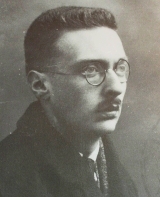 Roman Jakobson
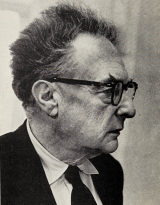 Roman Jakobson